
 E-Paper



Modi, Von der Leyen set target for concluding India-EU FTA within 2025
Von der Leyen is in India with 22 members of the 27-strong EU College of Commissioners for the first such visit to a non-European nation since she got a fresh mandate last year

 Prefer HTon Google


New Delhi: Prime Minister Narendra Modi and European Commission President Ursula von der Leyen on Friday threw their weight behind the ambitious goal of finalising an India-EU free trade agreement (FTA) within the year, against the backdrop of geoeconomic churn due to the trade policies of the Donald Trump administration.
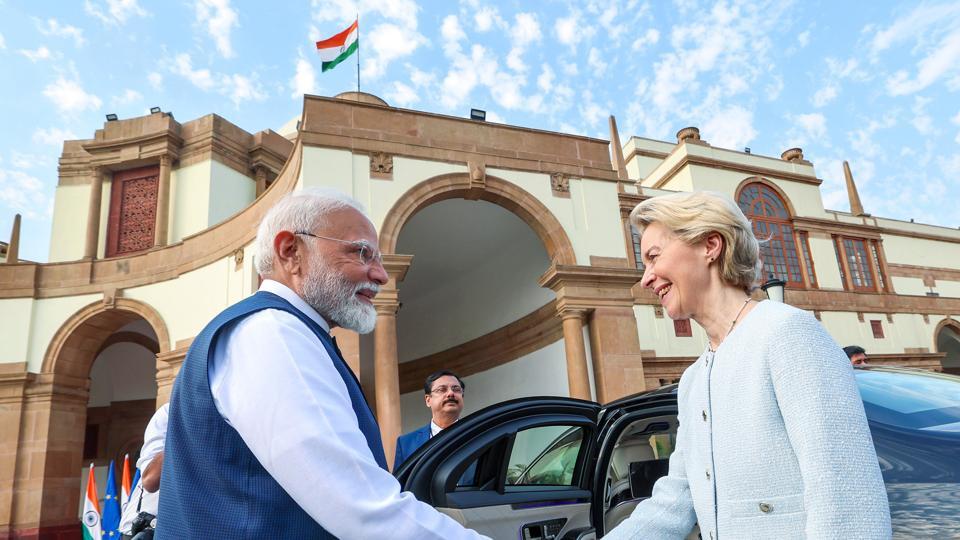
The two leaders unveiled other measures to intensify cooperation between India and the European Union (EU), ranging from a proposed security and defence partnership and a new space dialogue to closer collaboration on artificial intelligence (AI) and the interoperability of digital public infrastructure.
Von der Leyen is in India with 22 members of the 27-strong EU College of Commissioners for the first such visit to a non-European nation since she got a fresh mandate last year, reflecting the desire in Brussels to substantially upgrade ties with New Delhi. She arrived in India hours after US President Donald Trump said he would hit goods made in the EU with 25% tariffs, exacerbating European concerns about Washington’s unpredictable trade policies.
Also Read: India, EU working on security and defence partnership: Von der Leyen
“We have directed our teams to conclude a mutually beneficial bilateral free trade agreement by the end of this year,” Modi told a joint media interaction with Von der Leyen, speaking in Hindi.
Von der Leyen acknowledged the difficulties associated with finalising the trade deal, negotiations for which began in 2007, were suspended in 2013, and then revived in 2022. The two sides will hold the tenth round of talks in Brussels during March 10-14.
She said the two leaders tasked their teams to build on the momentum in economic ties – two-way trade in goods was worth €120 billion in 2024 – and “finalise our free trade agreement before the end of this year”. She added: “We are expecting a lot of our trade negotiators, we told them they should surprise us. Now more than ever, the geopolitical context asks for decisive action.”
Also Read: India-EU Trade and Technology Council assesses digital, green, and trade sectors
Modi said a bilateral blueprint had been prepared for collaborating in trade, investment, technology, green growth, security and mobility of professionals, and the two sides are moving forward on investment protection and geographical indication (GI) agreements.
“We have agreed on increasing cooperation in semiconductors, AI, high performance computing and 6G. We have also decided to initiate a space dialogue,” he said. The two sides will conduct joint research on EV batteries and green hydrogen, and take concrete steps to drive the India-Middle East-Europe Economic Corridor (IMEC) so that it serves as an “engine of global commerce, sustainable growth and prosperity”, he said.
While delivering a speech before her talks with Modi, Von der Leyen said the two sides are exploring a security and defence partnership to jointly counter common threats such as cross-border terrorism, cyber-attacks and attacks on critical infrastructure.
“We know that authoritarian states are getting bolder, ignoring borders and threatening peace at sea. Now is the time to step up our security and defence cooperation on land, at sea and in space,” Von der Leyen said at the media interaction. “The Indian Ocean is a lifeline for global trade. Ensuring its security is vital, not just for India but for the whole world.”
Also read: India, EU should reimagine partnership, finalise FTA this year: Von der Leyen
Modi noted that growing defence and security cooperation is a “symbol of our mutual trust” and said: “We will take forward our cooperation on cyber-security, maritime security and counter-terrorism. Both sides agree on the importance of peace, security, stability and prosperity in the Indo-Pacific region.”
He also said the two sides will create a “bold and ambitious roadmap” for the bilateral partnership for the period beyond 2025 that will be launched at the next India-EU Summit. The summit is expected to be hosted by India later this year, though a date is yet to be set.
Von der Leyen called for the India-EU Trade and Technology Council (TTC) to be taken to the next level for research, innovation and market uptake as part of efforts to build a common tech agenda. Europe and India can also ensure that AI is a driver of positive change for their economies and societies by working together, and the European AI Office and India’s Al Mission will deepen their cooperation, she said.
Officials from both sides acknowledged after the talks between the two leaders that several contentious issues would have to be addressed in order to finalise the FTA. The two sides have grappled with difficult issues such as tariffs, non-tariff barriers, government procurement policies and market access, especially for European agricultural products and automobiles.
Also Read: Why New Delhi and Brussels must reset bilateral ties
During Friday’s talks, the Indian side flagged its concerns about the EU’s Carbon Border Adjustment Mechanism (CBAM) or a tariff on carbon intensive products such as steel and cement that will take effect in 2026, Tanmaya Lal, secretary (West) in the external affairs ministry, told a media briefing.
“CBAM is a concern for a large number of countries, especially in the Global South. We have highlighted our concerns to our EU partners on a number of occasions,” Lal said, noting that the bloc has made some modifications to the CBAM framework to “simplify some of the aspects and we are examining the implications of that”.
“We hope that the concerns of the developing country partners will be taken into account and addressed suitably in any such scheme,” he said.
A senior EU official who is part of the visit pointed to the need for “strong commitments” from the Indian side on reducing tariffs for key EU products such as automobiles, wines and spirits and procurements, and for addressing non-tariff barriers. “At the same time, we are ready to respond to a number of Indian requests,” he said.
Lal said the “clear decision” by the leaders that the FTA has to be finalised within the year will be helpful in resolving many difficult questions when the negotiators meet. “The emphasis was on how to get the FTA done quickly and there was a clear political commitment and agreement to do it quickly,” he said.
The EU official said a trade deal wouldn’t be possible “without a substantive commitment” on automobiles and acknowledged the last mile in negotiations tend to be the hardest. “But there is a very strong political commitment from [Von der Leyen] as well as from [Modi] to get this deal done this year and to do it in the backdrop of a changing geopolitical landscape,” he said.
Also Read: EU leadership lands in Delhi for free trade deal talks amid Trump tariff threat
The joint leaders statement said the negotiating teams had been directed to finalise a “balanced, ambitious, and mutually beneficial FTA...within the course of the year”. It added, “The leaders asked the officials to work as trusted partners to enhance market access and remove trade barriers. They also tasked them to advance negotiations on an Agreement on Investment Protection and an Agreement on Geographical Indications.”
The FTA negotiations also figured at a meeting between commerce minister Piyush Goyal and EU trade commissioner Maroš Šefčovič, who are set to meet again in Mumbai on Saturday to take forward the process.
Von der Leyen also emphasised the need for India and Europe to reimagine their partnership in an era of great power competition and geopolitical headwinds and to finalise the FTA in her speech ahead of the talks with Modi. Without directly referring to the policies of US President Trump, she said “countries are weaponising their sources of strength”, including economic and military coercion, and 2025 marked an “inflection point in history”.
“This world is fraught with danger. But I believe this modern version of great power competition is an opportunity for Europe and India to reimagine their partnership,” she said. The proposed FTA, she added, would be the “largest deal of this kind anywhere in the world”.
The EU is India’s largest trading partner in goods. Two-way trade in goods nearly doubled in the past decade to reach a figure of $135 billion last year, while trade in services was worth around $53 billion.
The EU’s collective foreign direct investment (FDI) since 2000 is worth nearly $120 billion while India’s investment into the EU is estimated at around $40 billion. About estimated 6,000 companies from EU member states have a presence in India, while 1,200 Indian companies are active within the EU.
The Indian diaspora in the EU has grown to 1.65 million, including 120,000 students.



