A joint team of Odisha forest and Wildlife Crime Control Bureau (WCCB) of Jabalpur confiscated 14.2 kg pangolin scales in Dhenkanal district from two people on Sunday. This is the biggest-ever seizure of pangolin scales in Odisha.
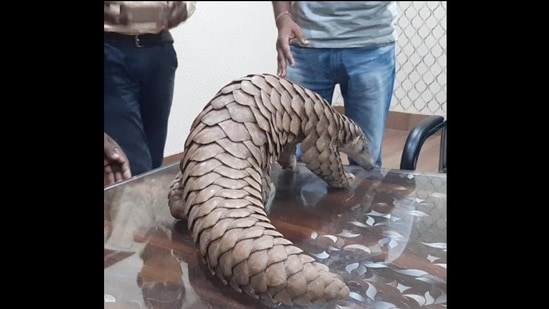
Dhenkanal divisional forest officer (DFO) Prakash Chand Gogineni said the scales were seized from Damodarnali area of Kapilash range in Dhenkanal district following an intelligence input from the WCCB. The DFO said that Ratnakar Rout (51) and Firoj Khan (52), from Dhenkanal town, had stored the pangolin scales at a godown in Banasinga area of Sarangi range in the division.
"They were collecting scales from poachers within Dhenkanal and nearby areas, but could not sell it due to the pandemic. Our team posing as customers struck a deal with the smugglers and arrested them," he said. The joint team has seized a two-wheeler and two mobile phones from their possession.
Last month, the special task force of the crime investigation department (CID) had seized 4.82 kgs of pangolin scales from a village in Mayurbhanj district. In April this year, a live pangolin was rescued by the Special Task Force (STF) in Cuttack district. During the last 1 year, STF has seized 3 live pangolins and 10 kg pangolin scales.
The Indian pangolin is a solitary, shy, slow moving, nocturnal mammal that is protected under Schedule I of Wildlife (Protection) Act, 1972. It is also listed under the Appendix I of the International Convention of Trade in Endangered Species (CITES) that prohibits its commercial trade. According to the IUCN Pangolin Specialist Group, poaching for illegal international trade for meat and scales, primarily destined for Asia, mainly China and Vietnam, are the main threats to pangolins resulting in declining populations of the species.
{{/usCountry}}The Indian pangolin is a solitary, shy, slow moving, nocturnal mammal that is protected under Schedule I of Wildlife (Protection) Act, 1972. It is also listed under the Appendix I of the International Convention of Trade in Endangered Species (CITES) that prohibits its commercial trade. According to the IUCN Pangolin Specialist Group, poaching for illegal international trade for meat and scales, primarily destined for Asia, mainly China and Vietnam, are the main threats to pangolins resulting in declining populations of the species.
{{/usCountry}}