The Madhya Pradesh government has announced that it will procure 60 percent of moong (green gram) from each eligible farmer, up from the earlier limit of 25 percent with state agriculture minister Aidal Singh Kansana on Wednesday saying the decision was taken after a late-evening meeting on Wednesday with representatives of 16 farmer organisations.
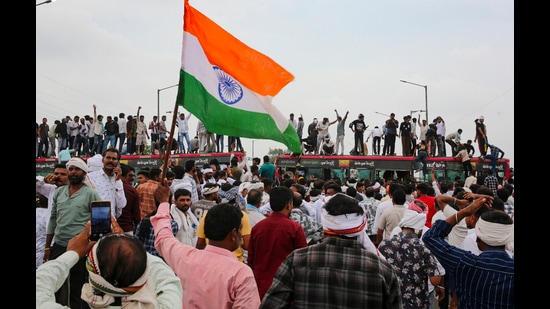
Earlier, Madhya Pradesh chief minister Mohan Yadav constituted a four-member committee to hold talks with farmers protesting for the past three days for complete procurement of moong (green gram) and scrapping of the e-token system for fertiliser distribution.
“In districts like Narmadapuram, Sehore and Harda, the yield is about three quintals per acre. This decision will be effective immediately, and our effort will be to ensure maximum farmers get the benefit,” Kansana said.
The minister also declared that the slot booking and procurement period would be extended by 10 days. In addition, a high-level committee will be formed to examine problems related to the e-token system and submit recommendations to the state government.
“Until the recommendations are received and improvements are made, fertilizer distribution through the e-token system is being suspended with immediate effect,” Kansana added.
The protesters, under the banner of Sanyukta Kisan Morcha, had been demanding procurement of 5 to 6 quintals per acre of moong at Minimum Support Price (MSP) instead of the 1.2 quintals being done. They also demanded scrapping of the e-token system, which they said complicates fertiliser distribution.
{{/usCountry}}The protesters, under the banner of Sanyukta Kisan Morcha, had been demanding procurement of 5 to 6 quintals per acre of moong at Minimum Support Price (MSP) instead of the 1.2 quintals being done. They also demanded scrapping of the e-token system, which they said complicates fertiliser distribution.
{{/usCountry}}Amid the protest, the farmers blocked traffic on the Hoshangabad highway near Bhopal, affecting nearly 300,000 residents, and prompting collector Priyank Mishra to declare a holiday for all schools along Narmadapuram road on Wednesday.
Deputy commissioner of police (DCP) Shailendra Singh Chouhan said, “We have made sufficient arrangements to stop the protestors from entering other areas of the city. We have diverted the traffic for people residing near Hoshangabad road.”
Leader of Opposition in state assembly Umang Singhar said the government was not willing to listen to farmers’ legitimate demands. “Farmers were demanding 100% procurement of green gram but MP government after a protest of months decided to procure 60% i.e., when union agriculture minister Shivraj Singh Chouhan exposed that state government can purchase to any extent.”
On Tuesday night, a farmer delegation met agriculture minister Aidal Singh Kanasana but discussions ended without resolution. Later, Kansana wrote to the Union agriculture minister to procure more than 800,000 metric tonne against the allocated 454,000 metric tonne.
On Wednesday, Chouhan replied that Under PM-AASHA, the Centre can’t purchase more than 25% of total production and extra could be procured by the state itself. “The Centre is already purchasing 87% of total procurement in India from MP. Now it can be increased only after procurement of total quota but till now MP government procured only 60,000 MT. We requested the MP government to procure green gram.”