Delhi Master Plan 2047 floats ‘congestion pricing’ for vehicles entering key city areas
Delhi's Master Plan 2047 proposes congestion pricing to manage traffic, requiring further policy development by the government and collaboration among agencies.
Delhi’s Master Plan 2047 has proposed introducing congestion pricing in identified parts of the city, allowing authorities to levy charges on private vehicles entering areas with high traffic volumes and vehicular pressure. The proposal, which places road pricing alongside parking management as a tool to regulate private vehicle use, is part of the transport strategy outlined in the long-term planning document.
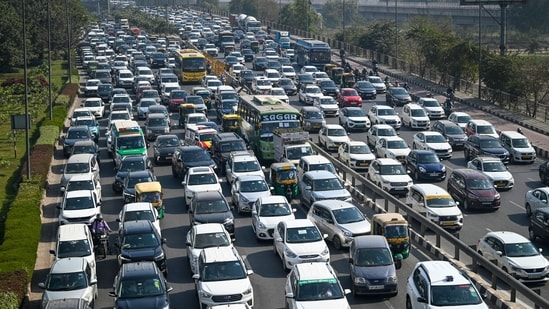
Under the congestion-pricing proposal, road-owning agencies and the transport department, in consultation with the traffic police, will identify areas that can be designated as congestion-pricing zones. (Sanchit Khanna/ Hindustan Times)
. The proposal, which places road pricing alongside parking management as a tool to regulate private vehicle use, is part of the transport strategy outlined in the long-term planning document.
Under the congestion-pricing proposal, road-owning agencies and the transport department, in consultation with the traffic police, will identify areas that can be designated as congestion-pricing zones. The document specifically says these areas “may include areas around TOD nodes, Walled City Heritage Zone and the Metropolitan City Centre (MCC).”
TOD, or transit-oriented development, refers to high-density mixed-use zones built around Metro and other mass-transit stations; the MCC is the central business district designation used in the plan.
The plan also provides for technology-based implementation. “RFID tagging, etc., may be used for implementation of congestion pricing,” it says, indicating that vehicles could be identified electronically as they enter designated zones rather than relying on manual collection of charges. The document does not specify a rate structure, exemptions or the mode of revenue collection.
MPD-2047 links congestion pricing with a broader strategy of discouraging private vehicle use by managing the availability and cost of parking as well. It proposes restricting public parking at work centres, entertainment areas, cultural hubs and markets where such restrictions could deter private vehicle use.
“The public parking at work centres, entertainment or cultural hubs, markets, etc. shall be restricted which will be a deterrent to private vehicular trips,” the document says.
It further proposes restricting both on-street and off-street public parking in areas that have high accessibility to public transport. The strategy is to make parking demand management work alongside congestion pricing rather than treating the two measures separately, an official aware of the matter said.
Another provision calls for “dynamic parking pricing” based on location and time of day to be used as a tool to discourage the use of private vehicles. The approach would allow parking charges to vary according to where and when a vehicle is parked, with higher charges possible in locations and periods experiencing greater demand. The plan also calls for strict enforcement of parking regulations.
Urban planner and Raahgiri Foundation trustee Sarika Panda Bhatt said Connaught Place was an area where congestion pricing could be considered. “Connaught Place is one of the areas that is mature for congestion pricing. For this, enforcement should ideally be camera-based and this would also require adequate alternatives to private vehicles, needing augmentation of informal transport modes within the area,” Bhatt said.
The proposed framework comes after earlier attempts to introduce congestion pricing in Delhi. A 2016 central government committee on decongesting Delhi had recommended effective parking pricing and a congestion tax to discourage private vehicle use, but the recommendation which could have been mandated by the Delhi government by notification of a policy was never taken up.
Congestion pricing is already operational in several major cities. London has operated its central congestion charge for more than two decades, under which vehicles entering the central charging zone during specified hours pay a daily fee. Singapore uses electronic road pricing, with charges varying according to location and time, while Stockholm levies a congestion tax during specified hours and varies charges by time of day. New York became the first US city to introduce congestion pricing when its Manhattan central business district tolling programme began in January 2025.
Snehil Sinha is an Assistant Editor with the Delhi Metro bureau of Hindustan Times, where she reports on politics, governance, public policy, urban infrastructure and transport, subjects that shape the everyday lives of millions in the national capital. Over a journalism career spanning 14 years, she has built a reputation for meticulous, data-driven reporting that combines on-ground perspectives with policy analysis. She began her career with The Indian Express before joining Hindustan Times, where she has reported extensively on civic administration and urban governance in Gurugram, Noida and now Delhi. Her reporting is distinguished by its clarity, depth and balance. Whether covering large-scale infrastructure projects, environmental challenges, transport reforms or government policy, she tries to translate complex administrative decisions into accessible, engaging stories without losing nuance. Her work reflects a strong command of public records, official data and field reporting, often connecting policy announcements with their impact on citizens. Her stories go beyond headlines to explain how governance decisions influence the city's growth, mobility and quality of life, making her work an important contribution to informed public discourse.
Get the latest India News, breaking headlines, and real-time updates from across the nation. Stay informed on politics, government policies, crime, weather, and CEC Gyanesh Kumar row Live.
Get the latest India News, breaking headlines, and real-time updates from across the nation. Stay informed on politics, government policies, crime, weather, and CEC Gyanesh Kumar row Live.
Home/India News/Delhi Master Plan 2047 floats ‘congestion pricing’ for vehicles entering key city areas
{{^htLoading}}
Advertisement
{{/htLoading}}
SHARE THIS ARTICLE ON
{{#usCountry}}{{/usCountry}}
Notifications
Get breaking alerts directly from the newsroom
Notifications are on!You'll be notified when news breaks