The Nagaland Legislative Assembly (NLA) on Thursday passed a Bill to establish the Frontier Nagaland Territorial Authority (FNTA), granting legislative, executive and financial autonomy to the region comprising the state’s six eastern districts.
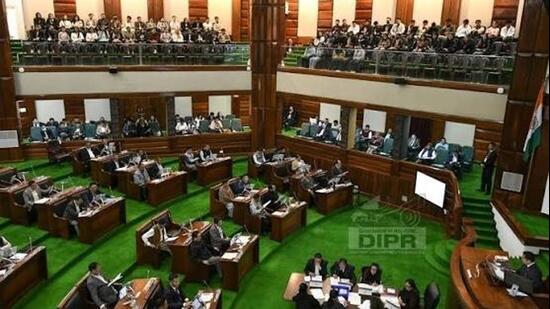
The Bill provides for the creation of the FNTA in line with the February 5 memorandum of agreement (MoA) between the Centre, the Neiphiu Rio-led Nagaland government and the Eastern Nagaland People’s Organisation (ENPO). The authority will cover Tuensang, Mon, Longleng, Kiphire, Noklak and Shamator districts.
The revised Bill, introduced in the Assembly on Tuesday, paves the way for the FNTA based on the spirit of Article 371A of the Constitution, providing for democratic, decentralised self-governance at the regional level with legislative, executive and financial autonomy within Nagaland. An earlier version introduced in March was deferred and withdrawn for further deliberations.
The FNTA will comprise 62 members, of whom 40 will be directly elected from territorial constituencies through adult suffrage, with one-third of the seats reserved for women. Two members will be nominated by the Nagaland governor in consultation with the FNTA from recognised tribes that may be unrepresented or under-represented, and will have the same rights and privileges as elected members. The 20 NLA members elected from Assembly constituencies falling in the FNT area will be ex-officio members without voting rights.
Also Read: Nagaland Assembly urges Centre to withdraw Protected Area Permit regime
{{/usCountry}}Also Read: Nagaland Assembly urges Centre to withdraw Protected Area Permit regime
{{/usCountry}}The FNTA will have 40 single-member territorial constituencies, with their boundaries to be determined by the state government through an order published in the official gazette.
Chief minister Neiphiu Rio said the FNTA would help the state and Centre bring about comprehensive and inclusive development, bridge developmental gaps and take governance and development to citizens, particularly those in the remotest parts of eastern Nagaland.
“The constitution of FNTA is envisaged for a comprehensive economic development of the eastern Nagaland region aligning its process with the rest of the state… The FNTA will go a long way in fulfilling the desire and aspirations of our brothers and sisters from eastern Nagaland. For many years now, they have yearned for a special institutional arrangement that would address their genuine concerns relating to development, accelerate faster economic growth and ensure all-round progress across the region,” Rio said in the Assembly while pushing for the Bill’s passage.
The Bill proposes an Executive Council of not more than nine members, chaired by a Chief Executive Member (CEM), in whom the executive powers of the FNTA will vest. The CEM will have the status equivalent to that of a cabinet minister in the state for protocol purposes, while other members will have the status equivalent to that of ministers of state within the FNT.
During the transitional period, the state government will constitute an Interim Council to oversee the affairs of the FNTA until it is constituted through elections. The governor will nominate up to 13 members to the Interim Council, while other members will be recommended by the ENPO in consultation with the respective tribal bodies and submitted to the state government for the governor’s approval. The Interim Council will function for one year from the date of its constitution or until the first FNTA is constituted, whichever is earlier.
The state government will appoint an Indian Administrative Service (IAS) officer, preferably of the rank of additional chief secretary but not below that of principal secretary to the government of Nagaland, subject to availability, as the Chief Executive Secretary (CES) of the FNTA. The authority will also have its own secretariat, with officers and staff determined by the state government in consultation with the CEM.
For law and order, the state government will post an IGP-Range, an Indian Police Service officer, at the FNTA headquarters to supervise police administration across the FNT in consultation with the CEM.
Special constitutional provisions under Article 371A, along with the Bengal Eastern Frontier Regulation (BEFR), 1873, and exemption from Panchayati Raj will continue to apply to the FNTA without any amendment or dilution.
The administrative set-up of the FNTA will be reviewed after 10 years to assess its efficacy in fulfilling the aspirations of the people of the FNT.
The objective of the FNTA is to establish a self-governing territorial authority that enables the people of eastern Nagaland to fulfil their social, economic, educational, cultural and linguistic aspirations through democratic, decentralised self-governance within the state.
The MoA followed prolonged discussions over the ENPO’s demand for a separate state for eastern Nagaland, which dates back to 2010 and is rooted in alleged developmental deficits in the region. The ENPO represents the Chang, Khiamniungan, Konyak, Phom, Sangtam, Tikhir, Yimkhiung and Eastern Sumi tribes from the six districts.