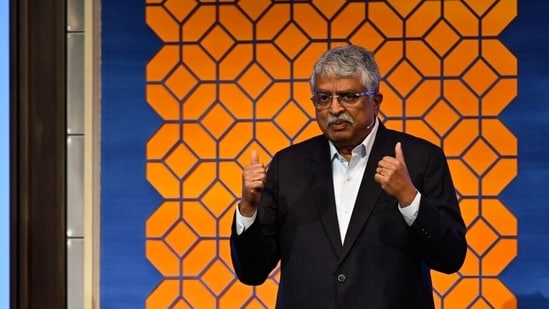
Nandan Nilekani's appointment on Sunday to head the Narendra Modi government's new exam-reform task force follows a pattern that goes back around two decades. Successive governments, of different parties, have brought the technocrat back for policy work. In that sense, it's only the latest turn in a career that has now spanned both the Congress and BJP.
Modi's latest move comes as the largely GenZ-driven protests by the Cockroach Janta Party (CJP) forced major decisions over the past week.
Was on exam-related panel in past
Exam reforms are not new territory altogether for Nilekani. Around eight years ago, the Supreme Court constituted a seven-member panel, chaired by retired judge GS Singhvi, that included Nilekani among others, to investigate irregularities in the Staff Selection Commission's CGL/CHSL 2017 exam.
The panel did submit a report, which the court cited in 2020 to conclude there wasn't enough evidence the entire exam process had been compromised. A fresh petition in 2025 said the committee’s report has never been made public, and argued that the underlying problems it was meant to fix had never really been addressed by the government. The plea was dismissed early this year as having too wide an argument, but the petitioner was told he could file one specifically about implementation of the committee’s report.
Amidst this, the NEET-UG leak in May sparked mass protests led by the CJP, leading to Dharmendra Pradhan's resignation as education minister, and PM Modi's steps such as forming the panel with Nilekani.
Going back to Aadhaar
{{/usCountry}}Amidst this, the NEET-UG leak in May sparked mass protests led by the CJP, leading to Dharmendra Pradhan's resignation as education minister, and PM Modi's steps such as forming the panel with Nilekani.
Going back to Aadhaar
{{/usCountry}}Born in 1955 in Bengaluru (then Bangalore), Nilekani studied electrical engineering at IIT Bombay, and in his first job at a company met NR Narayana Murthy. The two of them, with others, started Infosys in 1981. He would go on to run Infosys as CEO from 2002 to 2007 and chair its board in various capacities since.
He was the founding chairman of the Unique Identification Authority of India (UIDAI) in the rank of a cabinet minister from 2009-2014, his Infosys bio noted. His high-profile work with the government sector indeed started after the idea for a national identity number came up during the Congress-led UPA era in 2006 under PM Manmohan Singh, conceived as a fix for leaky subsidy programmes. The UIDAI was constituted under the Planning Commission in January 2009, and Nilekani was hired that June for the execution of what came to be known as Aadhaar.
He went on to also chair the Technology Advisory Group for Unique Projects (TAGUP), tasked with the IT architecture behind the tax network and the pension system.
In 2014, the technocrat tried to become a politician too. He quit the UIDAI to contest the Bangalore South seat on the Congress ticket. He lost to the BJP's Ananth Kumar.
Work with Modi: Key man after demonetisation
As Narendra Modi became PM, economist Montek Singh Ahluwalia has said, Aadhaar was in danger of being shelved given the BJP's opposition to it while out of power. Nilekani reportedly got a meeting with the new prime minister and made his case in person; Modi heard him out in June 2014, and Aadhaar was folded into his governance model.
Two years on, after the demonetisation of high-value notes, PM Modi brought Nilekani onto a committee mapping India's path towards digital payments at scale. “India has the underlying digital financial architecture in place to get this going,” Nilekani said at the time.
Nilekani has credited the previous UPA government for “initiating the vision” and the NDA government for “seeing the wisdom” of the project and taking it through to its “logical culmination” by putting in place a legal framework for Aadhaar to be used for subsidies and beyond. When Aadhaar drew fresh fire in 2017 over being made mandatory for tax filings, he told HT: “Demonising Aadhaar is not going to solve any problem.”
He served on an RBI committee too — the High-Level Committee on Deepening of Digital Payments, from January 2019. The commerce ministry added him to its Open Network for Digital Commerce council in 2021, the government's attempt to loosen Amazon and Flipkart's grip on Indian e-commerce.
Who will be in latest committee?
The committee now formed by Modi on exam reforms will comprise a multidisciplinary group of domain experts:
- Technology expert Nandan Nilekani
- Former ISRO chairman S Somnath
- Former Intelligence Bureau director Tapan Deka
- IIT Madras director V Kamakoti
- Former education secretary Anita Karwal
- Logistics expert Amrit Lal Meena