The National Democratic Alliance’s Waqf (Amendment) Bill makes fundamental changes in the central law that governs the Islamic charitable endowments, create a new set of framework that allows non-Muslims to be a part of waqf bodies, and authorises government officials to conduct surveys of waqf properties.
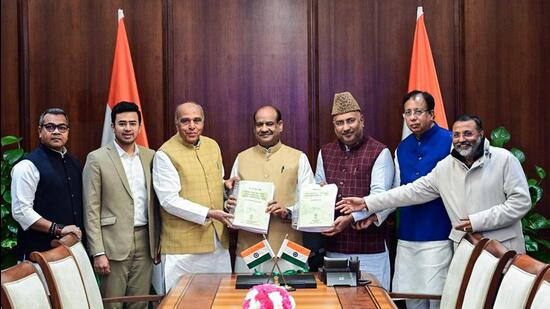
The new draft of the waqf bill, made public on Tuesday and to be taken up in the Lok Sabha on Wednesday, incorporates 25 recommendations made by the joint parliamentary committee (JPC). The Union government argues that the proposed law will address issues and challenges in regulating and managing waqf properties but the Opposition alleges it will impinge on constitutional rights.
The new law says only “practising Muslims” for at least five years can dedicate their own property to Waqf, restoring language that was present in the bill before the 2013 amendments, as per the JPC’s recommendations.
The amended legislation is set to propose that “any person showing or demonstrating that he is practising Islam for at least five years” can donate properties to waqf.
The original version of the bill planned to do away with the “waqf by user” provision, a category where a property is acknowledged as waqf because it has been used for religious activities for some time, despite there being no official declaration or registration as waqf. The original bill applied the removal of this provision retrospectively, raising concerns that tens of thousands of properties will come under a cloud.
{{/usCountry}}The original version of the bill planned to do away with the “waqf by user” provision, a category where a property is acknowledged as waqf because it has been used for religious activities for some time, despite there being no official declaration or registration as waqf. The original bill applied the removal of this provision retrospectively, raising concerns that tens of thousands of properties will come under a cloud.
{{/usCountry}}Now, the new bill will apply this contentious provision only prospectively. “Provided that the existing waqf by user properties registered on or before the commencement of the Waqf (Amendment) Act, 2025 as waqf by user will remain as waqf properties except that the property, wholly or in part, is in dispute or is a government property,” the new bill read.
In other words, waqf properties that are already registered would remain under waqf unless disputed or identified as government land.
In the original bill, the collector was allowed to conduct survey of waqf properties. But after the JPC’s recommendations, the amended bill will propose that a government officer above the rank of collector will investigate government properties claimed as waqf, preventing unwarranted claims.
“The state government may, by notification, designate an officer above the rank of collector (hereinafter referred to as the designated officer), who shall conduct an inquiry as per law, and determine whether such property is a government property or not and submit his report to the state government,” said the bill.
The waqf bill will also propose that women must receive their rightful inheritance before waqf dedication, with special provisions for widows, divorced women, and orphans. “The creation of a waqf-alal-aulad shall not result in denial of inheritance rights of heirs, including women heirs, of the waqif or any other rights of persons with lawful claims,” read section 3A (2) of the bill.
The bill will push for transparent waqf management and demand that mutawallis (manager of a waqf property) must register property details on the central portal within six months to enhance accountability.
In a controversial move, the bill proposed that two non-Muslim members will be included in both central and state waqf boards to ensure inclusivity. Many Muslim bodies and leaders have opposed this provision on the ground that Hindu temples don’t allow any non-Hindus to be a part of the administration.
The new bill made a distinction between trusts and waqfs. “Provided further that nothing in this act shall, notwithstanding any judgement, decree or order of any court, apply to a trust (by whatever name called) established before or after the commencement of this act or statutorily regulated by any statutory provision pertaining to public charities, by a Muslim for purpose similar to a waqf under any law for the time being in force,” the new bill read.
The bill also tried to end arbitrary property claims by removing section 40 from the original bill, preventing waqf boards from arbitrarily declaring properties as waqf and avoiding misuse such as declaring entire villages as waqf.
The amendments also include reducing the mandatory contribution of waqf institutions to waqf boards from 7% to 5%, allowing more funds for charity, and government-appointed audits for waqf institutions earning over ₹1 lakh annually.