A new website called “bribes.fyi” has emerged as a platform where users can anonymously report details of bribes they were asked to pay, including the role, amount and department involved. According to the website, it is India’s first crowdsourced bribe registry that is completely anonymous and permanently public.
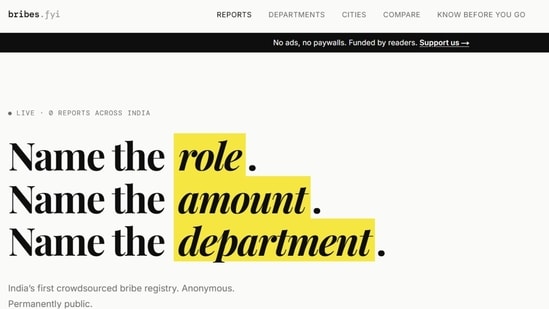
The website aggregates the reported data into three sections: reports, departments and cities. It also allows users to compare the number of reported bribes across different departments, providing an overview of the reports submitted through the platform.
The departments mentioned on the website include the Police, RTO, Revenue/Land Records, Passport Office, Municipal Corporation, GST Office, Electricity Board, Income Tax, and Food and Drug Administration.
One of the latest bribe reported on the website was for ₹2,000. The person who submitted the report alleged they were asked to pay the amount to the Police Department in Pune.
“Was told to take ‘tatkal’ route which costs 2500 to avoid multiple visits and unnecessary delays,” the person wrote while submitting the report.
What data shows
According to the data available on the website, a total of 617 bribe reports have been submitted across 253 cities. The website also states that 37% of the people who reported being asked for a bribe refused to pay it but still got their work done.
{{/usCountry}}According to the data available on the website, a total of 617 bribe reports have been submitted across 253 cities. The website also states that 37% of the people who reported being asked for a bribe refused to pay it but still got their work done.
{{/usCountry}}Among the departments listed on the website, the Police has the highest number of reported cases, with 336. It is followed by the RTO with 89 cases, Revenue/Land Records with 69 cases, the Passport Office with 43 cases, and the Municipal Corporation with 29 cases.
The data also shows that Karnataka has the highest number of reported bribe cases among the states listed, with 135 reports, followed by Maharashtra with 83 and Uttar Pradesh with 69. Delhi recorded 47 reports, while Telangana and Haryana had 36 and 34 reports, respectively.
West Bengal accounted for 32 reports, followed by Tamil Nadu with 27. Andhra Pradesh and Bihar each recorded 26 reports.
In the highest average bribe amount, Jammu & Kashmir tops the list at ₹19,067, based on six reports. It is followed by Chhattisgarh, with an average of ₹13,000 across two reports, and Maharashtra, where the average bribe amount stands at ₹10,238 across 83 reports.
According to the data, Assam has the highest refusal rate among the states and Union Territories listed, with 100 per cent of reported bribes being refused. However, the figure is based on just one report, with no average bribe amount listed.
Goa and Uttarakhand follow with refusal rates of 33 per cent each, based on three reports from each. Andhra Pradesh has a refusal rate of 23 per cent across 26 reports, followed by Rajasthan at 18 per cent from 17 reports.
The data and figures mentioned above are based on the information available on the website as of August 17. HT could not independently verify the numbers.
Government's outreach to Gen Z
In a bid to sway the sentiments of Gen Z and young people towards the government after the CJP student protests, the Bharatiya Janata Party (BJP) has planned to engage more with students and young adults to reset the narrative, HT reported earlier.
“The party has identified some gaps in our communication and outreach that could have exacerbated the students’ unrest and created a perception that the concerns of the youth were not addressed… There will be more engagement with students and young adults,” said a BJP lawmaker, requesting anonymity.
“Going forward the Yuva Morcha will be more active, there will be more programmes and events to connect with the youth. We will also reach out to the younger lot in schools, who may be young, but are clued in and active on social media,” said a second senior party functionary. “Both in Bankipur and Datia we failed to counter a particular narrative, which hurt the party… We felt some issues did not merit a response, but in hindsight we should have been more forthcoming in tackling those.”