A month ago, four-month-old Priyanshi lost her life to severe acute malnutrition at the Majhganwa Community Health Centre in Satna, Madhya Pradesh. A week ago, five-year-old Pawan was found severely malnourished in Chitrakut, Madhya Pradesh. There is a number behind the names, one emphasised by the findings of the latest National Family Health Survey (NFHS-6): Madhya Pradesh has reported the highest malnutrition for any state in the country. Worse, malnourishment has increased by about four percentage points in the last five years.
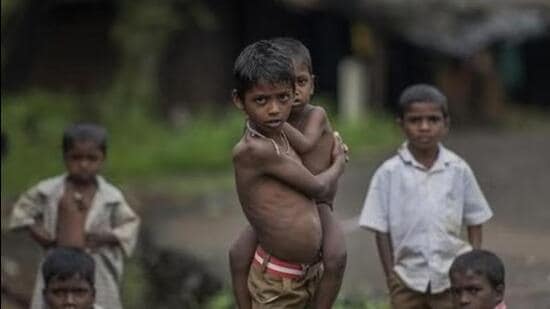
Madhya Pradesh now has the highest proportion of wasting (weight for height) children in India at 23.8%, up from 18.9% in NFHS-5. In the last survey, Maharashtra, Gujarat, and Bihar were the worst performers. The three states have improved, and Madhya Pradesh’s numbers have dipped.
In the underweight (weight-for-age) category, Madhya Pradesh ranked second at 39.7%, behind Jharkhand at 41.1%, marking a sharp 6.7-percentage-point increase since the last survey. The national averages stood at 19% for wasting and 31.8% for underweight.
To be sure, Madhya Pradesh has historically performed poorly on these parameters, with several districts among the worst in the country.
However, the state has witnessed improvement with the percentage of children with stunted growth falling from 35.7% in NFHS-5 to 31.4% in NFHS-6.
In 2025-26, the Madhya Pradesh government introduced the Yashoda scheme, promising tetra milk packs for children in schools and anganwadis. More than a year later, the scheme is yet to start.
{{/usCountry}}In 2025-26, the Madhya Pradesh government introduced the Yashoda scheme, promising tetra milk packs for children in schools and anganwadis. More than a year later, the scheme is yet to start.
{{/usCountry}}A senior government official aware of the development said the Panchayat and Rural Development department has yet to decide who will supply the milk and at what cost. Panchayati Raj minister Prahlad Patel said the milk has to be provided to 8 million children every day, and therefore it is taking time to finalise the scheme's rollout.
According to the budgetary provision, the state’s spending on nutrition schemes has remained between ₹1,300 crore and ₹ 1,400 crore in recent years. The state spent ₹1,342 crore in 2024-25-24 and made a similar provision for 2025-26 and 2026-27. The allocation for the state’s special Poshan Aahar Scheme — supplementary nutrition programme for mothers and children to combat malnourishment — fell from ₹1,300 crore in 2024-25 to ₹1,150 crore in 2026–27, but the state increased funding for the Poshan Abhiyan 2.0 — introduced by the Centre to take care of malnourished children — from ₹42 crore to ₹250 crore.
Women and child development minister Nirmala Bhuria insisted that the government is serious about tackling the crisis. “We are introducing region-specific schemes like Moti Aai, under which experienced local women adopt [malnourished] children to ensure proper nutrition and guide their mothers on child care practices. The initiative aims to improve conditions at [the children’s] home by adopting traditional practices without taking children away from their parents,” she said.
“Budget and schemes are not enough to improve the condition. It needs a strict campaign-like approach,” said a senior WDC department official, requesting anonymity.
Congress MLA Umang Singhar, leader of the opposition in the state assembly, said, “The state government is spending huge amounts on promotion and events, but they don’t have time or money for malnourished children.”