The Constitution (124th amendment) bill to set aside a 10% quota in jobs and education for the economically weaker section received the Lok Sabha’s approval with all-round support on Tuesday, hours after its introduction in the Lower House. The proposed law will be limited to public employment, but will cover both aided and unaided educational institutions.
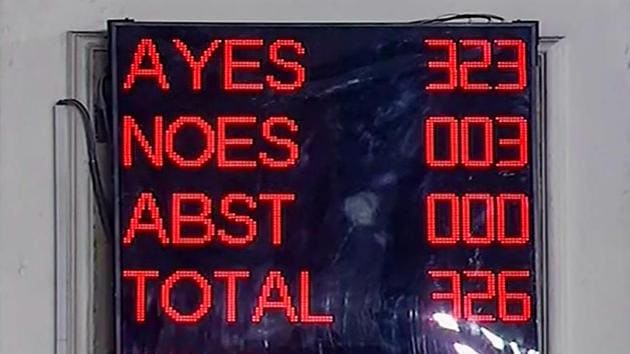
The government sounded confident that the amendment would withstand legal scrutiny even as the Congress suggested that the bill be sent to a joint parliamentary committee (JPC) for review. Intervening during the debate, finance minister Arun Jaitley pointed out, “the apex court had stated that the rule of 50% [cap on reservations] applies only to reservation for backward classes. This bill is for social and economic justice,” he said. Explaining why similar attempts failed earlier, Jaitley added that the PV Narasimha Rao government also brought 10% reservation for economically weaker sections, but it was through a notification.
“States, too, tried reservation through notification or a normal law. Narasimha Rao’s order didn’t have power from Constitution, same happened with the states,” he said. The bill will be brought in the Rajya Sabha on Wednesday. The government hopes to get the Upper House’s clearance the same day, which is the last day of the session.
While the bill saw overwhelming support from all parties, cutting across political lines, the Bharatiya Janata Party (BJP)-led government faced some criticism over the haste with which it brought in the legislation, and over the prevailing job situation.
{{/usCountry}}While the bill saw overwhelming support from all parties, cutting across political lines, the Bharatiya Janata Party (BJP)-led government faced some criticism over the haste with which it brought in the legislation, and over the prevailing job situation.
{{/usCountry}}The bill was opposed by PR Kunhalikutty (Indian Union Muslim League), Jayprakash Narayan Yadav (Rashtriya Janata Dal) and Asaduddin Owaisi (All India Majlis-e-Ittehad-ul Muslimeen) who all contended that it was against the Constitution.
The final tally after the voting on the bill was 323-3 in favour. Congress leader KV Thomas criticised the government’s “haste” and reminded it about the problems encountered in demonetisation and the GST [goods and services tax] rollout in 2017.
Read more| 10% quota for poor was your jumla: Arun Jaitley’s comeback to Congress in Lok Sabha
“This government had promised 2 crore of employment each year. but now unemployment rate is [at a] 27-month high. According to CMIE [Centre for Monitoring Indian Economy] 83% job loss is in rural India,” he said.
Some speakers, including Union minister Ram Vilas Paswan, urged the government to bring the entire quota system under the 9th schedule to protect it from judicial scrutiny.
Demands were also raised for caste-based reservation in the private sector and the Indian Judicial Service.
M Thambidurai, senior leader of Tamil Nadu’s ruling All India Anna Dravida Munnetra Kazhagam (AIADMK), a party largely supportive of the BJP, said, “You (the government) have so many programmes for economic development of the poor such as skill development, Mudra scheme (of loans for small businesses) or the scholarships. Now, this government wants to give reservation to economically weaker section [that] means all these programmes are not properly implemented.”
The BJP’s temperamental ally, Shiv Sena, took the opportunity to slam the government over job losses due to the November 2016 invalidation of high-value banknotes. “Many small units closed due to note ban. People employed in those units became unemployed. We a gave commitment that every year we [will] give 2 crore employment, but we have not been able to give it. GST also created some trouble in the initial phase,” said Sena’s Anandrao Adsul.
Trinamool Congress’s floor leader Sudip Bandopadhyay demanded a white paper on jobs and questioned why importance is not being accorded to passing of the women’s reservation bill.
Read more| ‘Landmark moment’: PM Modi’s thank you tweet after Lok Sabha clears quota bill
Bandopadhyay and some other leaders welcomed the idea of reservation for economically weaker sections, and maintained that nobody can oppose the bill as it involves giving reservation in government jobs to unemployed youth. “This bill is not about only jobs but it is also about misleading youth, this bill promises (a) fake dream. If we try to avoid everytime (the) unemployment issue, we can’t get any support from youth,” Bandopadhyay cautioned the government.
The Biju Janata Dal’s Bhartruhari Mahtab invoked late Odisha chief minister Biju Patnaik’s remarks that the poor don’t have any caste. “For the first time, the identification of beneficiaries will be based on economic condition and not on caste or class line,” he added.
Moving the bill for passage, union social justice and empowerment minister Thaawarchand Gehlot said, “Brahmin, Thakur, Bania, Patel, Jat, Gujjar, Muslims, Christians, all other castes and communities that are not covered under SC, ST reservation, will come under this act.”
“I am sure court will uphold this law. This will help in removing social injustice,” he added.
Gehlot denied the allegation that the bill had been introduced in haste, claiming that discussion on such a reservation had been underway for a long time.