
 E-Paper



DGCA issues fresh orders to mitigate Indigo chaos, says flight ops to stabilise at midnight
DGCA said that IndiGo acknowledged that the chaos was caused mainly by Phase-II of the revised FDTL rules.

 Prefer HTon Google


The Directorate General of Civil Aviation (DGCA) on Friday issued urgent directives to stabilise IndiGo’s operations after four days of massive flight cancellations disrupted travel for thousands of passengers. The regulator said it had issued two orders to address the disruption and restore flight schedules.
The DGCA’s latest directives follow its decision to temporarily roll back portions of the Flight Duty Time Limitations (FDTL) introduced on November 1. The regulator has granted exemptions from night-duty provisions and rules covering duties that extend into night hours, and has also withdrawn the weekly rest requirement for pilots to ease roster pressures.
The DGCA said the ministry of civil aviation was closely monitoring the situation and had instructed airlines, particularly IndiGo, to take immediate steps to stabilise services.
Passengers can expect schedules to begin “returning to normal by midnight”, with full operations resuming “over the next few days”, the agency added.
“Central Government is fully alert to air passenger woes and is in constant consultation with all stakeholders. Every possible measure, including rule exemptions as announced by DGCA on Friday, will be taken to restore schedules and ensure stability,” the regulator added.
Rollback of pilot rest rules
The DGCA’s fresh orders come after it temporarily relaxed the norms under Flight Duty Time Limitations (FDTL) that came into effect on November 1.
It temporarily exempted the rule that required weekly rest and leave to be treated as separate entitlements, which had increased mandatory rest from 36 to 48 hours to curb pilot fatigue.
The regulator said ongoing operational disruptions and requests from the airline industry prompted a “one-time exemption”.
DGCA also said that IndiGo acknowledged that the chaos was caused mainly by Phase-II of the revised FDTL rules, admitting that crew planning and rostering were insufficient to meet the new requirements.
To stabilise operations, the DGCA granted a temporary exemption for IndiGo’s A320 fleet from provisions related to night duty (0000–0500 hours) and flights encroaching into night hours.
In an internal note dated December 5, the DGCA said the relaxation was prompted by “ongoing operational disruptions” and repeated requests from the industry seeking flexibility to stabilise schedules.
Massive cancellations
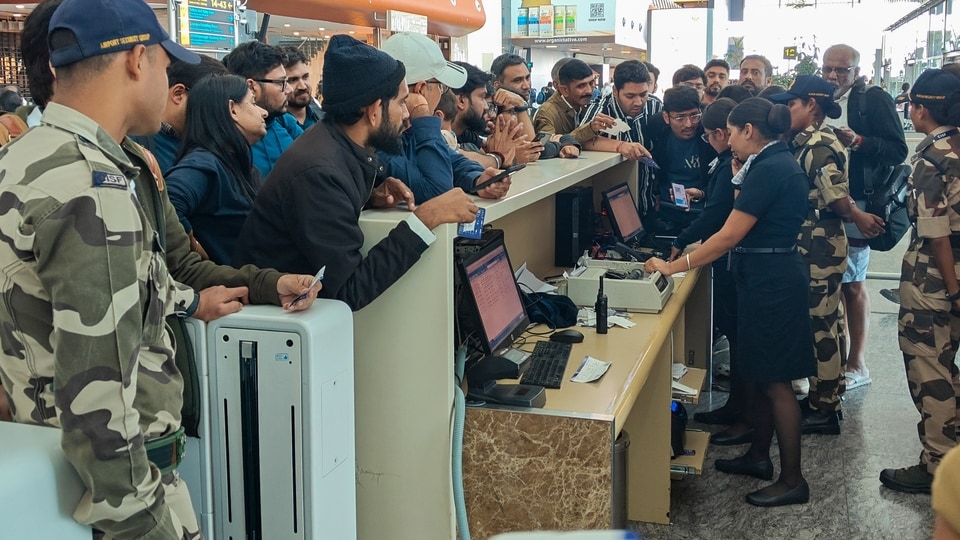
Over the past four days, IndiGo has cancelled more than 1,000 flights, severely impacting major hubs such as Delhi, Bengaluru, and Hyderabad, with hundreds of arrivals and departures being abruptly scrapped.
IndiGo has cancelled all flights from Delhi until midnight and suspended services from Chennai until 6 PM, blaming a “multitude of unforeseen operational challenges” such as technical glitches, congestion, winter schedule changes and weather.
IndiGo operates more than 2,200 flights daily, commanding 60% of the domestic market — nearly twice the scale of Air India. Even a small lapse in rostering can quickly cascade: a 10% disruption can affect 200–400 flights, stranding thousands.


