Downplaying the border row with India, Nepal's foreign minister Shisir Khanal on Thursday noted that neighbours will have ‘boundary problems’ and also implied that the issue was being blown out of proportion, stating that it is "not as big as it is made out to be".
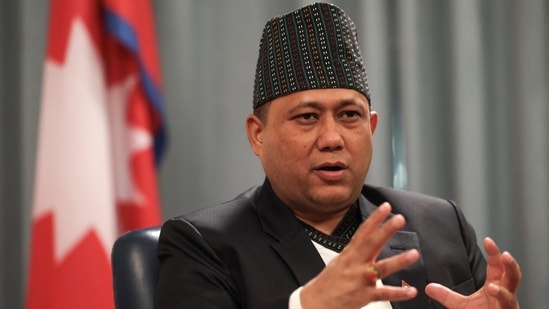
"Only neighbours will have boundary problems. If you're not a neighbour, you would not have that problem. I mean, we have very open borders. It's unique in the world. People can just walk without any paper, pretty much," Khanal said at an NDTV event as he acknowledged that there are "some issues"
Also read: MEA shares update on Nepal floods: 288 Indians uncontactable, 21 rescued, 200 seeking help in Tibet
"But obviously, there are some issues. It's not as big as it's often made out in narratives. Most of these are between Nepal and India and there are many different mechanisms, and among them is one area of boundary and border management as well," Khanal noted. Track live updates on Nepal floods
India-Nepal border row
A border dispute between India and Nepal erupted earlier this year linked to the Lipulekh Pass, located in Uttarakhand's Pithoragarh district, with Kathmandu renewing its territorial claim over Lipulekh. It also sought dialogue with New Delhi to resolve the issue.
{{/usCountry}}A border dispute between India and Nepal erupted earlier this year linked to the Lipulekh Pass, located in Uttarakhand's Pithoragarh district, with Kathmandu renewing its territorial claim over Lipulekh. It also sought dialogue with New Delhi to resolve the issue.
{{/usCountry}}Nepal had raised objections to India and China's plan to conduct the Kailash Mansarovar Yatra via the Lipulekh Pass, claiming it is Kathmandu's territory. The Nepalese foreign ministry said that Kathmandu was not consulted before finalising the pilgrimage route.
India slammed Nepal's objection, asserting that such "unilateral artificial enlargement" of territorial claims is "untenable."
“Nepal doesn't intend to enlarge its boundary; the territory belongs to Nepal, and the government has a clear view about this and is committed to its stance," Sasmit Pokharel, the Nepal government's spokesperson, had said amid the row.
India also rejected any involvement of third parties in resolving its boundary dispute with Nepal as reports said that Nepalese prime Minister Balendra Shah had sought the participation of China and the United Kingdom to address the long-standing issue.
However, Nepal later said it was in favour getting the dispute resolved through existing bilateral mechanisms as "no problem is too large and complex" when both sides meet with an open heart, rational mind and mutual respect.
Khanal had said that Kathmandu refuses to see New Delhi through the "distorted, hyper-sensitive lens" of 21st-century geopolitics and instead aims to look at India with "clear eyes and a single transparent agenda of economic transformation of Nepal".
Lipulekh Pass issue
Lipulekh Pass has been a long-standing point of dispute between India and Nepal. The row began in 2020, when the then-Nepalese prime minister KP Sharma Oli reportedly sought to use the boundary issue with India to deflect the increasing domestic pressure and challenge to his leadership.
Later that year, Kathmandu further escalated the row by publishing a new political map of the country, which showed three Indian territories, Limpiyadhura, Kalapani and Lipulekh, as part of Nepal.
Nepal has claimed that under the Sugauli Treaty of 1816, these three territories are integral parts of Nepal.
At the time, India firmly rejected Nepal's move and said that the Nepalese government had released a revised official map that included parts of Indian territory.
"This unilateral act is not based on historical facts and evidence. It is contrary to the bilateral understanding to resolve the outstanding boundary issues through diplomatic dialogue. Such artificial enlargement of territorial claims will not be accepted by India," the MEA had said.