Odisha’s test positivity rate dips below 5 after over 2 months
On Monday, the state reported 3,021 new Covid cases from 61,000 samples tested in the last 24 hours with a test positivity rate of 4.96, the first time it went below 5 after April 1
For the first time in the last 80 days, Odisha’s daily test positivity rate (TPR) for Covid-19 came down below 5 on Monday, signifying the rapidly declining infection curve during the second wave even as the daily fatalities continued to hover above 40.
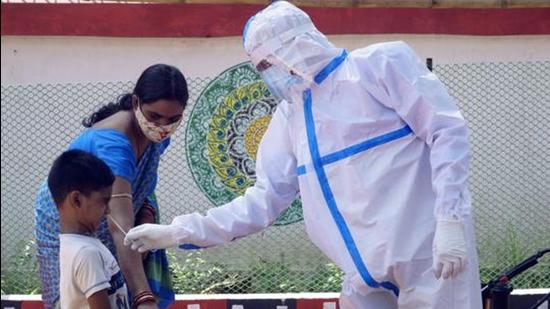
A health worker collects a nasal swab sample for Covid-19 testing from a boy at the urban primary health centre in Bhubaneswar. (File photo)
{{^htLoading}} {{/htLoading}}
On Monday, the state reported 3,021 new Covid cases from 61,000 samples tested in the last 24 hours with a test positivity rate of 4.96, the first time it went below 5 since April 2.
Despite the declining TPR, which is the percentage of people testing positive out of the total people tested, the situation in at least six districts, including Bhadrak, Balasore and Khurda, continues to be matter of concern as the weekly TPR between June 14 and 20 was more than 10. In Bhadrak, the weekly TPR was 15.66 followed by 14.86 of Balasore and 14.44 of Jajpur. In western Odisha district of Nuapada, the TPR seems to be on the rise at 10.45.
The lockdown, which has been extended till June 30, is still in force in all the 30 districts even as it has been partially relaxed in 17 districts due to their low TPRs.
{{/usCountry}}
{{#usCountry}}
The lockdown, which has been extended till June 30, is still in force in all the 30 districts even as it has been partially relaxed in 17 districts due to their low TPRs.
{{/usCountry}}
Director of health Bijay Mohapatra said even after the lockdown is lifted, no one should take it easy. “Masks and social distancing have to be followed rigorously. We are prepared for the third wave. The state government is ramping up vaccination so that we can vaccinate 300,000 people daily. Besides, training is being imparted to doctors and healthcare workers in special paediatric care,” he said.
June has been the most devastating for Odisha with 842 Covid deaths officially recorded so far, though by unofficial estimates, the number would be at least double. The state BJP has demanded a white paper on Covid deaths while a lawyer has filed a PIL in Orissa high court seeking a special audit of the deaths.
Debabrata Mohanty is a senior assistant editor of Hindustan Times who works as state correspondent from Odisha covering the state's politics, governance, public policy, natural disasters, environment and its society for close to three decades. With his long years of reporting from the state capital of Bhubaneswar, Mohanty has been known as one of the most experienced and credible journalists covering Odisha for the national English dailies. His reporting combines on-ground detail with deep institutional knowledge detailing the state's changing politics, governance issues, administrative reforms and the functioning of its public institutions. He has regularly reported on issues ranging from legislative developments and public policy implementation. Politics is his core areas of expertise as he closely tracks Odisha's political landscape, including the rise and transformation of the Bharatiya Janata Party (BJP), the Biju Janata Dal (BJD), the two principal political parties in Odisha. His long association with the state's political establishment enables him to write on contemporary developments in a larger political context. Mohanty takes a deep interest in writing human interest stories, environmental issues and documenting the impact of cyclones, floods, heatwaves, and other climate-related events in one of the most disaster-prone states. His coverage extends to public health, governance reforms and stories on accountability of government institutions. Before joining Hindustan Times, Mohanty worked with The Indian Express, Mail Today, and The Telegraph, where he covered at least six general elections and as many assembly elections. In 2007, he was selected for the prestigious Chevening Young Indian Print Journalist Programme at the University of Lincoln, United Kingdom, where he received advanced training in print journalism. In 2009 he won the Press Institute of India-International Committee of Red Cross award on conflict reporting for his on-ground reportage of 2008 Kandhamal riots.
Get the latest India News, breaking headlines and real-time updates from across the country. Stay informed about politics, government policies, crime, weather and major national developments.
Get the latest India News, breaking headlines and real-time updates from across the country. Stay informed about politics, government policies, crime, weather and major national developments.