If you happen to cross one of the key transit routes of ‘Kanwariyas’ — devotees who perform the revered Kanwar Yatra — chances are you saw groups of people engaged in a relay race of sorts, passing baton-like objects to each other in coordinated clothes and being assisted by trucks carrying their team memmbers— a practice known as 'Daak Kanwar' that is mostly undertaken on the last two days of the pilgrimage, i.e, 48 hours leading to Shivratri.
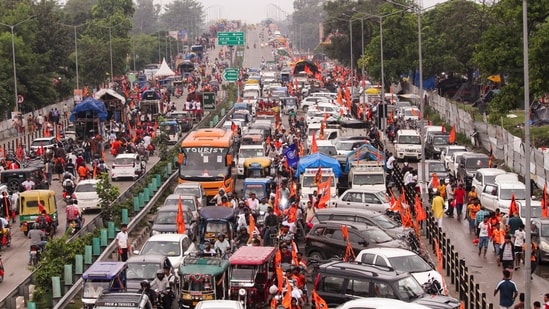
The Kanwar Yatra is a yearly holy walk by worshippers Lord Shiva that takes place during the Hindu month of Sawan or Shravan (July to August), in which pilgrims — mostly in saffron clothes — walk to holy rivers, and fill pots with Ganga water while making sure the pots don't touch the ground on the way.
The pilgrims carry these pots on their shoulders using a special bamboo pole called a ‘Kanwar’ and either walk back home or travel in vehicles to pour the water on a ‘Shivling’ at a local temple.
Watch | Kanwar DJs shake car windows
Given the key ritual of fetching holy water from the Ganges, Kanwar Yatra takes place primarily across northern India, moving through states like Uttarakhand where Haridwar is the main hub of Kanwariyas.
{{/usCountry}}Given the key ritual of fetching holy water from the Ganges, Kanwar Yatra takes place primarily across northern India, moving through states like Uttarakhand where Haridwar is the main hub of Kanwariyas.
{{/usCountry}}The Kanwar movement is also seen in other states like Uttar Pradesh, Bihar, West Bengal and Jharkhand, where the holy river flows.
What is ‘Daak Kanwar’
On the yatra routes, last two days of the pilgrimage are dominated by Daak Kanwars — pilgrims who do not stop to rest or sleep until reaching their destination after fetching holy water from the Ganges.
In a regular Kanwar Yatra, the Kanwariyas walk to collect holy water from the Ganges River and carry it back to offer on a Shiva temple. Daak Kanwars, on the other hand, complete the journey as quickly as possible, often by running or jogging.
The word "Daak" comes from the Hindi/Urdu word for mail or post, referring to the old postal runners who carried messages rapidly without long breaks.
The 'Daak Kanwar' yatra is mostly done in groups wherein members complete the trip in a relay, passing the kanwar between each other so that it is continuously moving.
Because Daak Kanwar participants often travel at higher speeds and through the night, it is considered more physically demanding than the regular Kanwar Yatra and requires significant endurance and planning.
Why do people undertake a ‘Daak Kanwar’?
Many devotees are believed to undertake the Daak Kanwar to fulfill a mannat (religious vow), many others do it merely as an act of devotion and penance to Lord Shiva.
Rules commonly followed during regular Kanwar Yatra and Daak Kanwar Yatra vary by region and tradition but motly include maintaining the purity of the kanwar and the sacred water, avoiding intoxicants as well as non-vegetarian food and remaining barefoot or wearing simple footwear, depending on local custom.
The most critical ritual of Kanwar Yatra is ensuring the kanwar, the pot carrying holy water, is not placed directly on the ground without a proper stand.
Pilgrims undertaking the Kanwar Yatra gather holy water from the Ganges River at sacred sites like Haridwar, Gaumukh, Gangotri, and Rishikesh in Uttarakhand, or Sultanganj in Bihar, Tarakeshwar in West Bengal.
Devotees walk back carrying the water to offer it at local Shiva temples or major shrines on Shivratri, which is being observed on August 11 this year.
HT report on Kanwar Yatra window-rattling music
While most Delhi residents have been dealing with traffic snarls and disruption as hundreds of devotees participating in the annual Kanwar Yatra traverse the city, those living next to temporary camps for Kanwariyas have borne a more immediate brunt: days of blaring music, rattling windows, disrupted sleep and clogged neighbourhood roads.
Through Monday, HT visited B-Block in Ramesh Nagar – a west Delhi neighbourhood between Kirti Nagar and Rajouri Garden – with a sound meter to track the sound levels there and found that the levels of exposure were high enough to cause long-term hearing damage. Residents there said the steady movement of devotees and two Kanwar camps set up below the Ramesh Nagar metro station had turned daily life into a struggle. Read full report here