
 E-Paper



‘One election’ bill tabled in House, may be sent to JPC
The proposal is fiercely opposed by a raft of political parties and activists who allege that it will hurt democratic accountability and federalism

 Prefer HTon Google


New Delhi The Union government on Tuesday introduced in the Lok Sabha two bills aimed at ushering in simultaneous state and national elections amid loud protests by the Opposition — taking the first step towards implementing sweeping changes in the way polls are conducted in the world’s largest democracy.
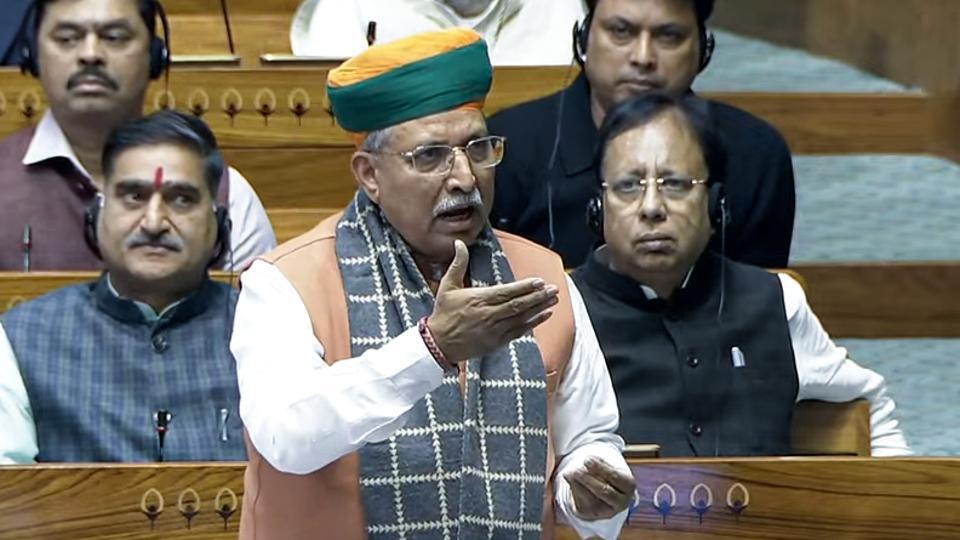
The Constitution (129th Amendment) Bill and the Union Territories Laws (Amendment) Bill will be sent to a joint parliamentary committee (JPC) for detailed review, said people aware of developments, after the Opposition forced voting over the scope of the bills’ introduction. As many as 263 members voted in favour of the bill and 198 against it.
The proposal to align elections – known colloquially as one nation, one poll (ONOP) – was a part of the Bharatiya Janata Party’s 2024 poll manifesto and is backed by Prime Minister Narendra Modi, who argues that it will trim election costs and give more time for development.
But the proposal is fiercely opposed by a raft of political parties and activists who allege that it will hurt democratic accountability and federalism. The bills propose the alignment process to begin in 2029 and the first simultaneous elections in 2034.
“When the ONOP bill was taken up in the Cabinet for approval, PM Modi had said that it should be sent to JPC for detailed discussion. If the law minister is willing to send the bill to JPC, the discussion on its introduction can end,” Union home minister Amit Shah said.
Lok Sabha speaker Om Birla will constitute a JPC in the next few days, said people aware of developments, with members of both the Lok Sabha and Rajya Sabha and headed likely by a lawmaker from the government side.
Union law minister Arjun Ram Meghwal introduced the constitutional amendment Bill – which proposes amendments and insertion of new Articles that will allow the terms of the Lok Sabha and state assemblies to be synchronised – and the Union territories Bill, which seeks to align elections in the Union territories of Puducherry, Delhi, and Jammu & Kashmir with the Lok Sabha polls, after nearly 90 minutes of debate.
The constitutional amendment bill will be a big test of the BJP’s ability to swing support in its favour as the ruling dispensation doesn’t have enough numbers to push a Constitution amendment in either House of Parliament. Article 368, which governs constitutional amendments, mandates that such a bill is passed “in each House by a majority of the total membership of that House and by a majority of not less than two-thirds of the members of that House present and voting”.
This means that in the Lok Sabha, the bill will need at least 272 members and also two-thirds of all members who are present to vote that day. If the House is in full strength, that number will rise to 362 – far more than the numbers of the National Democratic Alliance, which commands the support of 293 members in the House. The Indian National Developmental Inclusive Alliance (INDIA) has 237 members, and others have 11.
In the Rajya Sabha, which has 231 members currently, the government will need the support of 154 MPs. The NDA’s current strength in the Rajya House is 114, with six nominated members likely to back the administration. The INDIA bloc has 86, and others have 25.
The bills will also test the Opposition’s ability to keep its flock together.
From the first elections in independent India in 1952 until 1967, polls were held simultaneously across the country. But since the Lok Sabha and state assemblies can be dissolved before their tenures end, the state and national elections came to be held at different times after that.
Several committees, including a parliamentary panel, the Niti Aayog and the Election Commission of India, have studied simultaneous polls in the past, backing the idea but flagging logistical concerns.
If implemented, simultaneous elections will become part of a raft of sweeping changes that will change the political and social landscape of India, including the census and the delimitation exercise based on it, and the women’s reservation bill that is supposed to come into effect after that.
“The bills did not attack the basic structure doctrine…objections to the bill are political in nature,” Meghwal said in the Lok Sabha.
But the Opposition alleged it violated the basic structure of the Constitution.
Congress leader Manish Tewari alleged that the Constitution amendment bill goes beyond the Seventh Schedule, which defines the scope of the Central List, State List and Concurrent List. “It spells out certain basic features of the Constitution which are beyond the power of this House. It assaults the basic structure of the Constitution. How is it possible under our Constitution to make tenure of assemblies same as that of the Lok Sabha? India is a Union of states. This excessive centralism which is sought to be brought belittles the constitutional scheme of things,” he said.
The bills closely follow the road map laid out by a high-powered committee headed by former President Ram Nath Kovind, who had argued that the bills will not need to be ratified by a majority of the states as they don’t fall under the purview of Article 368(2). But Opposition leaders said this understanding was erroneous and could be legally challenged.
“I am unable to understand how two days ago, this government pledged to save the Constitution and to uphold its glorious traditions. Now they have brought this bill that will demolish the federal structure which has been made based on the country’s diversity. This bill is destroying the basic idea of the Constitution. Those who can’t conduct elections of eight states together, they want to do all elections simultaneously. The BJP invents new ways of tyranny. This is anti-Constitution, anti-federalism, anti-poor, anti-Muslim,” said Samajwadi Party’s Dharmendra Yadav.
Trinamool Congress’s Kalyan Banerjee said that the basic structure of the Constitution can’t be tampered with. “This bill hits the basic structure. This is ultra vires…The bill says tenure of states will depend on the tenure of the Lok Sabha. How can it be done? This is unacceptable,” he said.
NDA allies Telugu Desam Party and Janata Dal (United) backed the idea. But the Biju Janata Dal which has zero members in the Lok Sabha and seven in the Rajya Sabha, remained non-committal.
“Presently, the matter has been placed before JPC and once the committee examines this matter, then of course, BJD, on directions of our party president Naveen Patnaik ji, will take a call on this matter,” said the party’s Rajya Sabha leader Sasmit Patra.
Parliamentary affairs minister Kiren Rijiju said the Speaker gave a ruling to allow floor leaders of all parties to speak on the introduction of the bills.
“You alone do not represent Parliament, every political party has a representation here,” Rijiju said.
The constitutional amendment Bill suggests that if the Lok Sabha or any state assembly is dissolved before the end of the full term, midterm elections for that legislature alone would be held for the remainder of the five-year term.
It proposes including an Article — 82 (A) (simultaneous elections to the House of the People and all Legislative Assemblies) — and to amend Article 83 (Duration of Houses of Parliament), Article 172 & and Article 327 (Power of Parliament to make provision with respect to elections to legislatures).
The Kovind panel – set up by the Union government on September 2, 2023 — received responses from 47 political parties, with 32 favouring simultaneous elections. These parties — which included the BJP, the BJD, JD(U) and the Shiv Sena — said the proposal will save scarce resources, protect social harmony, and stimulate economic development.
However, 13 political parties opposed simultaneous elections — including Congress, Aam Aadmi Party, TMC CPI(M) — expressing concerns that it could violate the basic structure of the Constitution, be anti-democratic and anti-federal, marginalise regional parties, encourage the dominance of national parties, and lead to a presidential form of government.


