E-Paper



Indra Mohan Pandey: ‘Panditji just passed by us... I could see him clearly’
India@79: Pandey has watched India move from radio and trunk calls to smartphones and from scarcity and protectionism to liberalisation and globalisation

 Prefer HTon Google


Indra Mohan Pandey was 11 when he first saw Jawaharlal Nehru, the country’s first prime minister. The year was 1958, and children from across Delhi schools had been brought to the Red Fort to watch Independence Day celebrations. Pandey, an old Delhi boy, one of five siblings, was one of them.
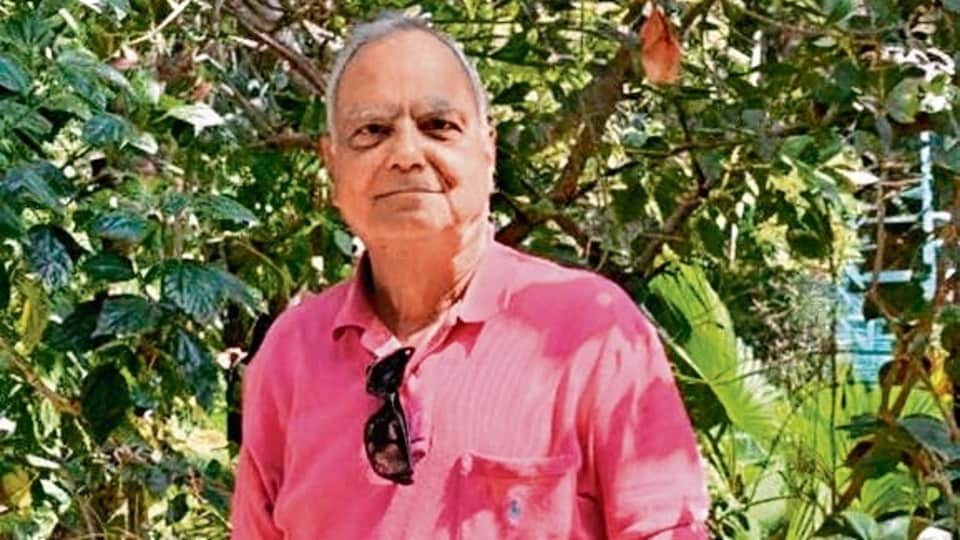
“Panditji just passed by us and cheered us on… I was in the front row and I could see him clearly,” recalled Pandey, who was born 10 days after India gained independence. The stage was small, security was sparse and the distance between the leaders of the new republic and the children watching them was little.
Also Read | Pushpa Singh: Only a few of us champions are left, the rest are out
Deep Dive

That child watching Nehru would go on to become a teacher, an economist and a management professor, spending more than five decades in classrooms across India and the US. He has watched India move from radio and trunk calls to smartphones, social media and artificial intelligence; from scarcity and protectionism to liberalisation and globalisation; from a country where higher education was largely a male preserve to one where women make up more than half the students in many institutions.
Born on August 25, 1947, in Pant Gaon, a picturesque village near Devprayag Sangam in present-day Uttarakhand, Pandey’s family was rooted in a tradition of Sanskrit scholarship and stayed in the village for about nine years. “My father, however, was determined that I should receive a modern education and have opportunities beyond the village. So, we moved to Delhi,” he said.
Also Read | ‘Beginning of another’: How Hindustan Times reported freedom on August 15, 1947
Home in Delhi was Bhagirath Palace near Chandni Chowk, a neighbourhood that today is known for wholesale electronics and medical markets. “Back then, Bhagirath Palace had many houses and even some offices of film distributors,” said Pandey.
There were few public schools at the time, and private education was beyond what the family could afford. While he was enrolled in Jain Sanskrit School in Dariba Kalan, it was Delhi that became his classroom.
“Politics and national security, especially during the 1962 Indo-China war, were discussed everywhere in this city. Even a bus ride was full of riveting discussions with agreements and disagreements,” recalled Pandey, who retired from IIM-Ahmedabad as professor in 2007.
Even though the India of his youth was poor and literacy low, Pandey remembers a country where political and intellectual life was alive. That came into sharper focus when he entered Shri Ram College of Commerce (SRCC) in 1963. A B.Com (Honours) degree was considered prestigious, and Pandey, who had secured a first division, entered its top section. He joined the History and Political Science Society and the Literature Society, and student societies became his window into the wider world.
Also Read | Freedom the same night, but different dates: Why Pakistan marks its Independence Day on August 14
His time at SRCC also taught him that learning did not happen only inside classrooms. As a society office-bearer, he helped invite some of the country’s most prominent political figures. “Ram Manohar Lohia, V K Krishna Menon, and Balraj Madhok came to our college. During the Kamaraj Plan in 1963, when several senior Congress leaders resigned from ministerial positions, we took advantage of the unusual political churn to invite some of them, including Lal Bahadur Shastri,” he recalled.
Funding his own education required some financial jugglery. SRCC’s monthly fee was about ₹15, while his father’s salary was around ₹100, and so he secured a scholarship. “My father had other plans for me. He had started out as a teacher but then joined an Ayurvedic dawakhana. He didn’t want me to pursue teaching and insisted I become a chartered accountant. I resisted and for months, he didn’t speak to me… Having a fight with my father about becoming a teacher was worth it,” said Pandey, who lives in Delhi, with wife. His children, aged daughter Ruchika Pandey (50) and Abhishek Pandey (47), live in the US, and he also has two grandchildren.
He joined Delhi School of Economics (Department of Commerce) in 1966-1968 for a post graduate degree and completed his PhD from the same institute (1972-76) in finance. “We didn’t even have enough calculators. At the university’s computer division, near the vice-chancellor’s office, researchers punched cards and queued for access to an IBM machine. Shoes were not allowed inside. You submitted your calculations to a computer assistant, and were given a time slot in the evening and returned later to collect the output. Sometimes the result was simply a syntax error. A comma where a full stop was expected could mean starting over again,” he said.
In 1968, Pandey joined SRCC as a lecturer and spent nine years there; in 1981, he began his 27-year-old teaching stint at the Indian Institute of Management (IIM) Ahmedabad, where he taught financial management, strategic management and other related subjects. In between, he also taught at Kansas State University as a visiting faculty member in 1985.
“New tools such as VisiCalc and Lotus 1-2-3 were beginning to transform computing. I had barely encountered them and I was desperate to learn. Lotus was later replaced by excel spreadsheets, and then came personal computers. Now it is an entirely different world altogether,” said Pandey.
He said that despite all the tech advancements and AI, human ability to ask questions will always remain essential. During the Emergency, his university colleagues gathered at a coffee house and decided to organise demonstrations and put up posters. The plan somehow reached the police. Policemen visited them and warned that they could be arrested. Some of his friends from left parties were arrested.
“Political discussions moved into drawing rooms after this but we found poetry to express ourselves. I wrote for Ganga, a Hindi magazine, about Patriotism and Struggles of middle-class,” he said.
The Mandal agitation triggered another churn. “Questions around reservation were some of the frequently asked ones in our interviews of candidates. We would like to know what their thinking was. We may like it, we may not. What was important was whether they were thinking or not,” he added.
When he was a young lecturer at SRCC, the college was, by default, an all-boys institution. He remembers having only one woman student. “Women studied at institutions such as Miranda House and Lady Shri Ram. Most of the remaining colleges were male bastions. Even when women obtained degrees, marriage and managing the household remained the expected trajectory for many,” he stated.
He remembers the excitement of buying his first car after returning from the US – a Maruti 800 with “original Japanese parts.” He has a Honda City, and rarely drives now. He uses social media apps and sees both the benefits and dangers of technology. The country has grown tremendously in front of his eyes, but progress has not been evenly distributed. “I see educated youngsters working for delivery apps. India’s next challenge is ensuring that the benefits of growth reach the lower sections of society too,” he said.
And then there is Gen Z. Pandey has watched young Indians take to the streets and use social media to organise, argue and express themselves in ways that would have been unimaginable in his student days. “Everyone is now making reels,” he said. The methods are different but the thread is familiar – young people are still asking questions.