
 E-Paper



Pushpa Singh: 'Only a few of us champions are left, the rest are out'
Born in May 1947, Singh has been playing competitive games for most of her life.

 Prefer HTon Google


At 79, Pushpa Singh is playing. One rainy evening, a table at her apartment complex in Ghaziabad is at the centre of a koat pees, or court piece, tournament. A newspaper is spread across it, partly covered by mobile phones, glasses, and keys. Around the table, players are sitting with their cards as others watch behind them.
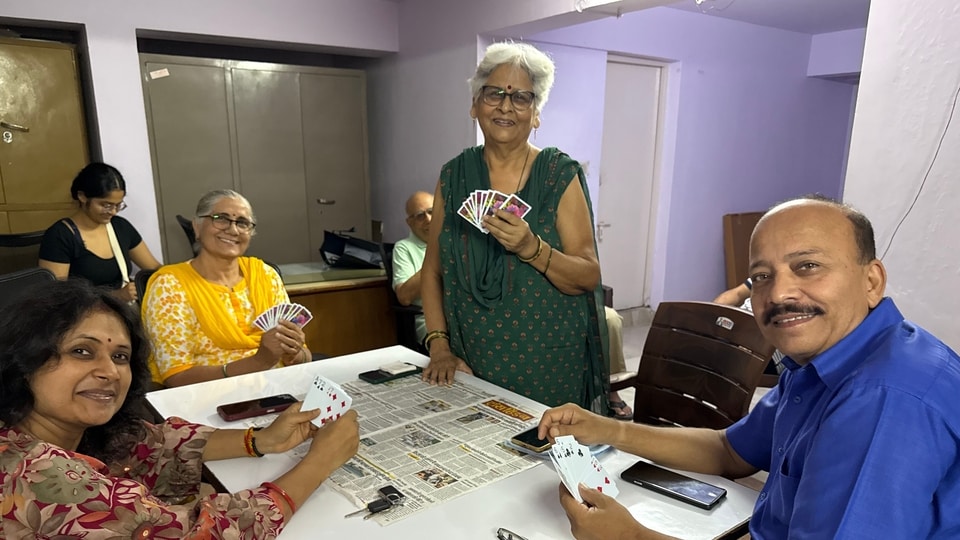
Singh stands by the table for a quick photo, holding her cards in a fan. She is in the semi-final. She has already played three rounds this week, with her neighbour Priya Sachan as her partner. “Only a few of us koat pees dhurandhars (champions) are left, the rest are out,” she says.
If Singh and her partner win, the final will be played later that night. The winners will receive their prizes on August 15, when their gated apartment complex celebrates Independence Day, marking 79 years of India’s freedom.
Deep Dive

ALSO READ | Freedom the same night, but different dates: Why Pakistan marks its Independence Day on August 14
Born in May 1947, Singh has been playing competitive games for most of her life. She was a schoolgirl in Nagina, in Uttar Pradesh’s Bijnor district, when her father, a teacher, told her, “Jao, khelo [Go play].” Singh grew up in the early years of independent India, a time often thought of as more restrictive than now for girls. But her story underlines that in some families and small towns, girls could still achieve some freedom through sport. She frequently participated in district tournaments, spending days outside her home without her parents accompanying her.
By Class 8, at Nagina’s Dayanand Vaidik Kanya Inter College, Singh was already a javelin champion. She also regularly competed in shot put, high jump, long jump, hurdles, relay and rope climbing. She and fellow athletes in the college often travelled to multi-day tournaments at girls’ colleges in nearby towns such as Dhampur, Bijnor and Seohara, staying in hostels. They played in salwar suits, tying their white dupattas around their waists.
Independence Day: HT full coverage
By Class 10, Singh had collected three state-government trophies for relay, high jump and rope climbing. None of her three brothers played sports. Once, she missed a tournament. Her parents were away in their village and her elder sister refused to let her go. When her father returned, he asked her sister why she had stopped her.
After Class 12, at 20, Singh was married to a public works department engineer employed by the UP government. Her husband’s postings took the family to various towns, and her sporting life changed. In Nainital, where the family once lived, there was rowing. Singh, then a young mother in her early 30s, would take a wooden boat onto Naini Lake and row by herself. In a photograph from those days, she is in the boat in a sari, both hands on the oars.
In another town where her husband was posted, she once saw some men playing badminton. “Let us also play,” she told her women friends. They did, and routinely.
Singh would play in a sari. Not used to sports shoes, she played in slippers. Once, she and her playmate entered a badminton tournament at a club in Lucknow. Singh was in her 50s. The other three women were in their 30s. Before the final, Singh told her partner to guard the net while she covered the back court. Her partner lost a point at the net, and they lost the match by a point.
ALSO READ | ‘Beginning of another’: How Hindustan Times reported freedom on August 15, 1947
Gradually, the games became less about running and jumping. Bridge arrived in her life. Singh learnt the complex card game when her husband was posted in Pilibhit, a town in the Terai. Friends in the PWD Colony took turns hosting the game at their drawing rooms every evening after dinner. Singh’s reputation as a formidable bridge player quickly spread through Pilibhit’s high society. An elderly bridge enthusiast, the father-in-law of the district magistrate, the “DM Sahib,” often visited from Delhi. He would call Singh’s husband and ask him to come over for a game, along with “Mrs Singh,” the bridge champion.
At home, there was carrom with her children after school. Now that the children are busy with their own lives and have their own children, Singh spends every afternoon with her retired husband, playing Paplu, another card game.
Singh’s passion for sport has percolated to the next generation. Her eldest daughter Parul is a working professional in her 50s who lives in Mumbai and frequently treks in the Himalayas. Earlier this year, Parul with her daughter trekked to the Everest Base Camp. Singh’s younger daughter Payal also has a career and lives in Delhi-NCR. Payal practises yoga, while her daughter spends 1.5 hours every day at the neighbourhood gym, working out with battle ropes.
Some years ago, Singh’s knees began to trouble her. Eventually, she underwent knee replacement surgery. But the games stayed.
Singh and her koat pees partner, Priya Sachan, face Geeta Chaudhary and Rajiv Mohan. The girl who once travelled to tournaments in the early years of independent India is, decades later, sitting down for another game. India has changed dramatically since then. Singh has too, though something of that girl remains.
The cards are dealt. Singh looks at her hand and declares the trump: “Chidi.”


