
 E-Paper



Parts of Bengaluru go under as overnight rain floods city
Boats, tractors and earthmovers were deployed on arterial roads and in residential colonies as heavy rain flooded large parts Bengaluru, virtually shutting down the city and sparking an outpour of public anger against mismanagement and alleged misgovernance.


Boats, tractors and earthmovers were deployed on arterial roads and in residential colonies as heavy rain flooded large parts Bengaluru, virtually shutting down the city and sparking an outpour of public anger against mismanagement and alleged misgovernance.
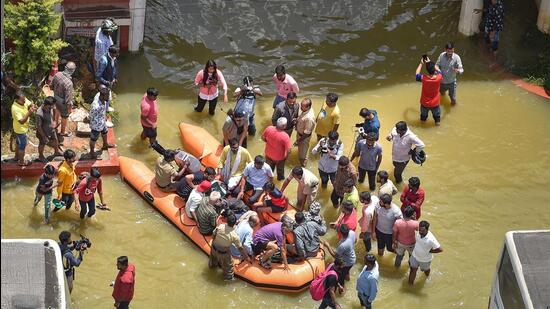
Water supply was snapped in large parts of Bengaluru on Monday, and several localities were without power for hours, amid reports of serpentine traffic jams on the city’s waterlogged streets, and flight disruptions at the airport.
Bengaluru recorded about 131.6mm rainfall in a 24-hour-period ending Monday -- the second-highest single-day rainfall in September in 24 years. According to the IMD data, Bengaluru recorded its highest rainfall for the month on September 12, 1988 at 177.6 mm of rain. On September 26, 2014, the city recorded 132.6mm of rain.
Karnataka chief minister Basavaraj Bommai on Monday said he has instructed officials to ensure that water is drained out from the inundated roads at the earliest. “There have been heavy rains in Bengaluru, I have spoken to the commissioner (municipal corporation), and other officials. I have asked officials to depute two State Disaster Response Fund (SDRF) teams to Mahdevapura and Bommanahalli zones in the city that have been worst affected, with boats and other equipment... also engineers are there,” Bommai told reporters.
Bommai said the administration has started clearing encroachments on drains. “For example, in Bheemeshwari (river from where drinking water is supplied to Bengaluru), there are encroachments in the upper side of it. And we will take all action to clear it,” he said.
But residents and experts said this was too little, too late.
The waterlogging in localities such as Rainbow Drive Layout and Sunny Brooks Layout reached a point that tractors and boats were used to ferry students and office-goers. The entire technology corridor between Silk Board and KR Puram, including Sarjapura Road and Manyata Tech Park were badly hit.
Outer Ring Road (ORR), which houses some of the top IT companies including Deloitte, Wipro, Manyata Technology Park and Eco-Space, suffered waterlogging and traffic pile-ups.
“Bangalore must be the only tech hub in the world, where software developers travel two hours to get to office so that they can build apps to deliver groceries in 10 mins,” read a Twitter forward shared by Mohandas Pai, the former chief financial officer of Infosys.
Residents came down heavily on city administration and the state government for unregulated growth over decades, and wiping out of an ecosystem of wetlands, lakes, valleys and traditional drains.
The Information Technology boom in the early 2000s increased the demand for housing, facilities, and roads to accommodate a burgeoning and flourishing middle-class. It led to growth, but haphazard planning also made Bengaluru a victim of its own success. According to the Land Use Land Cover [LULC] Dynamics paper by the Indian Institute of Science-Bengaluru, the city shows a 1005% increase in urban built up area between 1973-2016. Between 1992 and 2020, the city’s built up area rose from 27.3% to 93.3%, adversely impacting the area under vegetation and water bodies which came down by 88% and 79% respectively. The number of lakes was reduced by 790% between 1973 and 2016, according to the report.
Officials said that the Bangalore Water Supply and Sewerage Board (BWSSB) unit that manages Cauvery water supply to city at TK Halli, has been flooded, causing damage to machinery there. The water supply will, therefore, be affected on Monday and Tuesday.
According BWSSB, the flooding and rains will disrupt over two-thirds of drinking water supply to Bengaluru since at least two pump houses in TK Halli were under water and breached the previous flood mark by over 1.5m.
“If we look at rainfall data from 1971, it is the second highest rainfall in September after 1998. But this is one of the wettest monsoons in the history of Bengaluru,” Tushar Girinath, the chief commissioner of the Bruhat Bengaluru Mahanagara Palike (BBMP, the city’s civic body) said. He added that normal rainfall between 1-5 September is around 25mm and there are localities which have received between 150-300 mm rainfall.
While the chief minister said that all of the city’s 164 lakes were overflowing, experts said that unregulated urban expansion without consideration for the topography might be the reason for the flooding.
“All cities in India have same problem with respect to floods and stagnation — unplanned urbanisation, built-up in ecosensitive areas, lack of drains and culverts, maintenance rooted in our planning, governance, financial independence... What differs is whether the city faces heavy rain or not. It could be Bengaluru today, Chennai, Mumbai, Kolkata or Kochi tomorrow. When it rains heavily, people report them and talk about these issues. But once monsoons are over, it goes back to square one and we resort to continuing with the same practices which created the issue in the first place,” Raj Bhagat, senior manager, GeoAnalytics at WRI India, said on Twitter.
The parking area at the city airport was flooded but there were no major flight disruptions.
Bommai said that the government has decided to put up sluice gates around all major lakes in the city but the works can be taken up only after the rains subside.
“Since we did not make any proper pre-plan for such kinds of rains in Bengaluru and we get 8 tmc more, 110 villages were soaked into Bengaluru which has brought with it several problems. We are working to resolve them. Am assuring the people of Bengaluru that in these rains, your government , we will face it and fix it. Wherever there are problems, we will allocate much more money to it and create more infrastructure like SWDs, bridges, increase capacity, remove bottlenecks and encroachments, put gates in lakes, we will take it all up,” Bommai said.


