
 E-Paper



Air India crash report: Picking up the missing pieces to tragic puzzle
Investigators analyze Air India Flight 171 wreckage to reconstruct final moments of the crash, revealing crucial data from flight recorders and systems.

 Prefer HTon Google


Scattered across a 1,000-foot debris field in Ahmedabad, the remnants of Air India Flight 171 provided investigators with a puzzle of twisted metal and damaged components that would prove crucial to understanding what caused the Boeing 787’s catastrophic engine failure.
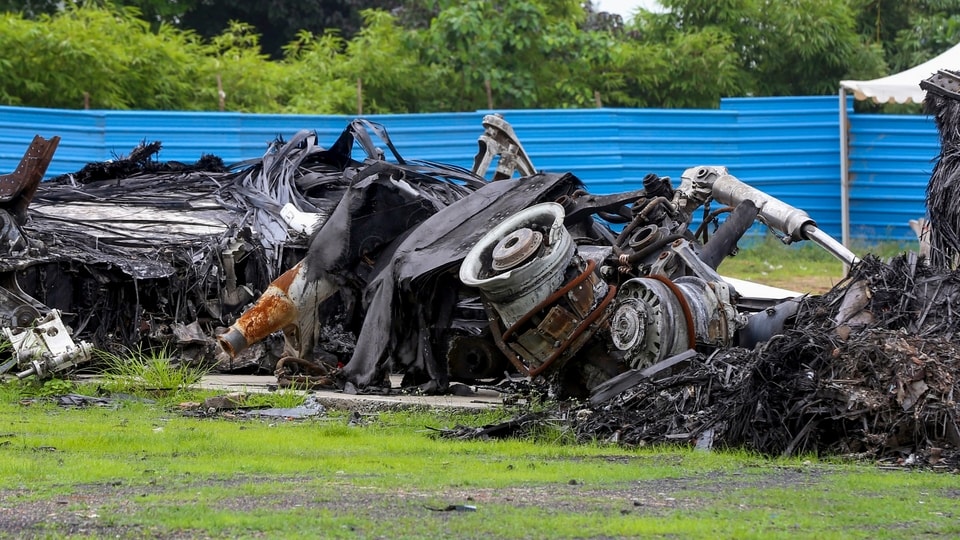
The Aircraft Accident Investigation Bureau’s preliminary report reveals how each recovered piece—from heavily damaged flight recorders to precisely positioned cockpit controls—contributed to reconstructing the final 32 seconds of a flight that claimed 260 lives.
A tale of two black boxes
The investigation’s breakthrough came from one of the aircraft’s two Enhanced Airborne Flight Recorders (EAFR), integrated black boxes that combine traditional flight data recording with cockpit voice capture in single units.
The aft EAFR, located in the tail section, was discovered on the roof of the hostel mess a day after the crash. “The EAFR had impact and thermal damages to the housing. The wires were protruding from the housing and the connectors were burnt,” the report states. The extensive damage rendered it unreadable through conventional means.
A breakthrough came when the forward EAFR was found three days later “from the wreckage debris besides the Building F” — this building was one of the hostels. Despite being “burnt and covered in soot,” this recorder remained “still attached to the equipment shelf with part of the connector melted but still connected,” providing investigators with the critical data needed to understand the disaster.
The forward recorder yielded “approximately 49 hours of flight data and 6 flights, including the event flight” plus “two hours in length” of voice recordings that captured the crucial final moments.
Console, frozen in time
The cockpit’s centre console was recovered, where investigators discovered both fuel control switches in the “RUN” position— confirming the attempt by the pilots to avert the crash. “Both fuel control switch were found in the ‘RUN’ position”.
The components told a story of proper procedures followed until the moment of crisis. The flap handle assembly, despite sustaining “significant thermal damage,” was found “firmly seated in the 5-degree flap position, consistent with a normal take-off flap setting.”
The landing gear lever remained in the “DOWN” position, indicating the gear had not yet been retracted when the emergency began—consistent with the aircraft being only seconds into its climb.
However, the thrust lever “sustained significant thermal damage” with “both thrust levers found near the aft (idle) position” and the report notes this contradicted flight recorder data: “the EAFR data revealed that the thrust levers remained forward (takeoff thrust) until the impact.”
This discrepancy suggests the levers could have moved during the crash from impact, rather than reflecting pilot actions during the emergency.
Emergency systems: Automatic responses to crisis
The wreckage provided evidence of the aircraft’s automatic emergency responses. The Auxiliary Power Unit (APU) was “found intact inside the APU compartment” with its “air inlet door found open,” indicating the APU had automatically started in response to the dual engine failure.
The report notes that “the APU Inlet Door began opening at about 08:08:54 UTC, consistent with the APU Auto Start logic,” suggesting the aircraft’s emergency systems functioned as designed.
Despite the intense post-crash fire fuelled by 54,200 kilograms of jet fuel, many critical components survived in recognisable condition. The investigation team successfully recovered and analysed the fuel control switches, landing gear components, flap mechanisms, and portions of the flight deck.
One notable absence from the wreckage analysis was any mention of the Emergency Locator Transmitter (ELT). The report states simply: “The Emergency Locator Transmitter (ELT) was not activated during this event,” without elaborating on the device’s condition or why it failed to function.


