Parliament’s effective revocation of Jammu and Kashmir’s special status reached the Supreme Court on Saturday when two National Conference leaders filed a legal challenge against the move, arguing that it violated the Constitution of India and the fundamental rights enshrined in it.
The petitioners said legislation approved by Parliament and the orders issued by the President should be declared “void and inoperative” by the apex court. The plea was filed by NC leaders Mohammad Akbar Lone and justice (retired) Hasnain Masoodi, both members of the Lok Sabha.
Masoodi is a retired Jammu and Kashmir high court judge who ruled in 2015 that Article 370, which offered special status to Jammu and Kashmir, was a permanent feature of the Constitution.
The Lower House effectively revoked Article 370 on Tuesday, one day after the Upper House did so, ending the special status of Jammu and Kashmir, and passed a bill bifurcating it into two Union Territories — J&K and Ladakh. Article 370 was nullified through a resolution after a debate that exposed divisions within the Opposition, including the Congress.
The petition was moved in the Supreme Court as Jammu and Kashmir governor Satya Pal Malik in Srinagar reviewed preparations for Eid celebrations next week. The situation remained peaceful in the Valley amid heavy security deployment. While shops and offices were closed across the Kashmir Valley, groceries, bakeries and meat shops were open and people could be seen queuing up outside ATMs.
{{/usCountry}}The petition was moved in the Supreme Court as Jammu and Kashmir governor Satya Pal Malik in Srinagar reviewed preparations for Eid celebrations next week. The situation remained peaceful in the Valley amid heavy security deployment. While shops and offices were closed across the Kashmir Valley, groceries, bakeries and meat shops were open and people could be seen queuing up outside ATMs.
{{/usCountry}}On Saturday morning, restrictions were eased in Srinagar’s Civil Lines, other parts of the city and most rural townships across the Kashmir Valley; additional checkpoints and barricades that had been set up in the past five days were removed.
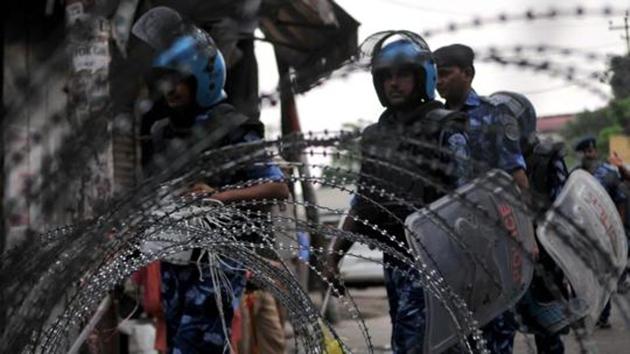
In the old city, restrictions continued as security personnel cordoned off most of the main roads and lanes with concertina wire. Internet, landline and mobile phone services have been suspended since Sunday night.
Eid-ul-Azha, or the festival of sacrifice also known as Bakr-Eid, will be celebrated on Monday and Tuesday. It commemorates Ibrahim’s readiness to sacrifice his son at the command of Allah. After testing his devotion, God switched the object of sacrifice to a sheep, which is why it is known as Bakr-Eid.
National Security Adviser Ajit Doval visited Anantnag in South Kashmir and interacted with sheep traders and locals ahead of Eid. He has been camping in Kashmir since August 6, a day after the Centre revoked the provisions of Article 370. The home ministry, meanwhile, termed as “completely fabricated and incorrect” a media report that said there was a protest by 10,000 people in Srinagar on Friday when restrictions were eased.
The NC leaders’ petition to the Supreme Court said the National Democratic Alliance (NDA) government had changed the status of Jammu and Kashmir “irreversibly” and without “the concurrence of the people of the state acting through their elected representatives”.
Terming the Centre’s move unconstitutional and violative of fundamental rights under Articles 14 and 21 of the Constitution, the petition sought the quashing of the presidential order and declaration of the Jammu and Kashmir (Reorganisation) Act 2019 as unconstitutional and inoperative.
Under Article 370 of the Constitution, Jammu and Kashmir enjoyed autonomy and the state legislature was free to draft its own laws except in the areas of communications, defence, finance, and foreign affairs. Under Article 35A, which too was nullified, non-state subjects were prohibited from purchasing land in the state and from employment in the state government.
The presidential orders paved the way for the application of entire provisions of the Indian Constitution in Jammu and Kashmir.
The two MPs submitted that the apex court now has to examine whether the central government can “unilaterally” unravel the unique federal scheme under the cover of President’s rule in force in Jammu and Kashmir while undermining crucial elements of due process and rule of law.
“This case, therefore, goes to the heart of Indian federalism, democratic processes and the rule of apex court as the guardian of the federal structure,” the petition said.
The two parliamentarians from Jammu and Kashmir contended in the petition, filed through advocate Mahesh Babu, that the presidential orders and the new legislation “unconstitutionally undermine the scheme of Article 370”.
Another petition was on Saturday filed in the apex court by the editor of a daily from Jammu and Kashmir, seeking the removal of some restrictions in the state. Anuradha Bhasin, executive editor of Kashmir Times, sought directions for the restoration of all modes of communication, including mobile internet and landline services, throughout the state in order to provide an enabling environment for the media to practise its profession.
A third petition by a Kashmiri law student, Mohammed Aleem Sayeed, sought the intervention of the top court after submitting that his parents had been detained in Kashmir and he had not been able to contact them. He sought a writ of habeas corpus for the production of his parents and brother with whom he lost contact after Article 370 was effectively removed.
“No ground exists for keeping his parents and entire Kashmir valley under detention,” the petition said.
The petitions come after three previous pleas in the top court challenged the presidential order and demanded that some leaders detained in Kashmir be released.
The petitions were filed on a day Russia backed India’s move on Jammu and Kashmir, saying that the changes in the status were within the framework of the Indian Constitution and hoped that the differences between India and Pakistan were resolved bilaterally on the basis of the 1972 Simla Agreement and the 1999 Lahore Declaration. “Moscow expects that India and Pakistan will not allow aggravation of the situation in the region due to the change by Delhi in the status of the state of Jammu and Kashmir,” Russia’s ministry of foreign affairs said.
Iran’s armed forces chief of staff, meanwhile, cautioned India and Pakistan to avoid any “hasty decision” on the issue, the semi-official Fars news agency reported.
Prohibitory orders under section 144 of the Code of Criminal Procedure were lifted in five districts and curfew was relaxed in Doda and Kishtwar districts on Saturday, officials said.
All schools and colleges reopened in five districts of the Jammu region, and attendance in government offices increased, a senior official said. “All kinds of restrictions in these five districts of Jammu, Kathua, Samba, Udhampur and Reasi have been withdrawn and all educational institutes have reopened today,” the senior official told PTI.