...
...
Next Story

PM Modi meetings on Covid-19 lockdown in last lap, decision at 10 am

The PMO is working with top government officials to draw up the blueprint to implement the Phase 2 of the Covid-19 lockdown. Prime Minister Narendra Modi is expected to sign off on the plan later in the day.

Updated on: Apr 14, 2020, 00:00:17 IST
Hindustan Times, New Delhi | By
Prefer HTon Google
Advertisement

The Prime Minister’s Office, which has been in the middle of the decision-making process during the Covid-19 lockdown, is holding one of the last rounds of meetings to finalise the modalities for the second phase of the graded lockdown that will be announced by PM Narendra Modi at 10 am tomorrow.
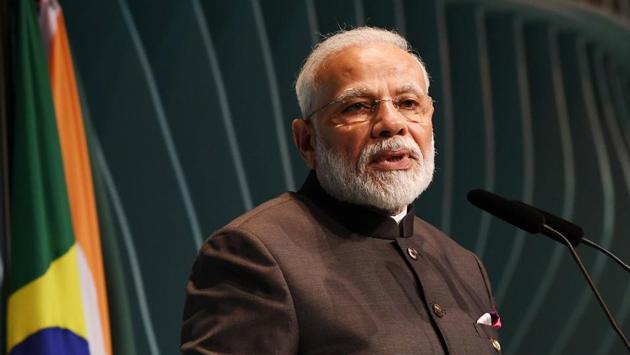
Prime Minister Narendra Modi will address the nation on the Covid-19 lockdown on Tuesday at 10 am, (PIB)

The 21-day national lockdown announced by PM Modi on March 24 evening ends on Tuesday midnight. PM Modi has told chief ministers that the focus of the second phase would be not only to save lives of people from the disease but also their livelihood.

The PMO is working with top government officials to draw up the blueprint of how this plan would be implemented. Prime Minister Narendra Modi is expected to sign off on the plan later in the day.

A top government official told Hindustan Times that while Prime Minister Narendra Modi will address the nation on the broad steps to follow, Home Secretary Ajay Bhalla will issue a detailed note on the mechanics. “A meeting on the next steps to be taken is currently on at Raisina Hill,” the official said.

Also Read: Ministries pitch plan to balance lives, livelihood in Covid-19 lockdown 2.0

The broad focus of this blueprint would be to gradually resume economic activity in the 160-odd districts that do not have a single case of coronavirus safe but take all steps to ensure that the Sars-CoV-2 pathogen that causes Covid-19 does not reach there.

The second set with limited economic activity will be districts with below 500 coronavirus positive cases along with revival of the self-contained public sector and private industrial units.

Within these states too, the government is looking at the proposal of the Department of Promotion of Industry and Internal Trade to reopen industrial units that are able to accommodate workers at its premises or bring them in special vehicles from safe zones. The department had proposed a list 12 big industries that could be allowed in a graded manner.

The third set will include states like Maharashtra, Delhi, Tamil Nadu and Kerala, where the number of corona positive cases are high even though those areas have been demarcated as containment zones.

Even in these red zones, officials said organised activity will be allowed. Unorganised economic activity may be allowed within monitored areas. For instance, officials said, they were looking at the possibility of using, say a hall in a school, for selling vegetables for a few hours, say 6am to 11 am, fruits for another set of hours and if need be, other essentials later.

The idea is to give unorganised trade a means for sustenance without risking spread of the disease.

 
ABOUT THE AUTHOR
Shishir Gupta

Shishir Gupta is Executive Editor at Hindustan Times and one of India's top journalists covering national security, strategic affairs, foreign policy and geopolitics. Over the past three decades, he has extensively reported on India's military, diplomatic and security landscape, covering every major conflict and national security challenge, from the 1999 Kargil War and the 2020 East Ladakh standoff to Operation Sindoor in 2025. He has also covered major terror attacks, including the IC-814 hijacking, the 26/11 Mumbai attacks and the 2025 Pahalgam terror strike, along with numerous Pakistan-backed terrorist incidents in the Kashmir Valley and across India. He has reported on national and state elections for more than three decades. A recognised authority on strategic affairs, Gupta has covered India's nuclear programme since the Pokhran-II (Shakti series) tests in May 1998 and has written extensively on global nuclear issues, Indian diplomacy and the country's expanding global outreach. He has also reported widely on international conflicts and terrorism, with a special focus on the Indian subcontinent. Gupta has interviewed Prime Minister Narendra Modi more than four times, including Modi's first interview with the print media after becoming Prime Minister in May 2014. His other interviews include three with the Dalai Lama, as well as conversations with Benjamin Netanyahu, Amit Shah, Yogi Adityanath, S. Jaishankar, Nirmala Sitharaman and Piyush Goyal. He is the author of Indian Mujahideen: The Enemy Within (Hachette, 2011) and Himalayan Face-off: Chinese Assertion and Indian Riposte (Hachette, 2014). He was awarded the Chevening-Wolfson Joint Scholarship at Wolfson College, University of Cambridge, UK, in 1998 and participated in the International Visitor Leadership Program (IVLP) of the US State Department in 2006. He received the Ben Gurion Prize from Israel in 2011 and the K. Subrahmanyam Prize for Strategic Studies in 2015 from the Manohar Parrikar Institute for Defence Studies and Analyses (MP-IDSA). Since 2024, he has hosted Point Blank, Hindustan Times' weekly YouTube show on global geopolitics.

Get the latest India News, breaking headlines and real-time updates from across the country. Stay informed about politics, government policies, crime, weather and major national developments.
SHARE THIS ARTICLE ON
Hindustantimes wants to start sending you push notifications. Click allow to subscribe