
 E-Paper



PM Modi mourns Khaleda Zia’s death, hails her contributions to India–Bangladesh ties: ‘Deeply saddened’
PM Modi acknowledged Khaleda Zia's role in fostering the India-Bangladesh ties and said that her “important contributions” would always be remembered.

 Prefer HTon Google


Prime Minister Narendra Modi on Tuesday condoled the death of Bangladesh’s first woman premier Khaleda Zia, saying she will be remembered for her important contributions to India-Bangladesh ties.
Khaleda, 80, died early on Tuesday at a hospital in Dhaka where she was being treated for infection in her heart and lungs. Her death occurred weeks before the general election scheduled for February 12, in which her Bangladesh Nationalist Party (BNP) is expected to emerge as the single largest party.
“Deeply saddened to learn about the passing away of former Prime Minister and BNP Chairperson Begum Khaleda Zia in Dhaka,” Modi said on social media.
“As the first woman Prime Minister of Bangladesh, her important contributions towards the development of Bangladesh, as well as India-Bangladesh relations, will always be remembered,” he said.
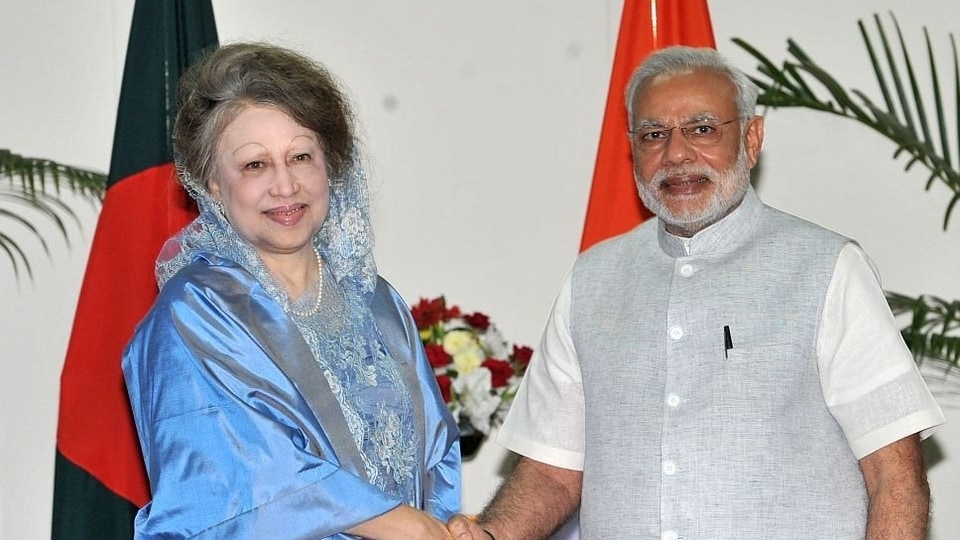
Modi recalled his “warm meeting” with Khaleda in Dhaka in 2015 and hoped “her vision and legacy will continue to guide our partnership”.
He offered his condolences to Khaleda’s family and the people of Bangladesh. “May the Almighty grant her family the fortitude to bear this tragic loss,” he said.
Bangladesh interim government chief Muhammad Yunus too condoled the death of the three-time former prime minister and described Khaleda as a “symbol of the democratic movement”. He said Bangladesh has a “great guardian” who represented an important chapter in the country's history.
Yunus said Khaleda's role in establishing democracy, a multi-party political culture, and the rights of the people will be remembered forever. “Despite political differences, her long political journey dedicated to national welfare, her people-oriented leadership, and her firm resolve always showed the way,” he said.
Khaleda's death was also condoled by her rival, former premier Sheikh Hasina, who recalled her role in the “struggle to establish democracy” and described her contributions to the nation as significant.
“Her passing represents a profound loss for Bangladesh’s political life and for the leadership of the Bangladesh Nationalist Party,” Hasina, who was locked in a decades-long rivalry with Khaleda, said in a statement released by her Awami League party.
Born in Jalpaiguri, Khaleda completed her education in Dinajpur and married Ziaur Rahman, then a captain in the Pakistan Army, in 1960. During Bangladesh’s Liberation War in 1971, Rahman defected and fought against the Pakistani forces. Rahman rose to become army chief, before taking over as the military ruler in 1976 and subsequently forming the BNP.
Rahman was assassinated in May 1981, and Khaleda, who had never been in politics, was forced to join the party and take over as its vice president in January 1984. She was later elected the BNP's chairperson.
Under Khaleda’s leadership, the BNP formed an alliance with other parties in 1983 and launched a movement against military dictator Hussain Muhammad Ershad. Her leadership played a key role in ending the nine-year-long autocratic rule of Ershad.
The BNP won the general election held in 1991, and Khaleda was sworn in as the first woman prime minister of Bangladesh.
She became the prime minister for a second consecutive term after the general election in 1996, which was boycotted by all major opposition parties.
However, Parliament was soon dissolved following a constitutional amendment regarding the conduct of elections under a caretaker administration and Khaleda stepped down. The BNP was defeated by the Awami League in the polls in June 1996, and Khaleda served as the Leader of Opposition till 2001.
A BNP-led alliance won the general election in October 2001, and Khaleda became prime minister for the third time.
Though the BNP boycotted several subsequent elections under the Awami League, Khaleda was never defeated in any election she contested. She also introduced free education and stipends for girls.
Khaleda was imprisoned in February 2018 after a special court gave her a five-year prison term in a corruption case. The high court increased the term to 10 years and she was also convicted in the Zia Charitable Trust corruption case.
Yunus said Khaleda became a “victim of extreme political vengeance” for opposing Sheikh Hasina and was sentenced to 17 years in prison in “false and fabricated cases”.
India's relations with Bangladesh while the BNP was in power were often strained, with New Delhi accusing elements in the party of backing anti-India forces. The BNP government turned a blind eye to the activities of militant groups from India's northeastern states, which set up bases within Bangladesh.
Khaleda is survived by her son Tarique Rahman, who recently returned to Bangladesh after 17 years in self-exile in the UK to lead the BNP in next year's election.



