The India-UK partnership is an important pillar of global stability and economic progress in an era of international instability, Prime Minister Narendra Modi said on Thursday after talks with his British counterpart Keir Starmer aimed at driving cooperation in areas ranging from trade and investment to defence and technology.
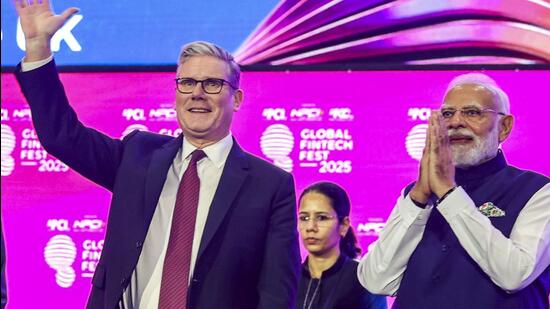
Starmer arrived in the financial hub of Mumbai on Wednesday with a 126-strong trade delegation for a two-day visit aimed at drumming up business and investments three months after India and the UK concluded a free trade agreement after years of start-stop negotiations, spurred by the geo-economic unpredictability triggered by the tariff policies of the Donald Trump administration in the US.
Also read: UK gets $468 million deal to supply lightweight multirole missiles to Indian Army
Besides reiterating their commitment to global stability and a rules-based world order, Modi and Starmer hailed the Comprehensive Economic and Trade Agreement (CETA), saying it will slash tariffs, increase access to each other’s markets, boost trade, create jobs, and benefit industries and consumers in both countries.
The leaders unveiled initiatives under the Technology Security Initiative (TSI) to drive cooperation in telecom, critical minerals, AI and health tech, as well as steps to advance defence and security collaboration, including an agreement on government-to-government supply of lightweight multirole missile (LMM) systems to bolster India’s air defence capabilities and an arrangement for Indian Air Force (IAF) instructors to be integrated with the Royal Air Force (RAF).
{{/usCountry}}The leaders unveiled initiatives under the Technology Security Initiative (TSI) to drive cooperation in telecom, critical minerals, AI and health tech, as well as steps to advance defence and security collaboration, including an agreement on government-to-government supply of lightweight multirole missile (LMM) systems to bolster India’s air defence capabilities and an arrangement for Indian Air Force (IAF) instructors to be integrated with the Royal Air Force (RAF).
{{/usCountry}}“India and the UK are natural partners. Our relationship is built on the shared values of democracy, freedom and rule of law. In today’s era of global uncertainty, our growing partnership stands as an important pillar of global stability and economic progress,” Modi said at a media interaction with Starmer, speaking in Hindi.
“India’s dynamism and the UK’s expertise together create a unique synergy. Our partnership is trustworthy, and driven by talent and technology,” he added.
Starmer added, “We’re creating a new modern partnership focused on the future and on winning the opportunities that it offers, and we’re doing it together because India’s growth story is remarkable.”
The UK will partner with India on the government’s vision of “Viksit Bharat” or a developed India by 2047, Starmer said, adding the two countries will deepen cooperation through the TSI with new commitments in AI, advanced communications, and defence technologies.
Modi noted that the two countries have decided to establish an Industry Guild and a Supply Chain Observatory for cooperation on critical minerals under the TSI, and created the Climate Technology Startup Fund to support innovators from both countries working in climate, technology and AI.
“Our defence cooperation has deepened. We are moving towards defence co-production and connecting the defence industries of both countries,” Modi said about new initiatives for security cooperation. The two sides, he said, signed an agreement whereby the IAF’s flying instructors will serve as trainers with the RAF.
Both leaders noted their meeting coincided with Konkan 2025, a joint naval exercise involving a British carrier strike group and Indian warships, and Starmer said the UK is committed to strengthening the strategic partnership and taking defence and security cooperation even further.
A joint statement referred to new initiatives in defence and security and said India and the UK will establish a Regional Maritime Security Centre of Excellence (RMSCE) under the Indo-Pacific Oceans Initiative (IPOI) and finalise an inter-governmental agreement on developing maritime electric propulsion systems for Indian warships.
Modi and Starmer announced an agreement on government-to-government supply of lightweight multirole missile (LMM) systems that will meet the current and future needs of India’s defence ministry and support long-term collaboration on complex weapons, the joint statement said.
The two PMs strongly condemned all forms of terrorism and called for zero tolerance of terrorism and concerted global efforts to combat the problem in a comprehensive manner. They also agreed to counter radicalisation and violent extremism, combat terror financing and cross-border movement of terrorists, enhance cooperation in information-sharing, and strengthen bilateral and multilateral cooperation at the UN and FATF.
“They condemned in the strongest terms the April 2025 terrorist attack in Pahalgam, Jammu and Kashmir. They committed to strengthen cooperation to take decisive and concerted actions against globally proscribed terrorists, terror entities and their sponsors,” the joint statement said.
Higher education also figured in the meeting between the two PMs with nine leading British universities opening campuses in India. The University of Southampton has set up a campus in Gurugram, while Indian authorities have cleared branch campuses of the University of Liverpool, University of York, University of Aberdeen and University of Bristol. Queens University of Belfast and Coventry University have been cleared to open campuses in GIFT City, and Indian authorities handed over a LoI for a campus of Lancaster University in Bengaluru and gave in-principle approval for a campus of the University of Surrey in GIFT City.
India currently has 40 million students in universities, and 70 million places are needed by 2035. The UK’s higher education sector is eyeing a £50-million boost to the economy as part of the expansion of British universities in India.
The two leaders also discussed regional and global issues such as the Indo-Pacific, peace and stability in West Asia and the conflict in Ukraine. “On the issues of the Ukraine conflict and Gaza, India supports all efforts to restore peace through dialogue and diplomacy. We are fully committed to enhancing maritime security cooperation in the Indo-Pacific region,” Modi said.
Starmer welcomed the deal for the first stage of the peace plan for Gaza, and said it must be implemented “in full without delay and be accompanied by the immediate lifting of all restrictions on life-saving humanitarian aid to Gaza”.
Sameer Patil, a Mumbai-based security expert, said the convergence of interests between India and UK, including the defence deals, came against the backdrop of the uncertainty sparked by the policies of the US administration.
“The two defence deals signed by India and the UK fulfil immediate and future operational capabilities of the Indian military,” he said. “At a broader level, these agreements help India to burnish the partnership with a Western power amid uncertainty over US trade and tariff policies.”
Air defence capabilities have assumed additional significance for India after Pakistan launched a barrage of drones during the hostilities in May, he said. “The procurement of LMMs from the UK will help replenish stocks. The arrangement on electric engines for warships helps the Indian Navy to leverage the Royal Navy’s experience in operating electric propulsion ships,” he said.