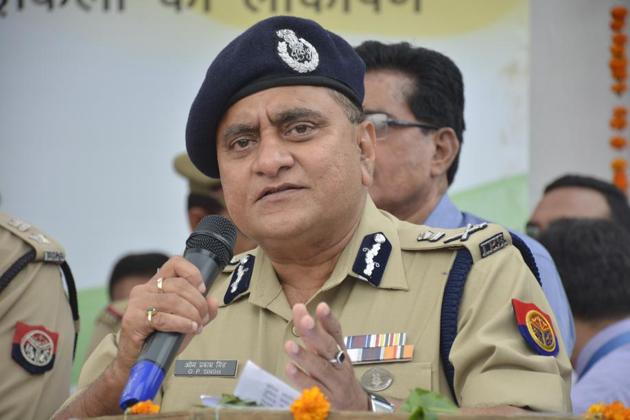
Uttar Pradesh director general of police O P Singh,in an interview, spoke about protests against the Citizenship (Amendment) Act, or CAA, and the proposed pan-India National Register of Citizens (NRC) that rocked the state last week, police firing on the protestors, their links with the Ayodhya judgment, internet shutdowns and damage caused to public property. Edited excerpts:
Q. Why has major violence been reported only in Uttar Pradesh during the anti-CAA protests? Was the UP Police not prepared or did it fail to gauge the situation correctly?
Around the time when some litigants decided to go for a review against the Ayodhya judgement, CAB was also being discussed and there was increased sensitivity. Some vested interests were projecting the NRC exercise in Assam as being discriminatory and indulging in scaremongering. Social media was being used to circulate all kinds of rumors about detention centres, documents required {for NRC} and the entire process. All these contributed to heightened sensitivity and maybe even projected a sense of alarm among UP’s Muslims, who incidentally make up a huge number of just under one-fourth of the country’s Muslim population. Some ill-meaning organizations started telling the Muslims that their citizenship was in danger and this was a do or die moment for them.
It was a sustained, systematic effort aimed at undermining peace and harmony. We constantly appealed to the people to abide by the Section 144 orders {banning large public assemblies}. Protestors chose to defy it (our appeal) knowing fully well the potential risks they were creating for the entire society. Some political parties also behaved similarly. As a result, after the Friday prayers {on December 20}, where natural congregations present a readymade crowd, these people instigated children and young boys to resort to stone-pelting, arson, firing and motivated damage to public property. Teenagers with masks attacked the police in guerilla fashion. The scale of firing on police was something we had not expected.
{{/usCountry}}It was a sustained, systematic effort aimed at undermining peace and harmony. We constantly appealed to the people to abide by the Section 144 orders {banning large public assemblies}. Protestors chose to defy it (our appeal) knowing fully well the potential risks they were creating for the entire society. Some political parties also behaved similarly. As a result, after the Friday prayers {on December 20}, where natural congregations present a readymade crowd, these people instigated children and young boys to resort to stone-pelting, arson, firing and motivated damage to public property. Teenagers with masks attacked the police in guerilla fashion. The scale of firing on police was something we had not expected.
{{/usCountry}}Q: So, were the protests against CAA or the Ayodhya judgment?
I think it is a combination of all the factors. The NRC exercise in Assam was used by some fringe elements to wrongly paint a picture of injustice to some sections of society. They were not interested in the details of the CAA, but in misrepresenting it to push their own design--which was to convince the people that this was a do or die situation.
Q. You earlier said not a single bullet was fired by police, but later Bijnor police admitted that one of the protestors had been killed in police firing. Please elaborate.
In an operational scenario, details are shared as and when the law and order situation permits taking stock of the situation and reporting to headquarters. In Bijnor, some protestor directly fired upon the SP {superintendent of police}. One of our brave constables, escorting him {SP}, took the injury and fired back in self-defence. He had to be rushed to Meerut for treatment. In the entire episode, no firing under 129 CrPC (law on dispersing a crowd) was ordered.
In four districts, minimal rounds were fired in the air to disperse the crowd after they did not heed the command to disperse. When you look at the scale at which we were fired upon, with 647 used cartridges being recovered, you’d agree that we displayed a lot of restraint and professional handling.
Q. Videos and pictures have been shared on social media showing UP police officers entering homes and indulging in vandalism?
If anybody has any grievance, they can approach the local police and executive magistrates with their complaint and it shall be looked into. There are also alternative remedies available in law. As has been made clear, we have not entered homes and fired at protestors. Action on the ground is taken as per the situation, in accordance with SOPs {standard operating procedures} and the law.
Q. The BPR&D {Bureau of Police Research and Development} handbook on crowd control says that the police should avoid firing at protestors, especially students, even if legally justified.
We have displayed exceptional patience and forbearance when dealing with students, even at the cost of receiving brickbats. Nowhere have we fired on the students. Nowhere have we fired on the protestors, except in self-defence at Bijnor, which the IPC {Indian Penal Code} allows. The same BPR&D manual also says that when students resort to violence against life and property then force may be used.
Q. Which organizations are behind the violence other than PFI {Popular Front of India}?
Twenty-five members of PFI have been arrested and incriminating evidence like pamphlets and phone messages have been recovered, which show that they played a key role. In one district, members of a political group indulged in arson. As the detailed investigation by SIT {special investigation team} has just started, we will be able to share other names as and when they come to light.
Q. Which political parties have fuelled the tensions?
All I can say is that such groups that have used the CAA protest to encourage mobilization in violation of prohibitory orders, whether by words or actions, should be held responsible.
Q. Why are there so many Internet shutdowns in different districts in UP?
We found that social media was being misused to circulate rumors and mobilize protestors. The internet shutdown was done for required duration in only those districts where sensitivity was high. In fact, most districts did not face a single moment of shutdown and in other districts, Internet has been restored periodically. We have acted against more than 19,000 social media posts so far.
Q. How much damage has been done to public and private property in the anti-CAA violence?
The damage to public and private property is being assessed at the local level. A total of 327 cases have been registered so far and 1,113 persons arrested; 5,558 persons were taken in preventive custody; 288 police officers were injured, of which 61 received firearm injuries. About 498 people have been identified for recovery of damage to public and property so far.
Q. Is there something you think you could have done differently to handle the anti-CAA protests?
First, 80% of the districts did not see any disturbance and that itself is a cause for satisfaction. Secondly, in districts where there was violence, given the scale of the aggressive protestors, we handled the situation very well by containing massive armed crowds within a few hours. Communal harmony has been maintained. However, there is always scope for improvement and I think we need to undertake more and more outreach programs to promote correct understanding of issues and to counter malicious rumors.