
 E-Paper



Rashtrapati Bhavan halls renamed as Ganatantra Mandap, Ashok Mandap
The President’s Office said in a communique that there has been a consistent endeavour to make the ambience of the Rashtrapati Bhavan reflective of the Indian cultural ethos


Rashtrapati Bhavan’s grand Durbar and Ashok Halls, which are used for ceremonies and celebrations, have been renamed as Ganatantra Mandap and Ashok Mandap in keeping with the ongoing efforts to reflect Indian culture and ethos, the President’s Office said in a communique on Thursday.
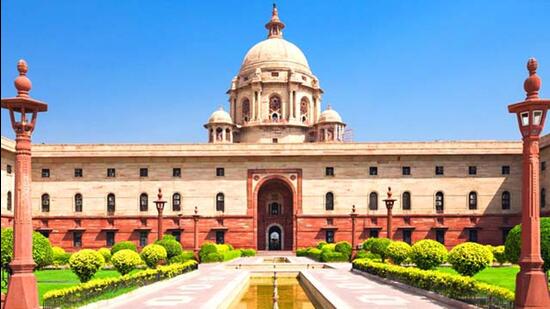
“Rashtrapati Bhavan... is a symbol of the nation and an invaluable heritage of the people. Continuous efforts are being made to make it more accessible to people. There has been a consistent endeavour to make the ambience of the Rashtrapati Bhavan reflective of the Indian cultural values and ethos,” the communique said.
It added the term Durbar referred to courts and assemblies of Indian rulers and the British. “It lost relevance after India became a Republic, that is, ‘Ganatantra’. The concept of ‘Ganatantra’ is deeply rooted in Indian society since ancient times, making ‘Ganatantra Mandap’ an apt name for the venue,” the communiqué said. It added the Ashok Hall, originally a ballroom, will now be known as the Ashok Mandap to do away with “traces of anglicisation”
“The word ‘Ashok’ connotes someone who is ‘free from all sufferings’ or is ‘bereft of any sorrow’. Also, ‘Ashoka’ refers to Emperor Ashok, a symbol of unity and peaceful co-existence. The National Emblem of the Republic of India is the lion capital of Ashok from Sarnath. The word also refers to the Ashok tree which has deep significance in Indian religious traditions as well as arts and culture. Renaming ‘Ashok Hall’ as ‘Ashok Mandap’ brings uniformity in language and removes the traces of anglicisation while upholding the key values associated with the word ‘Ashok’,” the communique said.
The Durbar Hall under the central dome of the erstwhile Vice Regal Lodge was initially known as the Throne Room. It was the venue for the swearing-in ceremony of C Rajagopalachari as the Governor-General of India in 1948. The hall is used for civil and defence investiture ceremonies. Before 2014, swearing-in ceremonies of the new governments were held there. The oath-taking ceremonies have since taken place in the forecourt of the Rashtrapati Bhavan.
Heads of foreign missions present their credentials at the Ashok Hall. It is also a formal place of introductions for the visiting and Indian delegations before the commencement of the State Banquets. Its ceiling has a leather painting of Fath Ali Shah, the second of seven Qajar rulers of Persia, hunting a tiger in the presence of his 22 sons.
In 2023, the world-renowned Mughal Gardens at the Rashtrapati Bhavan were renamed as Amrit Udyan.


