E-Paper



Record 52,537 MW energy generation capacity added in FY 2025-26, 75% from renewable energy: Centre
In 2025-26, of the 52,537 MW added, 39,657 MW was added from renewable energy sources (75.48%), which includes 34,955 MW of solar and 4,613 MW of wind, the ministry said.

 Prefer HTon Google


A record 52,537 MW of energy generation capacity (from all sources) has been added in the current financial year 2025–26 (up to January 2026), the Union power ministry said in a statement on Sunday. Of the total installed capacity, non-fossil fuel-based capacity is now 52.25%, according to the data.
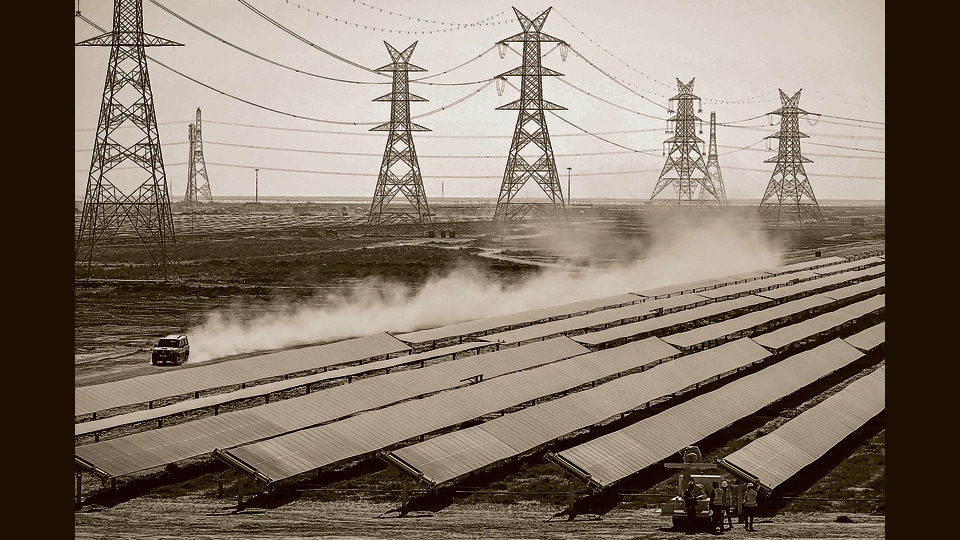
In 2025-26, of the 52,537 MW added, 39,657 MW was added from renewable energy sources (75.48%), which includes 34,955 MW of solar and 4,613 MW of wind, the ministry said.
“This marks the highest ever capacity addition in a single year, surpassing the previous record of 34,054 MW achieved during FY 2024–25,” the statement said.
As on January 31, 2026, India’s total installed power generation capacity stands at 520,510.95 MW, comprising 248,541.62 MW of fossil fuel based capacity; 271,969.33 MW of non-fossil based capacity; 8,780 MW of nuclear and 263,189.33 MW from renewable energy sources.
“RE with solar in particular is the main component of addition in 2025-26. Almost 80% is from RE sources. This is significant given our clean energy commitments and energy transition,” an official said. Further, during 2025-26 (up to January 31, 2026), there was an addition of more than 11% to the total installed capacity of the country.
HT reported in July last year that India has surpassed its target of installing 50% of its power capacity from non-fossil fuel sources, achieving one of its key nationally determined contributions (NDCs) under the Paris Agreement five years ahead of schedule, the union cabinet said.
India’s updated NDCs under the Paris Agreement, submitted in August 2022, said that the country aims to reduce the emissions intensity of its gross domestic product (GDP) by 45% by 2030 from 2005 levels; increase the share of non-fossil fuel-based energy resources to 50% of its installed power generation capacity by 2030; and create an additional carbon sink of 2.5 to 3 billion tonnes of CO2 equivalent through additional forest and tree cover by 2030.
India is expected to submit its updated NDC for the 2035 period. The deadline to submit the 2035 NDC was last year. But India’s NDC is awaited due to certain procedural issues. India stands committed to combat climate change and has taken several measures to meet India’s NDC submitted to the United Nations Framework Convention on Climate Change (UNFCCC) under the Paris Agreement in 2015 which was updated in 2022, union environment ministry informed Rajya Sabha on January 29 in a written response.
“The NDC, including that for 2031-35, is finalized after extensive stakeholder consultation, the outcome of which is declared after the completion of the process and upon approval of the Competent Authority,” said Kirti Vardhan Singh, union minister of state for environment.
Sources have said India’s NDC is expected soon.
Last September, the Chinese President Xi Jinping announced that China, world’s largest polluter in terms of CO2 emissions, will cut economy-wide net greenhouse gas emissions by 7 to 10% from peak levels and increase non-fossil fuel energy consumption to over 30% of the total energy consumption by 2025. He also called on countries to adopt low-carbon growth.
China will also expand the installed capacity of wind and solar power to over six times the 2020 levels, striving to bring the total to 3,600 gigawatts. Xi added that the total forest stock volume will surpass 24 billion cubic metres. China’s NDC suggests emissions will peak before 2035, although some assessments show them as having already peaked.