A lower-than-expected inflation in May and higher than expected industrial growth in April has, once again, underlined a Goldilocks economic environment for the Indian economy characterised by steady growth and low inflation. Retail inflation, as measured by the Consumer Price Index (CPI), grew 4.25% in the month of May on the back of lower vegetable and cooking oil prices. This is the lowest inflation print in 25 months. Factory output, as measured by the Index of Industrial Production, meanwhile, rose 4.2% in April, with manufacturing growing 4.9%. The numbers come on the back of a better-than-expected 7.2% growth in GDP in 2022-23, announced last fortnight.
Also read: RBI keeps rate on hold, talks tough on inflation
This healthy mix notwithstanding, the growing uncertainty over the south-western monsoon seems to justify last week’s hawkish commentary by the RBI’s Monetary Policy Committee (MPC).
The latest inflation number is marginally lower than the 4.31% forecast by a Bloomberg poll of economists. May is the third consecutive month when the benchmark inflation rate has been below the 6% threshold which is the upper limit of RBI’s tolerance band under India’s inflation targeting framework. With values of 5.7% in March, 4.7% in April and 4.3% in May, the headline inflation number is inching closer to the actual target of 4%, which RBI governor Shaktikanta Das underlined as sacrosanct after the last MPC meeting. The latest inflation print also makes it highly likely that inflation for the quarter ending June 2023 will end up lower than RBI’s forecast of 4.6%. To be sure, the May inflation value also has an element of a favourable base-effect given the fact that annual inflation was 7% in May 2022.
While a bulk of the moderation in inflation numbers is the result of a cooling down of food inflation, even core-inflation — it measures the non-food non-fuel component of the CPI basket — continues to come down and reached 5.13%, the lowest value since June 2020 according to data from the Centre for Monitoring Indian Economy (CMIE) database. This underlines the fact that there is also a broad-based moderation in price growth in the economy.
{{/usCountry}}While a bulk of the moderation in inflation numbers is the result of a cooling down of food inflation, even core-inflation — it measures the non-food non-fuel component of the CPI basket — continues to come down and reached 5.13%, the lowest value since June 2020 according to data from the Centre for Monitoring Indian Economy (CMIE) database. This underlines the fact that there is also a broad-based moderation in price growth in the economy.
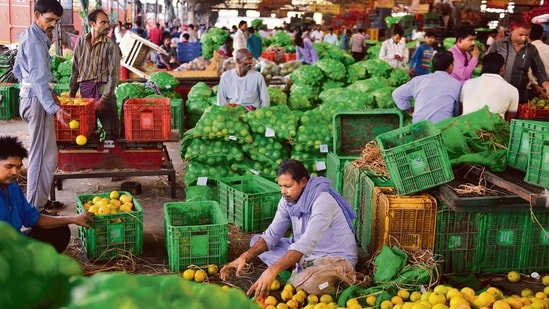
{{/usCountry}}Food inflation, as per data from the National Statistical Office (NSO) press release came down from 3.8% in April 2023 to 2.9% in May 2023. A sharp contraction in prices of edible oil and vegetables — the annual contraction in these two sub-categories is to the tune of 16% and 8.2% respectively in May 2023 — is the biggest reason for a moderation in food inflation. To be sure, cereal and milk inflation continues to remain high at 12% and 8.9%. The fact that the Union government announced stock limits on wheat on June 12 and has decided to release some of its stocks for open market sales suggest that cereal inflation continues to be a matter of concern at the policy level.
“Going forward, the headline inflation trajectory is likely to be shaped by food price dynamics”, MPC had said in its resolution dated June 8. This means that the monsoon’s performance will be crucial for inflation’s future trajectory. Grim forecasts about the monsoon season by private forecasters — a Skymet prediction up to July 6 says that large parts of the country could be extremely dry — are in sharp contrast to the official commentary by the India Meteorological Department, which continues to assert that the monsoon’s progress is by and large normal.
In another set of statistics, industrial growth sprung a big positive surprise with a value of 4.2% in April 2023 against a Bloomberg forecast of just 1.4%. Manufacturing, which has a weight of more than three-fourth in the index grew at 4.9% which compensated for the 1.1% contraction in electricity generation. The latter is likely a result of a cooler than normal April leading to low power demand. While the revival in manufacturing growth is good news, a use-based classification of IIP shows that bulk of the manufacturing growth is on account of tailwinds from capital (6.2%) and infrastructure/construction goods (12.8%) even as durable consumer goods production contracted by 3.5%. The latter underlines the fact that consumer demand continues to be a matter of concern.
Also read: Repo rate, inflation and GDP: What did RBI's Monetary Policy Committee say today
“While base effects are helping bring down the annual print, a flat sequential momentum indicates that price pressures are genuinely easing. High frequency price data indicates that June inflation could come in closer to the RBI’s 4% target. That said, once the base effect wanes (post September), headline CPI inflation could rise back up,” Aayushi Chaudhary, economist at HSBC Research and Pranjul Bhandari, its chief India and Indonesia economist said in a research note.
“True that deficient rains can complicate inflation management. In fact, we find that climate change has altered rain patterns, making food prices volatile. And yet, annual food inflation has fallen over the last few years, led by nimble supply management by the government (see India RBI Watch: Here comes the sun, 5 June 2023). All eyes will be on similar steps in the pre-election year,” they said.