Retail inflation, as measured by the Consumer Price Index (CPI) jumped from 4.87% in June to 7.44% in July, powered by higher prices of vegetables, cereals and pulses, with food inflation at its highest level in 39 months.
The numbers released by the National Statistical Office (NSO) on August 14 show that July saw the highest monthly inflation print in 15 months, since April 2022. What makes the latest inflation number especially shocking – a Bloomberg forecast of economists underestimated it by a full percentage point – is that the 2.57 percentage point jump in the headline inflation print between June and July is the highest monthly jump in the current CPI series.
The latest inflation numbers are bad news for both fiscal and monetary arms of policymaking. The former will be increasingly worried about the squeeze inflation, especially in food prices, is putting on household budgets. More than half of India’s households spend at least half their budget on food. Monetary policy will have to pivot towards a hawkish stance even if it is detrimental to growth. This will be especially bad for households who will have to suffer form a further increase in mortgage payments along with higher prices for groceries. interest rate hikes cannot do much to bring down food prices. With less than a year to go for elections, neither of these are politically very palatable options.
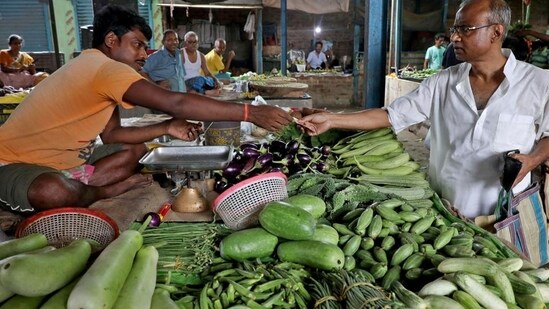
The unprecedented, even shocking spike is hardly a result of just an increase in tomato prices, which have dominated the news cycle in the past few weeks. Tomatoes have seen an annual inflation of 201% in July, but they account for just 9.4% of the CPI vegetable basket and 0.57% in the overall CPI basket. Vegetable prices, as a whole have increased by 37% on an annual basis with 15 out of the 22 vegetables in the CPI basket are showing double digit inflation in July 2023.
{{/usCountry}}The unprecedented, even shocking spike is hardly a result of just an increase in tomato prices, which have dominated the news cycle in the past few weeks. Tomatoes have seen an annual inflation of 201% in July, but they account for just 9.4% of the CPI vegetable basket and 0.57% in the overall CPI basket. Vegetable prices, as a whole have increased by 37% on an annual basis with 15 out of the 22 vegetables in the CPI basket are showing double digit inflation in July 2023.
{{/usCountry}}Inflation in cereals – their share in CPI basket is 9.7% compared to 6% for vegetables – is at 13.04% in July 2023, making it the 12th consecutive month of double-digit inflation in the subcategory. At 12.96%, rice inflation is the highest in the current CPI series. Wheat inflation continues to be double digits for the 14th consecutive month. And inflation in pulses has jumped to 13.3%, the highest since January 2021. Food inflation, as a whole, is 11.5%, the highest since April 2020.
While most experts believe that a moderation in vegetable prices is very likely in the immediate term – onion prices have started rising as tomato prices are coming down and these days one never knows about crop destruction on account of abnormal rainfall – the inflation in cereal and pulses (especially tur or pigeon pea) seems to be more entrenched. Domestic cereal prices are more aligned to global markets than vegetable prices. India’s export ban on non-basmati rice and Russia derailing the Black Sea grain trade deal have generated massive tailwinds for global cereal prices. It is in this context that the food policy arm of the government has been hyperactive with (non-basmati rice) export bans and (tomato) imports from even a small country such as Nepal. If the government moves to procure grains aggressively to distribute among the poor, it could stoke additional fires in the cereal market. But not doing so will run the risk of stocks being inadequate to insulate the poor from high food prices.
Thanks to the wild increase in prices in the food category, favourable movements in non-food categories have become completely irrelevant. Core inflation – it measures the non-food non-fuel component of the CPI – came down to 4.97% in July 2023, the lowest it has been since May 2020. Wholesale Price Index (WPI), contracted for the fourth consecutive month in July, which means that producer prices are actually coming down in the economy. But none of this seems to have mattered as far as the headline inflation print – which is the number that matters for monetary policy – is concerned.
To be sure, the Reserve Bank of India did see this coming. “Going forward, the headline inflation trajectory is likely to be shaped by food price dynamics,” the Monetary Policy Committee (MPC) of RBI had noted in its resolution dated June 8. And the latest MPC resolution suggests that if things do not improve, it might take a more hawkish path.
“We do look through idiosyncratic shocks, but if such idiosyncrasies show signs of persistence, we have to act,” RBI governor Shaktikanta Das said in his statement after the conclusion of the MPC meeting on August 10. The governor’s statement needs to be seen in the wider perspective of climate crisis driven shocks to food production becoming the norm rather than exception. This suggests that India’s battle against inflation increasingly runs the risk of being an exercise in demand-supply management to climate inflicted supply shock management. This is exactly the lesson July inflation numbers teach us beyond their immediate relevance.
Experts said RBI is likely to maintain its mildly hawkish stance.
“CPI inflation surged in July, driven by steep increases in vegetable prices. Non-perishable food prices increased too, while fuel and core inflation moderated. RBI is likely to look through the transitory food price shock, but will likely maintain its mildly hawkish stance,” said Rahul Bajoria, MD and head of EM Asia (ex-China) Economics at Barclays.