Rashtriya Swayamsevak Sangh (RSS) chief Mohan Bhagwat on Friday expressed concern over India’s growing population, calling it a “predicament” that could give rise to “many problems in the near future” and renewed his demand for a national population policy.
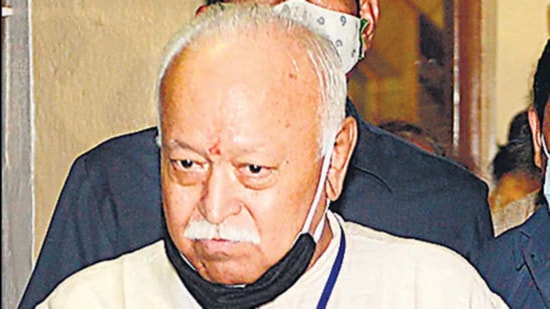
Delivering his annual Vijaydashami speech in Nagpur, Bhagwat said, based on the “demographic changes and imbalance” that is being noticed worldwide, there is a need for a policy “applicable to all”.
“There should be a population policy. There has been some discussion on the issue before. Based on the view of experts, the government agreed to a 2.1 children per family formula. But we feel there is a need to revisit the issue,” Bhagwat said.
He said the country will need a policy that will take into account the next 50 years and strike a balance – even assessing how many people will be needed to feed the aging population after 30 years.
Bhagwat referred to a resolution passed by the Sangh in 2015 demanding a population policy; and said it was in line with a resolution on population control passed in Cairo in 2005 when Manmohan Singh was the Prime Minister.
This is not the first time that the Sangh chief has voiced the demand for a law to check population. In 2018, he underscored the need for a common law to ensure “demographic balance”, pivoted on the principle of a uniform policy that would be applicable to all and implemented without exception. The Sangh’s repeated mention of a population policy, while mentioning the perils of a large population, is also built around the belief that the Hindu population of the country isn’t growing as fast as the Muslim or Christian population, one reason why Bhagwat’s older comments on this, as well as those from his speech on Friday, emphasise terms such as demographic imbalance and universal applicability of any policy.
{{/usCountry}}This is not the first time that the Sangh chief has voiced the demand for a law to check population. In 2018, he underscored the need for a common law to ensure “demographic balance”, pivoted on the principle of a uniform policy that would be applicable to all and implemented without exception. The Sangh’s repeated mention of a population policy, while mentioning the perils of a large population, is also built around the belief that the Hindu population of the country isn’t growing as fast as the Muslim or Christian population, one reason why Bhagwat’s older comments on this, as well as those from his speech on Friday, emphasise terms such as demographic imbalance and universal applicability of any policy.
{{/usCountry}}Such a policy, the Sangh says, will serve the multiple purposes of checking illegal infiltration, conversions through coercion and ensure an equal right to natural resources.
A 2019 report by the UN Department of Economic and Social Affairs said that India would add around 273 million people to its population between 2020 and 2050, around 13.7% of the increase in the world’s population in the same period. The report put India’s population in 2050 at 1.64 billion. India’s population is expected to exceed China’s by 2027.
India will retain a demographic advantage till the middle of the century with the median age of its population increasing to 38 from 29; by then, China’s median age is expected to be 55-56 and the US’s 44-45.
In 2004, at the Akhil Bhartiya Karyakarini Mandal or the executive board meeting, the Sangh referred to Census 2011 to buttress its claims of changes in numbers of Hindus and other communities.
According to census data, the population growth rate in the decade 2001-2011 was lower than in the 1991-2001 decade. The overall 17.7% growth rate in 2001-2011 was 0.82 times of the 21.5% growth rate in the 1991-2001 decade.
While growth rates of all major religions also decreased, they did not decrease in the same degree. The Hindu population grew by 0.87 times as it had the previous decade, while in the case of the Muslim population, the growth was slightly slower: 0.84 times of the previous decade.
In case of Christians and Sikhs, the dip was larger. The Christian population grew at 0.69 times the previous decade and the Sikhs’, the increase was nearly half.
To be sure, these figures are dependent on 1991 projections for Jammu and Kashmir, where the census was not conducted in 1991 due to unrest
In 2015, a year after the BJP-led NDA government came to power at the Centre with a clear majority, the Sangh at its Akhil Bharatiya Karyakari Mandal held in Ranchi, passed a resolution demanding that the government should “reformulate the national population policy keeping in view the availability of resources in the country, future needs and the problem of demographic imbalance” and that this policy should be “applied uniformly.”
It was this resolution that Bhagwat read from in his speech.
Following the Sangh’s concerted campaign for a population policy, at least three BJP-ruled states -- Uttar Pradesh, Uttarakhand and Assam -- recently announced their intent to introduce the population control policy.
SS Jodhka, professor of sociology at the Jawaharlal Nehru University however, said the anxiety about changing demography is a mechanism that the Sangh uses to push its ideology.
“Changes in demography have been one of the foundational anxieties of the Sangh. It is a political strategy to mobilise anxiety among the Hindus that they are a persecuted majority. There is no data-based evidence to suggest that Muslims are outnumbering the Hindus. The birth rate of Hindus in the lower socio-economic demographics has been nearly equal to the Muslims in the comparable stratum...” Jodhka said.
BJP’s Rajya Sabha MP, Rakesh Sinha said Bhagwat’s demand was an “expression of the collective sentiments of 130 crore Indians who face the challenges imposed by the growing population on a day-to-day basis”.