The Supreme Court on Monday made it clear that its monitoring of the investigation into alleged embezzlement of donations received at the Ram temple in Ayodhya has nothing to do with the Ramjanmabhoomi-Babri land dispute, while allowing petitioners and other bona fide public-spirited persons to suggest ways to make the special investigation team (SIT) probing the alleged misapplication of trust funds more “accountable, transparent and effective”.
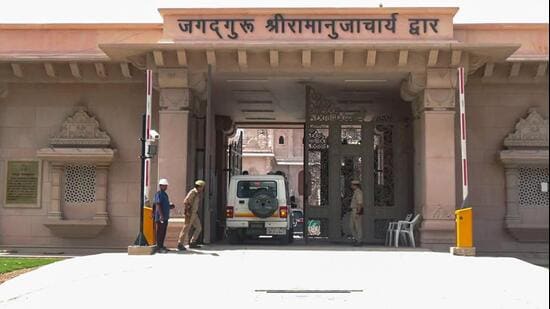
A bench of Chief Justice of India Surya Kant and justices Joymalya Bagchi and V Mohana said the SIT, constituted by the court to investigate the allegations, was answerable and accountable to it and would submit its status report directly to the Supreme Court.
The bench also made it clear that suggestions to improve the quality of the investigation could be considered, even as it refused to entertain a plea seeking to link the ongoing investigation to the original Ramjanmabhoomi title dispute.
Senior counsel Sushil Jain, appearing for the Nirmohi Akhara, one of the original plaintiffs in the Ramjanmabhoomi title dispute, told the bench that the Akhara had filed an application in the matter as it had a direct stake in the original case.
Solicitor General Tushar Mehta, however, pointed out that the application had nothing to do with the Ayodhya land dispute. SG, appearing for the Centre as well as the Uttar Pradesh government, was assisted by the state’s senior additional advocate general Sharan Dev Singh Thakur.
{{/usCountry}}Solicitor General Tushar Mehta, however, pointed out that the application had nothing to do with the Ayodhya land dispute. SG, appearing for the Centre as well as the Uttar Pradesh government, was assisted by the state’s senior additional advocate general Sharan Dev Singh Thakur.
{{/usCountry}}The bench told the parties that if they had suggestions for improving the functioning of the institution or the investigation, they could place them before the court. “If you have any suggestion for the betterment of the institution, give that to the learned SG,” said the bench.
It added that suggestions aimed at making the SIT “more accountable, transparent and effective” could be considered, and that, if necessary, supplementary directions would be issued. “If the SIT is doing the job satisfactorily, but if some qualitative improvement is required, we are open to issuing further directives,” it added.
When senior advocate Puneet Jain sought to link the application to the main Ramjanmabhoomi case on the ground that the direction for creation of the temple trust had originated from the same proceedings, the bench rejected the submission.
“How can you file an IA (interlocutory application) in the other case? That has already been disposed of,” asked the bench, making it clear that its monitoring was confined to the investigation.
“We are monitoring investigation by the SIT to ensure that it is done in an independent and dispassionate manner. It has nothing to do with the main case,” it emphasised.
The court said the issue was being examined “only for the purpose of investigation” and declined to entertain anything beyond that in the disposed title suit. It said parties were free to pursue a review or any other appropriate remedy separately.
The bench, however, allowed the array of petitioners and other bona fide public-spirited persons to submit suggestions on aspects that required thorough investigation.
The court’s order recorded that an SIT had been constituted by its July 27 order to investigate allegations of misapplication of Trust funds, with a forensic auditor also included in the team.
The SIT, comprising the officers specified in the earlier order along with the forensic auditor, is currently investigating the financial affairs of the Trust.
The bench directed that the SIT’s status report, which has already been prepared, be filed in the Supreme Court registry in a sealed cover for its perusal. Since the investigation is still underway, the bench posted the matter for further consideration after three weeks.
The development follows the Supreme Court’s July 20 intervention, when it cautioned against politicising the probe and sought to ensure that the investigation was conducted in a fair, impartial and dispassionate manner.
The court had then asked the Uttar Pradesh government to consider placing the criminal investigation under the supervision of the same three-member SIT that had conducted the preliminary inquiry and found prima facie evidence of alleged financial irregularities. Eight accused were subsequently arrested and nearly ₹80 lakh allegedly diverted from temple donations was recovered, according to the earlier proceedings.
The allegations surfaced in June over the suspected siphoning of donations before they were deposited into the temple trust’s designated bank accounts. Several petitions have since sought an independent or court-monitored investigation and forensic audit of the trust’s finances.
A five-judge bench of the Supreme Court, in its November 2019 judgment in the Ram Janmabhoomi-Babri Masjid title suit, ruled in favour of the Hindu side and acknowledged the historical presence of the Nirmohi Akhara at the disputed site. Invoking Article 142 of the Constitution, the court directed the Centre that while framing a scheme for the temple’s management, “appropriate representation may be given in the Trust or body, to the Nirmohi Akhara in such manner as the Central Government deems fit.”
The Nirmohi Akhara’s latest application sought, among other things, implementation of the 2019 direction that “appropriate representation” be given to the Akhara in the management of the temple. The Akhara has also questioned the manner in which the Trust was constituted and alleged that it had become an unaccountable private body.