The Supreme Court on Friday sought the response of the central government on a petition challenging the constitutional validity of section 152 of the Bharatiya Nyaya Sanhita (BNS) which replaced the offence of sedition punishable under section 124A of the Indian Penal Code (IPC).
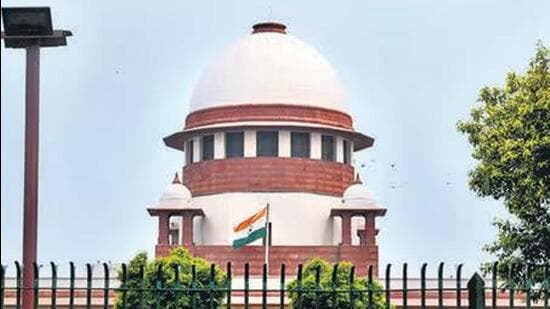
A bench headed by Chief Justice of India (CJI) Bhushan R Gavai and comprising justices K Vinod Chandran and NV Anjaria further directed the petition to be tagged with a pending batch of cases where validity of section 124A is already under challenge.
The petition filed by retired army officer SG Vombatkere described the new provision as a “repackaged” sedition law, which reintroduces section 124A under a new nomenclature.
Appearing for the petitioner, senior advocate PB Suresh along with advocate S Prasanna pointed out that though the language of the new provision has been altered a bit, its substantive content, which seeks to criminalise vague and broad categories of speech and expression, makes the provision arbitrary and discriminatory, and hence unconstitutional.
Incidentally, Vombatkere had challenged the earlier provision of Section 124A as well and it was on his plea among a batch of petitions, the top court in May 2022 directed all proceedings related to sedition to be kept in abeyance.
The petition demonstrated how Section 152 criminalises a wide spectrum of expressive conduct, including those who “purposely or knowingly” use words—spoken, written, electronic, symbolic, or financial—to “excite or attempt to excite” secession, rebellion, or subversive activities. It said that such sweeping language fails the test of constitutional validity for being vague and broad, and that could have a chilling effect on free speech.
It further questioned the undefined terms such as “endangering”, “sovereignty”, “unity”, and “integrity” found in the title of the provision that forms the basis for punishing acts ranging from actual incitement to mere expression of critical or dissenting political opinions.
“The title itself prejudges and colours the conduct described in the provision as one that “endangers” national integrity, without requiring any proof of such actual consequence,” the petition said. Objecting to such legal architecture, the petition said, “The title invites prosecutorial and police discretion, leading to arbitrary and discriminatory application, especially against dissenters, minorities, journalists, and civil society actors.”
The 79-year old petitioner also challenged the provision for endangering sovereignty or integrity by “use of financial means” which is undefined. “This may criminalise legitimate financial contributions, fundraising, or donations, even when unrelated to any unlawful act. The catch-all phrase ‘or otherwise’ renders the scope of the section limitless, in violation of the rule of law,” the petition said.
“Penal laws must meet the constitutional requirement of clarity and foreseeability. The use of such indeterminate terms violates the principle of legality and has a chilling effect on constitutionally protected speech,” Vombatkere said.