
 E-Paper



SC grants interim bail to Arvind Kejriwal in ED case
Legal victory for AAP, boost for political narrative. Continued custody in CBI case.

 Prefer HTon Google


The Supreme Court on Friday granted interim bail to Delhi chief minister Arvind Kejriwal in the Delhi excise policy case investigated by the Enforcement Directorate (ED), acknowledging that he has already spent over 90 days in incarceration and that the issue at hand concerns the fundamental rights to life and liberty of an individual.
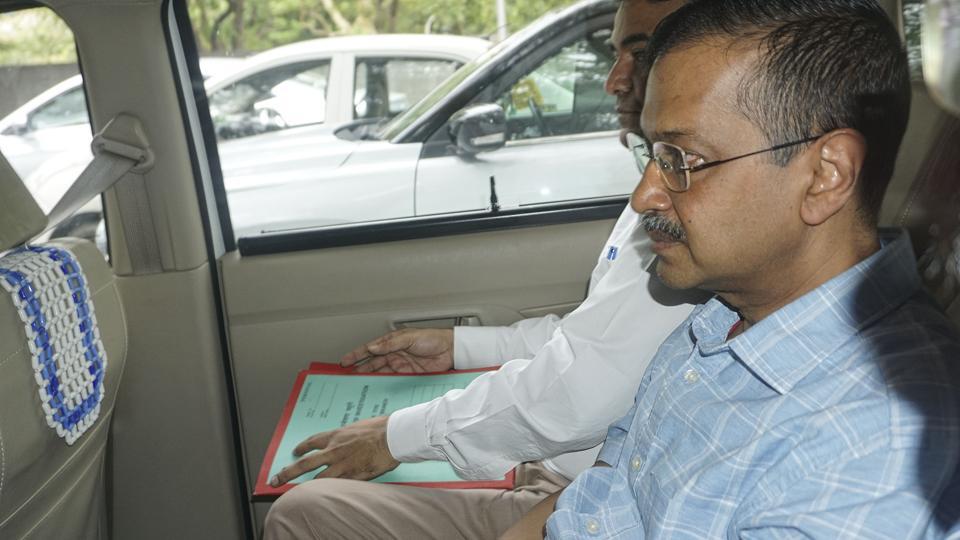
Despite this relief, Kejriwal, who was arrested by ED on March 21 and has been detained ever since except for a 21-day interim bail granted in May to campaign for the Lok Sabha elections, will continue to remain in custody due to his arrest in a separate case being investigated by the Central Bureau of Investigation (CBI) related to the same matter.
A bench of justices Sanjiv Khanna and Dipankar Datta felt the need to grant interim bail Kejriwal as it referred one of the critical issues involved in the case to a larger bench – the legal scope of integrating the necessity to arrest and the doctrine of proportionality into cases under the Prevention of Money Laundering Act (PMLA). The larger bench will determine whether the discretionary power given to ED officers for arrests, under Section 19 of PMLA, should be subjected to a more stringent judicial scrutiny.
Also Read | Kejriwal still a criminal, must resign as CM, demands BJP after interim bail
“Given the fact that right to life and liberty is sacrosanct, and Arvind Kejriwal has suffered incarceration of over 90 days, and that the questions referred to above require in-depth consideration by a larger bench, we direct that Arvind Kejriwal may be released on interim bail,” ordered the court.
The verdict marks a crucial legal victory for Kejriwal and the Aam Aadmi Party (AAP), providing a much-needed boost to the political narrative of the party, which has been mired in controversies and legal battles over the Delhi excise policy case. The order of interim bail is expected to invigorate the AAP’s political campaign, allowing the party to rally around the narrative of judicial vindication, providing the party with an opportunity to highlight perceived overreach by investigative agencies and political witch-hunt.
The AAP termed the Supreme Court order a “victory of truth, and a defeat of the BJP’s (Bharatiya Janata Party) conspiracy”.
While the interim bail is a step forward, it is not the end of Kejriwal’s legal troubles as the AAP chief continues in custody due to a separate case being investigated by CBI in the excise policy matter. When the challenge to his ED arrest was pending before the Supreme Court, Kejriwal was arrested by CBI on June 26 on charges of corruption and criminal conspiracy in the excise policy case. On Friday, a Delhi trial court extended Kejriwal’s judicial custody till July 25 in the CBI case.
Also Read | AAP hails SC’s Kejriwal bail order as ‘victory of truth’
Kejriwal’s interim bail order came with the same set of conditions that were imposed on him at the time of granting bail to him for canvassing in the general elections. The stipulations included refraining from official duties as CM and signing any file unless necessary for obtaining approval of the lieutenant governor of Delhi.
Pertinently, the questions of law referred to a larger bench focussed on the “need and necessity to arrest” under Section 19(1) of PMLA -- which is presently not a formal ground to challenge an ED arrest. The issues being considered include whether the “need and necessity to arrest” can be an additional ground to challenge an arrest by ED, and whether this factor can vary from person to person due to subjective reasons. If the larger bench affirms that the “need and necessity to arrest” can be a separate ground, the court said, it should lay down parameters to guide courts.
The court’s reference stemmed from its concerns over an apparent lack of uniformity in arrests and other coercive actions by ED. Citing statistics available on the ED’s website, the bench pointed out that while 5,906 ECIRs were recorded as on January 31, 2023, searches were conducted only in 531 cases.
“The total number of ECIRs recorded against ex-MPs, MLAs and MLCs was 176. The number of persons arrested was 513. Whereas the number of prosecution complaints filed was 1,142. The data raises a number of questions, including the question whether the DoE (directorate of enforcement) has formulated a policy, when they should arrest a person involved in offences committed under the PML Act,” the court wondered.
According to the bench, the doctrine of “need and necessity” to arrest possibly can provide some guidance in the ED cases, especially because Section 45 of PMLA gives primacy to the opinion of DoE when it comes to grant of bail. “DoE should act uniformly, consistent in conduct, confirming one rule for all,” it asserted.
Kejriwal had contended in his petition that there was no “necessity to arrest” him in March because the materials cited by ED to justify the action against him were in the agency’s possession for long and that he could not be arrested for the purposes of further investigation because PMLA required the arresting officer to record “reasons to believe” that the accused is guilty of the alleged offences.
The judgment, authored by justice Khanna, refrained from issuing any direction regarding Kejriwal’s position as the CM, leaving it to his discretion to decide whether to continue in office.
“We are conscious that Arvind Kejriwal is an elected leader and the Chief Minister of, Delhi, a post holding importance and influence. We have also referred to the allegations. While we do not give any direction, since we are doubtful whether the court can direct an elected leader to step down or not function as the Chief Minister or as a Minister, we leave it to Arvind Kejriwal to take a call,” stated the 64-page judgment.
The court underlined that it could not conduct a “merits review” of the factual assertions in the case when ED has complied with the procedural formality of recording the “reasons to believe” that Kejriwal is guilty of the alleged offences at the time of making arrest. Given the limited power of judicial review, the bench said, it cannot set aside and quash the “reasons to believe” at this juncture but Kejriwal can raise all factual arguments at the time of arguing his bail to discredit the agency’s case.
The top court had on May 17 reserved its judgment on Kejriwal’s petition that sought invalidation of his arrest by ED on March 21 in connection with a money laundering probe pertaining to alleged irregularities in the now-cancelled Delhi excise policy 2021-22.
The bench, during the previous hearings, delved into the sufficiency of evidence in Kejriwal’s case, besides raising key questions about the fairness of the investigative process and the weight accorded to exculpatory materials that the CM claimed the agency purposely hid from the court to target him.
.



