NEW DELHI: The Pahalgam terror attack was strongly condemned by the Shanghai Cooperation Organisation (SCO) on Monday, with the bloc endorsing India’s position that the perpetrators of the assault must be brought to justice and that double standards are unacceptable in the fight against terrorism.
SCO also said the members opposed “unilateral coercive measures, including those of an economic nature” that go against accepted UN and WTO norms, an apparent reference to US trade tariffs that have roiled global trade.
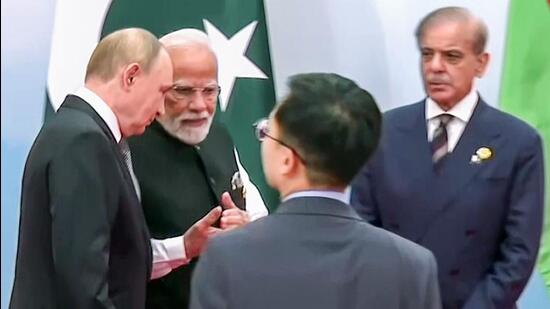
The 10-member bloc listed its commitment to fight terrorism and extremism and urged the world community to combat the cross-border movement of terrorists in the Tianjin Declaration adopted at the conclusion of a two-day summit attended by Prime Minister Narendra Modi, Chinese President Xi Jinping, Russia’s President Vladimir Putin and Pakistani Prime Minister Shehbaz Sharif.
However, the SCO sought to strike a balance by also condemning two terror attacks in Pakistan’s Balochistan province this year, including one on the Jaffer Express train in March, with the joint declaration saying sovereign states and their authorities should take the “leading role” in countering terrorist threats.
“[The SCO member states] expressed their deepest sympathy and condolences to the families of the dead and the wounded. They further stated that perpetrators, organisers and sponsors of such attacks must be brought to justice,” the joint declaration said.
{{/usCountry}}“[The SCO member states] expressed their deepest sympathy and condolences to the families of the dead and the wounded. They further stated that perpetrators, organisers and sponsors of such attacks must be brought to justice,” the joint declaration said.
{{/usCountry}}Ahead of the summit, the Indian side pushed for strong condemnation of the Pahalgam attack, carried out by a proxy of Pakistan-based Lashkar-e-Taiba, and the issue of terrorism figured in a bilateral meeting between Modi and Xi on Sunday. India conducted military strikes on terrorist infrastructure in Pakistan in May in retaliation for the Pahalgam attack, triggering four days of hostilities between the two sides.
The SCO member states opposed the use of terrorist and separatist groups for “mercenary purposes” in the joint declaration and reaffirmed their commitment to the fight terrorism, separatism and extremism. While condemning all forms of terrorism, the declaration stressed that “double standards in the fight against terrorism are unacceptable”.
While addressing the SCO Summit on Monday, Modi, without directly referring to Pakistan, questioned both the support of terrorism by “some countries” and the double standards in combating terror.
The SCO member states listed other measures to counter traditional and new security threats, including drug trafficking, arms smuggling and transnational organised crime, such as the Agreement on the Universal Centre for Countering Challenges and Threats to the Security of SCO Member States.
The joint declaration expressed concern at the continuing escalation of the Palestinian-Israeli conflict and condemned Israel’s military strikes on Gaza, saying this has led to “numerous casualties among the civilian population and a catastrophic humanitarian situation”. The SCO states called for an immediate ceasefire, access to humanitarian aid, and intensified efforts to achieve peace and security for all residents of the region.
The “only possible way to ensure peace and stability in the Middle East is through a comprehensive and just settlement of the Palestinian question”, the declaration said.
The SCO member states also strongly condemned military strikes by Israel and the US against Iran in June, with the declaration saying such “aggressive actions against civilian targets, including nuclear energy infrastructure,” violated international law and the UN Charter, and were an infringement on Iran’s sovereignty. These actions also undermined regional and international security and had implications for global stability, the declaration said.
In June, India disassociated itself from a SCO statement that condemned Israel’s actions, indicating the extent to which the US-India relationship has changed since. Back in June, the two countries hoped to sign a trade deal, but US President Donald Trump abruptly announced a 25% tariff on Indian merchandise exports to the US on July 31, and followed up in August with a 25% penal tariff citing that this was on account of India buying Russian oil.
India , however, didn’t join the other members of the bloc in endorsing China’s Belt and Road Initiative (BRI) in the joint declaration, a position in keeping with New Delhi’s long-standing opposition to the China-Pakistan Economic Corridor (CPEC), a crucial segment of Beijing’s flagship connectivity project. India has opposed CPEC as a key part of it passes through Pakistan-occupied Kashmir.
The joint declaration also called for reform of international governance mechanisms such as the UN and global financial institutions such as the IMF and World Bank. The UN should adapt to modern political and economic realities through a balanced reform to ensure representation of developing countries, the declaration said.
The SCO member states also backed the reform of the global economic governance architecture to uphold an open, inclusive, non-discriminatory and multilateral trading system that promotes an open global economy and ensures fair market access.