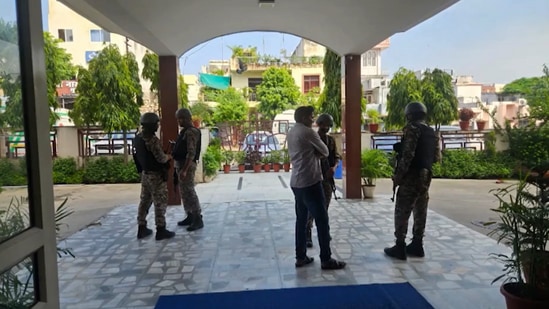
Several hospitals in Jaipur on Sunday received bomb threats via email. Among the hospitals that received the bomb threats were CK Birla Hospital and Monilek Hospital. The emails were received at around 7am.
The emails were received at around 7am. (PTI)
{{^htLoading}} {{/htLoading}}
Teams of police officials and bomb disposal squad were dispatched to the hospitals.
"So far, four hospitals have said that they received such (bomb threat) emails. More hospitals are likely to confirm as and when they check emails," Jaipur Police Commissioner Biju George Joseph told PTI.
In the emails, the sender claimed that bombs were kept under hospital beds and in bathrooms and also added that "terrorists ching and cultist" were behind this “massacre”, according to the news agency.
{{^htLoading}} {{/htLoading}}
{{^usCountry}}
The incident comes a day after a bomb threat was received at Ambience Mall in Haryana's Gurugram on Saturday. No suspicious thing was found during the search.
{{/usCountry}}
{{#usCountry}}
The incident comes a day after a bomb threat was received at Ambience Mall in Haryana's Gurugram on Saturday. No suspicious thing was found during the search.
In May, about 250 schools in Delhi and NCR had received similar threats, triggering massive evacuations and searches as panic-stricken parents rushed to pick up their children. PCR vehicles were rushed to schools, and district police, BDS, MAC, Special Cell and Crime Control Room, DDMA, NDRF, Fire CATS and several other agencies were alerted. However, nothing was found during searches by authorities which later declared it a mass hoax.
{{^htLoading}} {{/htLoading}}
The police said the emails were sent using a virtual private network (VPN) that routed and rerouted data via foreign servers. In this case, the user had used a Russian company's mailing service to send the email, the police had said.
In view of the threat to schools in Delhi, the Union home ministry had stressed the need to prepare detailed protocols and standard operating procedures (SOPs) for handling such situations. The ministry also stressed the need to enhance security measures, including the installation of CCTV cameras and regular monitoring of emails in schools.
Follow the latest breaking news, major developments and agenda-setting stories from India and around the world with the newsdesk at Hindustan Times. Operating round the clock, the desk brings together experienced editors, reporters and correspondents to deliver fast, accurate and contextual reporting across subjects that influence public policy, governance, business, society and international affairs. The HT News Desk covers politics, elections, government policies, the economy, business and markets, science and technology, the environment, law and order, infrastructure, education, climate issues and geopolitics, while closely tracking developments across states, institutions and global capitals. The team also leads coverage of major breaking news events, policy announcements, court proceedings, natural disasters, public emergencies and significant international developments. Reports published by the newsdesk are based on information gathered from reporters on the ground, official statements, government agencies, court records, regulatory filings, recognised institutions and other authoritative sources. Stories undergo editorial scrutiny and verification processes to ensure accuracy, fairness and relevance, and are updated as events evolve and additional information becomes available. Whether covering a key political decision in New Delhi, an economic policy shift affecting millions, a landmark court ruling or a major global event, the HT News Desk aims to provide readers with reliable, fact-based journalism that delivers not only the latest developments but also the context and analysis needed to understand their wider implications.
Get the latest India News, breaking headlines and real-time updates from across the country. Stay informed about politics, government policies, crime, weather and major national developments.
Get the latest India News, breaking headlines and real-time updates from across the country. Stay informed about politics, government policies, crime, weather and major national developments.
Home/India News/Several Jaipur hospitals receive bomb threats on email
{{^htLoading}}
Advertisement
{{/htLoading}}
SHARE THIS ARTICLE ON
{{#usCountry}}{{/usCountry}}
Hindustantimes wants to start sending you push notifications. Click allow to subscribe