The Supreme Court has directed that states, Union territories and even individual districts be fined if the quality of Yamuna water deteriorates on any parameter while flowing through and exiting their respective jurisdictions, seeking to fix accountability for pollution in the river.
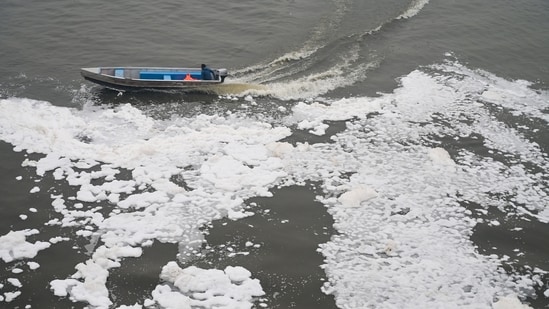
A bench of justices Manoj Misra and Manmohan said that any state, UT or district where deterioration in water quality is detected should be held accountable and penalised, with the compensation or fine deposited in the Supreme Court registry.
The Central Pollution Control Board (CPCB) has been asked to suggest a formula for calculating the penalty. States and UTs would, however, be free to recover the amount from polluters and officials found remiss in discharging their duties after conducting an inquiry.
The decision could have particularly significant implications for Delhi, where the Yamuna flows through a 22-km stretch between Wazirabad and Okhla -- just 2% of the river’s length -- but contributes the most to its overall pollution load.
In a detailed order released on Monday, the court laid down a framework for monitoring water quality at the entry and exit points of every state, UT and district along the river, with financial penalties for any deterioration. It also prescribed measures to ensure that sewage treatment plants (STPs) and common effluent treatment plants (CETPs) function efficiently, industrial waste is checked at source and untreated wastewater is prevented from entering the river.
{{/usCountry}}In a detailed order released on Monday, the court laid down a framework for monitoring water quality at the entry and exit points of every state, UT and district along the river, with financial penalties for any deterioration. It also prescribed measures to ensure that sewage treatment plants (STPs) and common effluent treatment plants (CETPs) function efficiently, industrial waste is checked at source and untreated wastewater is prevented from entering the river.
{{/usCountry}}Also Read | Pollution in Yamuna increased despite huge expenditure on cleaning: Supreme Court
The bench observed that the Yamuna’s condition reflected the failure of civic administration across towns, cities and villages along its banks.
“Everything that is wrong with civic administration in the towns, cities and villages situated along the banks of the river is reflected in the poor health of the river and in the 520 drains” discharging wastewater into it, the court said. This, it added, explained why pollution had continued to increase despite huge sums being spent on cleaning the river.
The court said industrial pollution and untreated sewage must be curtailed, if not stopped altogether, at source. Where that was not possible, sewage must first be tapped and then treated. It acknowledged, however, the difficulty of laying sewer networks in unauthorised colonies that had developed without proper grid layouts and have little space for such infrastructure.
It also said illegal and unauthorised colonies, JJ clusters along drains and settlements on the riverbed would have to be removed after rehabilitating eligible occupants. Otherwise, sewage from these areas would continue to pollute the river. The bench flagged the problem of illegal and unaccounted-for dairies, particularly in Delhi, noting that proposed biogas plants would not address waste generated by dairies outside the authorised network.
On ecological protection, the court said Zone ‘O’, designated as a green zone under Delhi’s Master Plan 2047, should be protected and, if feasible, extended upstream and downstream from the Yamuna’s source to its confluence with the Ganga. No permanent structures, other than green parks and essential public infrastructure, should be permitted. Recreational and tourism activities should be restricted to semi-permanent facilities such as cycling and walking tracks. Existing structures should be removed in accordance with law, after providing alternative accommodation to those entitled to rehabilitation.
Also Read | Delhi Police arrests BSP worker who posted videos of dead fish in the Yamuna
Shared responsibility
The court called for treating the Yamuna as one continuous ecosystem rather than a collection of state-wise stretches. Invoking the principle of “common, but differentiated responsibilities”, it said all states sharing the river had a common obligation to protect it, while each state’s specific responsibilities should be calibrated according to the pollution it contributed and its capacity to address the problem. A state’s responsibility, it said, could not be confined to what happened within its own stretch.
The Yamuna flows through Uttarakhand, Himachal Pradesh, Haryana, Delhi and Uttar Pradesh, making its conservation a shared responsibility.
CPCB has been directed to submit details of chemical composition and water quality parameters — including biochemical oxygen demand (BOD), chemical oxygen demand (COD), faecal coliform and total suspended solids (TSS) — at points where the river and major drains entering it cross state, UT and district boundaries. The court noted that CPCB already monitored the river at entry and exit points quarterly and suggested that samples collected simultaneously be analysed by institutions such as the IITs for independent verification.
The bench also ordered stricter monitoring of treatment infrastructure. Every STP, CETP and government-commissioned biogas plant must install tamper-proof smart energy meters within a month. STPs and CETPs must additionally install inlet and outlet meters with continuous sensors to record wastewater volumes and parameters such as pH, BOD, COD, TSS and ammoniacal nitrogen. Faecal coliform levels must be tested weekly in accredited laboratories.
All readings must be uploaded live, plant-wise, on CPCB and state pollution control board websites, allowing authorities and the public to track the hours of operation, electricity consumed, volume of wastewater treated and quality of discharge.
A break in the data feed exceeding 24 hours, it said, would be presumed to indicate that the plant was not operating, unless its operator could establish otherwise. Biogas plants must additionally record the quantity of waste received and gas produced.
CPCB has been asked to arrange unannounced inspections and sampling of every STP with a capacity of 5 million litres per day (MLD) or more, as well as CETPs, at least once every quarter through IITs, NITs or accredited third-party laboratories. Results must be published within 30 days, and environmental compensation recovered from operators for every day of non-compliance.
Other measures include real-time water quality monitoring stations along the river and major drains in all basin states, with data shared with CPCB through an integrated system. Urban local bodies must register all septage tankers, install GPS tracking systems and develop portals to track septage generated by households, collected and ultimately disposed of.
Also Read | Will Yamuna get its Sabarmati makeover? Delhi plans 52-km riverfront in two phases
The court also mandated unrestricted access for CPCB and its designated agencies to treatment plants, installations and records for surprise inspections and technical assessments. Police commissioners, district magistrates and superintendents of police must assist inspection teams when required. Chief secretaries of the basin states and UTs, and secretaries of the concerned central ministries, must nominate senior officers, not below the rank of special secretary, as nodal officers within two weeks.
The officer in charge of every treatment plant and major drain must be identified on a public portal and submit a monthly compliance affidavit before the court.
The directions follow the court’s examination of a comprehensive Yamuna Action Plan prepared by a committee headed by the Union home secretary. The plan envisages 125 new STPs with a combined capacity of 4,401.30 MLD, upgrades to 20 existing STPs, 12 new CETPs in Haryana, 10 municipal solid waste processing plants and 23 biogas plants. It also proposes intercepting and treating 520 drains that currently discharge around 9,666.81 MLD of wastewater into the Yamuna and its tributaries.
While describing the plan as a significant step forward, the bench cautioned that constructing more treatment plants alone would not revive the river. It flagged inconsistencies, including discrepancies over encroachments on water bodies and wetlands in Delhi’s Zone ‘O’, and noted that none of the Capital’s 37 existing STPs met all prescribed standards.
The matter will now be heard on January 13, 2027.