Six of India’s 10 most polluted cities are in Uttar Pradesh, according to Greenpeace India’s fourth Airpocalypse report released on Tuesday.
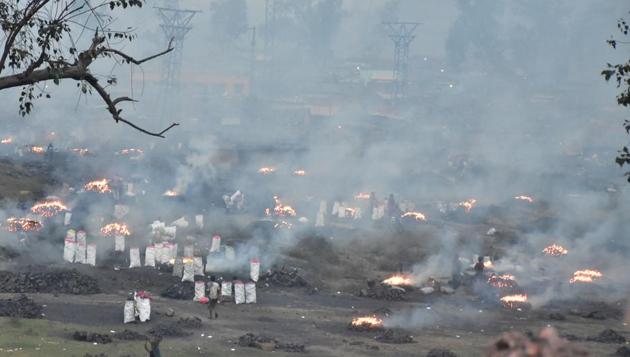
Noida, Ghaziabad, Bareilly, Allahabad, Moradabad and Firozabad in Uttar Pradesh figure in list of 10 most polluted cities topped by Jharia in Jharkhand and closely followed by Dhanbad in the same state.
According to the report based on analysis of particulate matter (PM) data of 287 cities, Delhi was 10th most polluted city in 2018, an improvement by two notches as compared to 2017. Greenpeace has used Central Pollution Control Board data to rank the most polluted cities in India.
Lunglei in Mizoram is the least polluted followed by Meghalaya’s Dawki. Lunglei is also the only Indian city with PM levels under the World Health Organisation’s (WHO) prescribed level of 20/ug/m3 (micrograms per cubic meter), the report said.
Jharia and Dhanbad are twin cities in the coal mining belt of Jharkhand. PM-10 level was recorded at 322 ug/m3 (micrograms per cubic meter) in Jharia, which was the highest in the country. In Dhanbad, PM-10 level was recorded at 264 un/m3 in Dhanbad, which is the second highest in the country.
Jharkhand pollution board officials said vehicular emission, road dust, air pollution from bio-mass burning, air pollution from industry, construction and demolition activities, diesel generator sets and use of coal in dhabas and road side eateries were major drivers for worsening the air quality in Dhanbad and Jharia.
{{/usCountry}}Jharkhand pollution board officials said vehicular emission, road dust, air pollution from bio-mass burning, air pollution from industry, construction and demolition activities, diesel generator sets and use of coal in dhabas and road side eateries were major drivers for worsening the air quality in Dhanbad and Jharia.
{{/usCountry}}“The data of 2018 was analysed in the report and we are in 2020. The measures taken to improve the condition in past one year did not reflect in it. Improvement in the air quality will be visible in the next year’s report, as several steps have been taken,” said AK Rastogi, chairman of Jharkhand State Pollution Control Board (JSPCB).
He said several restrictions were imposed on unscientific coal dumping and coal transportation. “We are also trying to find out source of pollution. National Environment Engineering Research Institute (NEERI), Nagpur, is studying the source of pollution in Jharia and it will submit its report very soon,” Rastogi said, adding, they have also planned to install air quality measurement devices at 101 places of the state including two places in Dhanbad.
In 2019, the central government launched National Clean Air Programme (NCAP), a five-year action plan with a target of reducing concentrations of PM-10 and PM-2.5 up to 30% by 2024 in 102 non-attainment cities, with 2017 as the base year. The Greenpeace report said the air pollution data shows that Indian cities were not progressing well to achieve the NCAP target.
“The permissible limit for PM-10 is 60 ug/m3, according to the National Ambient Air Quality Standards (NAAQS), while it is mere 20 ug/m3, as per the World Health Organization (WHO),” said Avinash Chanchal, senior campaigner of Greenpeace India. “WHO says PM-10 starts impacting health after it exceeds 20 ug/m3 limit.”