
 E-Paper



Stakeholders push to lift curbs, open schools in Delhi
There have been growing demands in recent days from the city’s elected government, the business community, and parents of schoolchildren for the DDMA to ease Covid-19 related restrictions.

 Prefer HTon Google


The Delhi government’s health department has recommended that businesses activities in the national capital should be allowed to resume without restrictions,and private schools have urged the authorities to bring children back to the classroom as the clamour to start unlocking the Capital gained momentum amid a fall in Covid-19 cases and consistently low hospitalisation rates.
A decision, however, is likely only after three more days, when the Delhi Disaster Management Authority (DDMA) meets on January 27 to discuss changes to restrictions.
There have been growing demands in recent days from the city’s elected government, the business community, and parents of schoolchildren for the DDMA to ease Covid-19 related restrictions, which several medical experts regard as unnecessarily stifling at a time when the outbreak is under control.
“Covid cases have been on a decline over the last week. On January 20, there was a minor spike but we had more tests that day and the positivity rate was lower, which was another indication of receding cases. Our assessment is that we can remove restrictions in a phased manner, and we have communicated that to the DDMA,” a health department official said on Monday, asking not to be named.
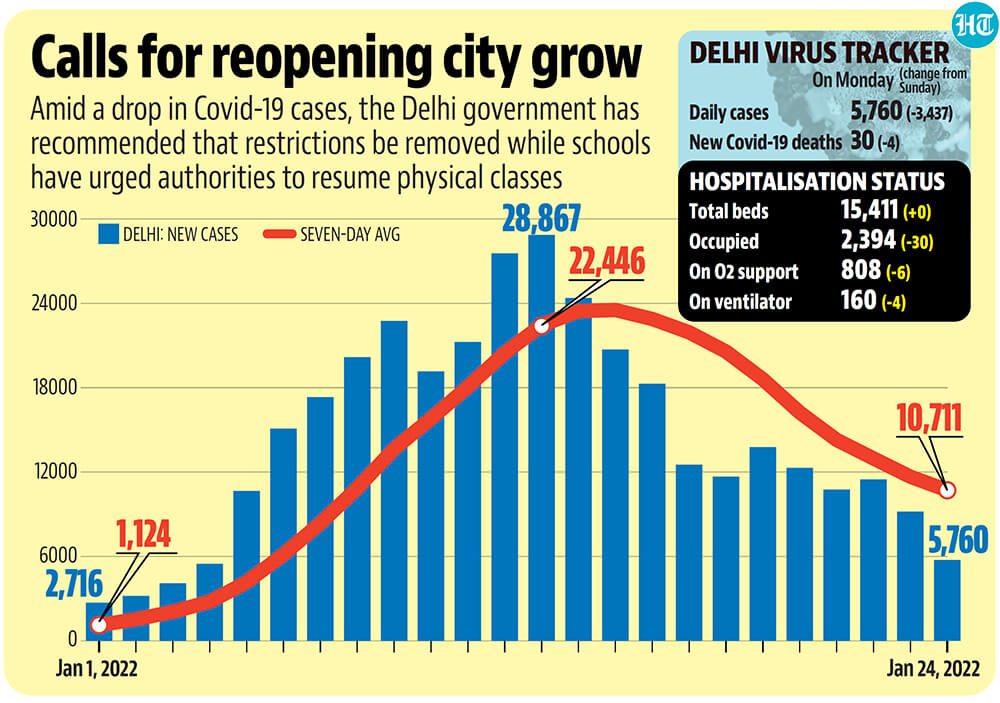
Numbers released on Monday further reinforced the assessment. The city recorded 5,760 new infections from 11.79% of all tests conducted the day before, the lowest rate at which the tally grew in 20days. The number of people in hospitals with Covid-19 too shrunk significantly to 2,394, the lowest since January 16.
DDMA, headed by lieutenant governor Anil Baijal, has called a meeting for 12.30pm on January 27 to discuss the Covid-related public health measures in the city. Last week, the agency rejected a request from the Delhi government to lift the weekend curfew and allow all shops to open instead of the odd-even rule at present, although it accepted the proposal to let private offices call back 50% of staff to their locations.
“The larger opinion of the government is that we can ease restrictions so that the economy is not burdened. There are people whose livelihoods are being impacted by these prolonged restrictions, which were needed during the peak Covid period, but since that phase has passed we should not burden them,” a second health department official said, asking not to be named.
Over the last week, the Aam Aadmi Party-led Delhi government, the opposition Bharatiya Janata Party (BJP), and a variety of trade groups made repeated appeals to Baijal to rethink continuing restrictions such as the weekend curfew, the night curfew and a rule to allow only alternate shops in marketplaces to open in light of the infection trends. Since hitting a peak on January 13, the number of new cases in the city has only shrunk.
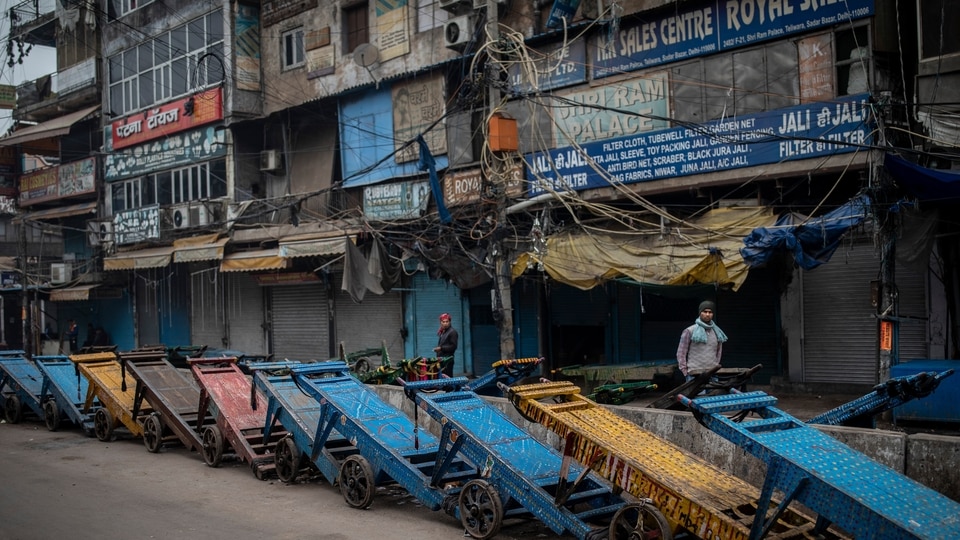
Trader groups told HT that a survey of business across the city showed that 86% of them reported their business to have shrunk to 40% of what they routinely earn as they stay shut or work in limited hours, while markets and malls in neighbouring regions are open for regular operations.
They reiterated their appeal on Monday with a stronger warning of unavoidable jobs cuts due to the strain of fixed costs like rent while their earning days are significantly limited. “Due to this financial crunch, the traders are left with no other option (but) to cut down expenses, terminate employees to sustain their business, which in fact would lead to a huge unemployment situation in Delhi,” said a letter signed by the New Delhi Traders Association president Atul Bhargava, sent to Baijal.
Brijesh Goyal, chairman of the Chamber of Trader and Industry, an association of traders, said a group of traders protested in Rohini on Monday against the DDMA’s Friday decision not to lift the curbs.
Similar appeals have also come from schools and parents of school-going children.
“We are vaccinating students in eligible categories but the government should reopen schools for students in all classes. Complete reopening is the need of the hour,” said Bharat Arora, general secretary, Action Committee of Unaided Private Schools.
The government had urged schools to ensure 100% vaccination of eligible children so that a stronger case could be made to the DDMA to allow classes to resume.
Between the first lockdown, the four past Covid waves in Delhi and the period of air quality crisis, children in Delhi have spent some of the longest time out of school over the last two years in the country. Experts have warned not only will the learning loss from these be severe, particularly among those that cannot afford digital devices to learn from home, but children will have missed days of social interactions that are critical for their early age development even though their infection risk is starkly low.
Dr Jugal Kishore, head of the department of community medicine at Delhi’s Safdarjung hospital, said that the closure of schools over the past two years had derailed the overall growth of children and it was necessary for the government to reopen schools for all children. “Children have been heavily affected in the past two years. Children in the younger age group are particularly vulnerable and need to be in classrooms for the development of interpersonal relationships. The government should reopen schools without any ifs and buts. It should educate parents that children are least affected by Omicron or Covid,” said Kishore.
“My children wait for turns to use the one mobile phone that we have. Despite the financial constraints caused by the pandemic, we are taking all efforts to educate our children. If other states can reopen schools, the same can be done in Delhi,” said Dharam Pal, who works with a transport company.
Monday marked the first day that schools in several parts of Maharashtra opened. The state, particularly its capital Mumbai, was among the earliest to be hit by the Omicron variant along with Delhi.
Students in most cities can now go back to in-person classes after the outbreak there appeared to be under control.
The third nationwide outbreak of Covid-19 began in late December and has since swept across much of the country. But in keeping with other regions of the world where the Omicron variant has spread, there was a significant decoupling in the rate of hospital admissions and deaths from new infections. Even when cases reached sharp, high peaks – deaths and hospital admissions have remained a low – a trend reflected in Delhi’s numbers as well.
For instance, even when the number of new cases reached close to an all-time high of over 28,000, the hospital bed occupancy rate remained under 20% throughout the month.
Dr Suneela Garg, professor and member of the Lancet Commission Covid India Task Force, said that life and livelihood will have to go hand in hand now. “Life and livelihood has to be in the forefront but Covid appropriate behaviour needs to be strictly followed. For the last four days, Delhi is recording a steady decline in infections and from around 28% positivity rate during the peak period we have come down to around 11% very quickly. If the situation remains similar for the next two-three days, we can surely ease restrictions in a phased manner,” said Dr Garg.


