E-Paper



Supreme Court’s stay on Aravallis order hailed across party lines
Union minister Yadav pledged assistance for protection, while the Opposition called for his resignation, arguing the ruling undermined his previous stance.

 Prefer HTon Google


Leaders across political lines and environmentalists on Monday welcomed the Supreme Court’s stay on its November 20 judgment that narrowed the definition of the Aravalli range, with Union environment minister Bhupender Yadav promising all assistance in the protection and restoration of the Aravallis.
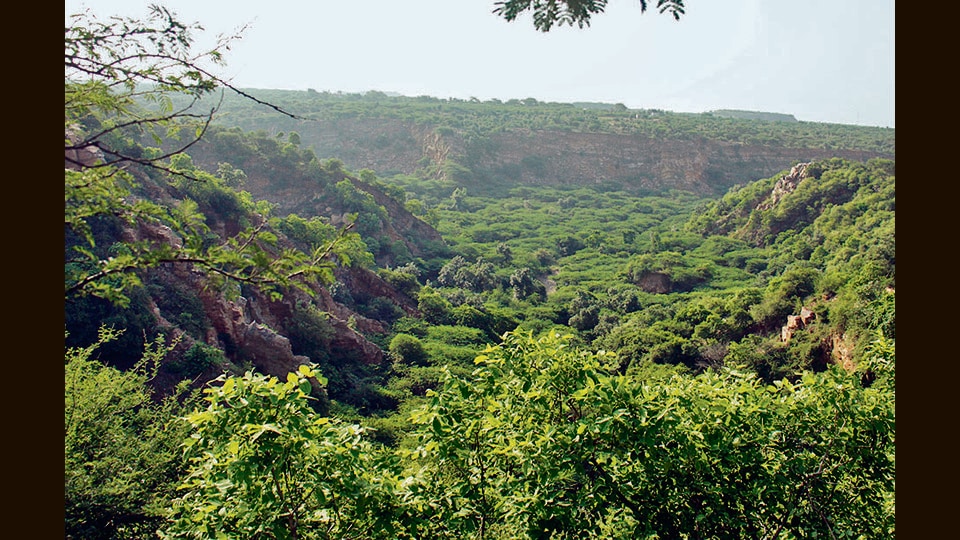
The Opposition, too, hailed the verdict but called for Yadav’s resignation, saying the order was a “rejection of all the arguments he has been giving in favour of the redefinition”.
The top court on Monday “put in abeyance” its November 20 ruling to accept an expert committee’s recommendation to define the Aravallis purely on an elevation-based criterion. Under that definition, only landforms rising at least 100 metres above the local relief, measured from the lowest contour encircling the landform to its peak, qualify as the Aravalli hills.
Hearing the matter suo motu, a bench comprising Chief Justice of India Surya Kant and justices JK Maheshwari and AG Masih also proposed the constitution of a high-powered expert committee to assess concerns relating to the height-based definition, ecological continuity, and permissible mining.
“I welcome the Supreme Court directions introducing a stay on its order concerning the Aravalli range, and the formation of a new committee to study issues. We stand committed to extending all assistance sought from MOEFCC in the protection and restoration of the Aravalli range,” Yadav said in a post on X.
“As things stand, a complete ban on mining stays with regards to new mining leases or renewal of old mining leases.” he added.
The Congress lauded the verdict, saying the top court directive gave a “flicker of hope” in the efforts to protect the Aravallis. “The Indian National Congress welcomes the directives given by the Supreme Court on the redefinition of the Aravallis being pushed through by the Modi Government,” Congress general secretary Jairam Ramesh said.
Ramesh said that the issue needed to be studied in detail, noting that the new definition had been “opposed by the Forest Survey of India, the Central Empowered Committee of the Supreme Court, and by the amicus curiae himself”.
“There is now a temporary respite but the struggle to save the Aravallis from the machinations of the Modi Government to open it up to mining, real estate, and other activities will have to be resisted in a sustained manner,” he said. “Today’s Supreme Court directive gives a flicker of hope.”
The former environment minister further demanded Yadav to resign in light of the judgment, saying: “...The Union Minister for Environment, Forests, and Climate Change must resign immediately. It is a rejection of all the arguments he has been giving in favour of the redefinition.”
Shiv Sena (UBT) leader Aaditya Thackeray also hailed the move, noting that the relief, though huge, must be made permanent.
“I hope that we are able to bring the strongest protection to the Aravalli Range and to nature across the country,” he said in a post on X. “It is also important that we don’t fall prey to the misinformation campaign being run to say that Aravalli Range is safe –– it is NOT with the government’s intent to redefine it and sell it off.”
Environmental experts and conservationists had flagged concerns with the new definition, saying that it excluded large tracts of smaller hills, ridges, and undulating terrain from the continuous geological and ecological system of the Aravallis. They argued that it potentially opened them up to mining and development.
The controversy intensified after the Union environment ministry, on December 8, convened a meeting to initiate groundwork for delineating Aravalli areas “as per the definition accepted by the Supreme Court on November 20”. The exercise was intended to serve as the baseline for the Management Plan for Sustainable Mining (MPSM) for the entire Aravalli range through Indian Council of Forestry Research and Education (ICFRE).
The delineation process is expected to be paused until the Supreme Court settles the definition issue.
“Holding in abeyance the November 20 judgement is a welcome step,” said RP Balwan, a former Indian Forest Services officer, who has moved a review petition against the November 20 order.
Balwan said that ecosystem fragmentation based on vertical limits in the highly fragile Aravalli ecosystem would lead to its destruction. “Once biodiversity is finished, no one can revive it due to prevalent harsh environmental factors,” he said.
Highlighting that the Aravallis require no new definition, he said, “It is already well defined in geology as stratigraphic succession. Every Aravalli rock unit is well identified along with its structures.”
Forest analyst Chetan Agarwal, meanwhile, said the focus now shifts towards the constitution and the terms of reference (TOR) of the high-powered expert committee proposed by the Supreme Court. “It is hoped that the new committee looks at the Aravallis as an ecological entity –– a living breathing habitat that provides the little remaining forest cover, a home and habitat for the last vestiges of wildlife, its role in moderating air pollution and enhancing groundwater recharge –– and functions in a transparent manner with wide consultations,” he said.