
Suspected ammonium nitrate traces in car recovered in Faridabad post Delhi blast
A National Security Guard (NSG) bomb disposal team rushed to site and sealed an area within a 50-metre radius of the red Ford EcoSport car
Preliminary inspection of the red Ford EcoSport car owned by Dr Umar Un-Nabi, the prime suspect of the blast near Delhi’s Red Fort on Monday, found outside a house near Faridabad’s Khandawali village, showed suspected traces of ammonium nitrate, people aware of the matter said.
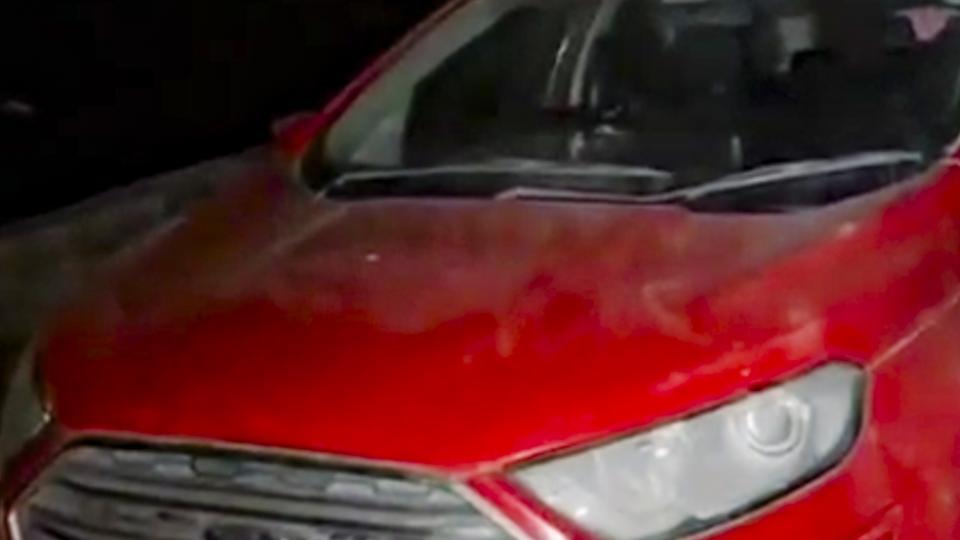
The Delhi-registered car (DL10 CK 0458) was traced on Wednesday after an intelligence input from the Jammu and Kashmir Police, which has been tracing vehicles that the busted terror module linked to the blast allegedly used.
A National Security Guard (NSG) bomb disposal team rushed to Khandawali and sealed an area within a 50-metre radius of the car. The Haryana Police sealed a larger 200-metre perimeter.
Officials said the NSG team scanned the vehicle to ensure it did not contain any hidden explosive materials. “Preliminary inspection indicates that traces of ammonium nitrate may be present in the car. Samples have been collected for laboratory testing,” said a police official. “We suspect that the same explosive compound was transported in different vehicles to multiple locations.”
The Delhi blast followed the recovery of nearly 2,900 kilograms of ammonium nitrate, detonators, timers, and assault rifles.
Faridabad Police spokesperson Yashpal Singh said the vehicle was found parked near the premises of one Farrukh Khan, an autorickshaw and JCB driver. “The car has been seized and handed over to the National Investigation Agency (NIA) for detailed forensic examination,” Singh said.
Khan was detained for questioning. “He is a poor man. His connection with Dr Umar or any terror activity has not yet been established,” a second officer said.
Khandawali residents expressed disbelief over the developments. “Farrukh is a simple man who barely earns enough for his family. It is impossible to believe he had any link with terrorists,” said Mohammad Mubin, a neighbour. Another villager, Shakir Hussain, added, “He does not even own a car. Shockingly, such a vehicle was found outside his house.”
Investigators said the red Ford EcoSport was registered under a fake address in Delhi’s Seelampur area. Nabi is suspected of having used it for reconnaissance and to transport explosive materials before the Red Fort blast.
Officials described the recovery as “a critical breakthrough” in tracking the movements of the accused and uncovering the wider network operating across Haryana, Delhi, and Jammu and Kashmir.
ABOUT THE AUTHORLeena DhankharLeena Dhankhar is Senior Editor and Bureau Chief, Gurugram, at Hindustan Times, where she has spent over 17 years chronicling the transformation of one of India's fastest-growing urban regions. From starting her career as a crime reporter to leading the Gurugram bureau, her journalism has been defined by investigative reporting, in-depth storytelling and an unwavering focus on public interest. Over nearly two decades, she has reported extensively across crime, politics, civic governance, elections, real estate, environment, courts, sports, education and entertainment, covering Gurugram, Faridabad, Nuh and Palwal. Her reporting has exposed several major scams and systemic failures, including insurance frauds, waste management irregularities, illegal arms manufacturing units in Nuh, illegal mining in the Aravallis, organised crime networks and governance lapses affecting millions of residents. Known for her investigative work and exclusive stories, Leena has reported on high-impact national issues, including the Nicaragua charter flight carrying Indian migrants that was turned back amid allegations of human trafficking, exposing the growing network of illegal immigration rackets. Her work has also focused on gang wars, prison administration, juvenile crime, women and child protection systems, the functioning of the Juvenile Justice Board and Child Welfare Committee, and environmental challenges such as pollution, waterlogging and deteriorating civic infrastructure. Beyond hard news, Leena has extensively documented Haryana's rich heritage, forests and wildlife, bringing attention to the state's historical landmarks, biodiversity, conservation efforts and ecological challenges through immersive reportage and feature writing. Her journalism has consistently gone beyond breaking news. She has documented Gurugram's rapid urbanisation through long-form narratives and enterprise reporting on issues ranging from pothole-ridden roads, flooding and waste management to the changing social fabric of India's Millennium City. She also writes widely read feature columns, including The Outsider, Changemaker, and Concern for Gurugram, profiling people, places and ideas shaping the city's identity. Leena is the author of Gurugram School Murder, published by Juggernaut Books, a deeply reported account of one of India's most high-profile school murder investigations. She is currently working on her second book, an investigative work exploring some of India's most significant scams and fraud investigations. Beyond print journalism, she has expanded her storytelling through public speaking and digital media. She is a TEDx speaker and has produced podcasts exploring Gurugram's transformation, civic challenges and untold stories. Her work reflects a commitment to narrative journalism that combines rigorous reporting with compelling storytelling. A law graduate with an MBA in Human Resources, Leena brings a multidisciplinary perspective to her reporting, particularly on governance, public policy and legal affairs. She has travelled extensively across India to pursue investigative assignments, often reporting from remote locations and conflict-prone areas in search of stories that matter.Read More

E-Paper


