The US in the twilight of its power and China needing to reorient its economy away from exports to domestic consumption are the central contradictions facing today’s global economy, economist and Nobel laureate Joseph Stiglitz said at the 24th Hindustan Times Leadership Summit on Saturday.
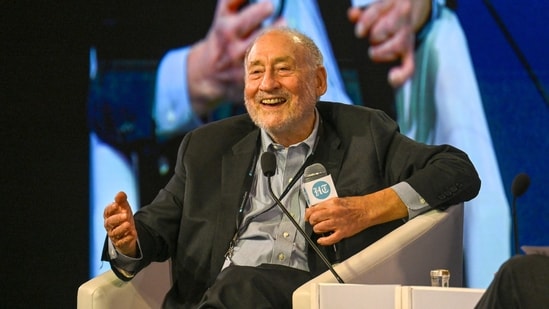
The new world order will be multipolar unlike the unipolar US-dominated world order that existed after the second world war. Adjusting to it will not be easy for all countries. India’s key opportunity and challenge lies in managing its domestic inequality; and if done well, there is no reason the nation cannot sustain high levels of growth, the US economist said.
What the world needs to navigate this phase is the leadership of young, idealistic and pragmatic people. It also needs the rest of the world, especially the so-called middle powers, to stand up together against bully-like behaviour from the US, which is what it has become under President Donald Trump, he added. The former is what seems to have worked for the Democratic Party in the recent mid-term elections in the US, Stiglitz said, while adding that he worries about the rise of right-wing politics among men under 35 even as women continue to support progressive politics in the US.
Deep Dive
How could reducing income inequality help India sustain 7% economic growth?
Why does Stiglitz say India should be concerned about AI’s impact on jobs?
What investments does Stiglitz say India needs to manage economic change?
The biggest change in the global economic order came in the last decade when China overtook US’s GDP in purchasing power parity (PPP) terms, Stiglitz pointed out. But neither of them advertised it in a big way as the US could not accept losing its leadership and China was still interested in exploiting the export route to growth. With China reaching an unprecedented trade surplus of more than a trillion dollars, the global economic balance is untenable now. There is no way the rest of the world can accommodate China’s large trade surplus and the latter needs to reorient its economy towards domestic consumption, and a better quality of life, he added.
{{/usCountry}}The biggest change in the global economic order came in the last decade when China overtook US’s GDP in purchasing power parity (PPP) terms, Stiglitz pointed out. But neither of them advertised it in a big way as the US could not accept losing its leadership and China was still interested in exploiting the export route to growth. With China reaching an unprecedented trade surplus of more than a trillion dollars, the global economic balance is untenable now. There is no way the rest of the world can accommodate China’s large trade surplus and the latter needs to reorient its economy towards domestic consumption, and a better quality of life, he added.
{{/usCountry}}Also Read | AI bubble will break; India should be worried: Economist Joseph E Stiglitz at HT Leadership Summit 2026
China’s economic rise as an export superpower worked well for Americans initially. “It wasn’t (Alan) Greenspan, it was China that kept our prices down. So, we should say thank you to China…But China has grown so much over the last 30 years…Nobody had a sense that it would become a competitor to the United States, the competitor that it has become,” Stiglitz said.
The US economy has also seen a larger increase in the monopoly power of companies and an arrangement where the super-rich do not pay their fair share of taxes, he said.
The latter is the biggest reason why the US is staring at a fiscal cliff in terms of extremely high deficit and debt burden today, he added. Unlike during the Second World War, there is no other reason to justify the high deficit and debt levels in today’s US, he contended. Growing debt levels in the advanced economies, especially the US, unless corrected by taxing the super-rich, will raise the cost of capital for all nations, including India, he added.
Inequality is a problem, not just within countries, but also between countries, Stiglitz explained.
Migration pressures in advanced economies in both the US and Europe, which are linked to global inequality, are generating a lot of anxieties.
Politicians like Trump are a product of that, Stiglitz said. In the name of addressing these anxieties, Trump is undoing the biggest advantage the US enjoyed in the past.
“The United States really did have some strengths. We attracted the best people from all over the world to our universities, and many of them stayed there. You look at Silicon Valley, half of them are Indians. And so we were the place that benefited from the talents of the entire world. And now under Donald Trump, he’s attacked our universities, he’s attacked our research, he’s defunded our science,” Sitglitz said.
Also Read | Economist Joseph Stiglitz on how China makes entire global economy unstable | HTLS 2026
“The world needs a better understanding of inequality and this is why I have been arguing for a global panel on inequality on the lines of what we did on the issue of climate change,” he explained. It needs to be treated as a systemic political economic risk, he added.
Stiglitz was member of the Intergovernmental Panel on Climate Change (IPCC) in the 1990s.
Climate change has happened at a much faster pace than what IPCC had assumed then, the economist said. While this acceleration will adversely affect every part of the world, tropical areas, India included, will be particularly severely hit, he added. “I have heard that ground water sustainability is becoming a crisis in India. If this is allowed to reach a situation where agricultural productivity comes down, the consequences will be very serious.”
The resurrection of borders mattering again in today’s world is not just on account of Trump but a more widespread phenomenon, he added. “National economic sovereignty” will be a defining feature of the global economic order going forward and this could even entail capital controls, not just tariffs,” Stiglitz added.
Also Read | HT Leadership Summit: Economist Joseph E Stiglitz questions value of trade deals with Trump’s US
“What worries me, both in India and the United States, is the balance between demand and supply. If you have a country with growing inequality, like the United States, you won’t have the demand…Now the big advantage that India has is it has a huge domestic market, if you manage it well…if you make sure that income inequality is not too great then I think there is enough domestic demand and enough room to grow, because you’re still so much below the global frontier that I think there’s no reason why you can’t continue to grow at 7%”, he said.
India also needs to make sure that it continues to invest in both human capital, especially education and keeps adding to its physical infrastructure. India will also need to maintain fiscal discipline going forward, he added. The latter is especially relevant given the fact that return on investment in advanced countries, particularly the US, is going to become higher, he said.