
 E-Paper



'Double standards won’t do': Modi on terror at SCO meet, with Pak PM watching
Addressing the plenary session at SCO Summit, Prime Minister Narendra Modi urged the grouping to stand united in the fight against terror.

 Prefer HTon Google


With Pakistan’s Prime Minister in the room, Prime Minister Narendra Modi delivered a sharp message at the 25th SCO Heads of State Council Summit on Monday, declaring that terrorism remains a challenge for all of humanity – not just one nation – and that “double standards” over it won't be acceptable.
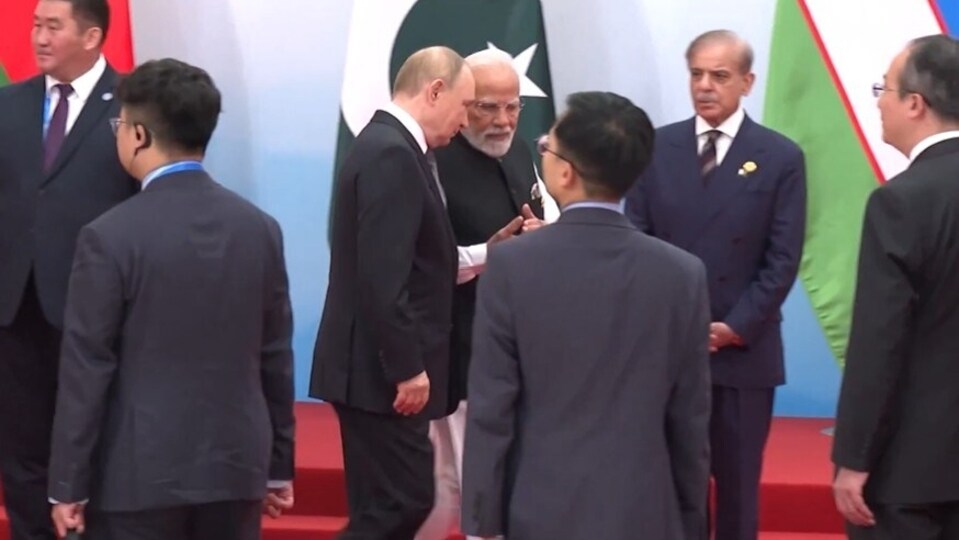
Addressing the plenary session, PM Modi cited the Pahalgam terror attack of April 22 and also emphasised that security, peace, as well as stability are the foundations of progress. He urged the SCO to stand united in the fight against terror. Follow SCO Summit LIVE updates
“In the fight against terrorism, India stands firm on unity, and the SCO has an important role,” PM Modi said, adding that any kind of double standard is not acceptable on the issue of terror.
PM Modi highlighted India's fight against terror outfits like Al-Qaeda and its associates.
"...India has taken the lead in the fight against terror outfits like Al-Qaeda and its associates, and we oppose any kind of terror-financing. We have recently seen the brutal Pahalgam terror attack. I thank all the friendly nations who stood with us...," PM Modi said.
India has been facing scourge of terrorism for last seven decades, PM Modi said at the SCO summit.
The strong message against terrorism comes months after the terror attack of Jammu and Kashmir's Pahalgam, in which terrorists found to have links with Pakistan killed 26 people, mostly civilians.
The April 22 Pahalgam terror attack was retaliated to by India with Operation Sindoor – military strikes carried out on May 7 on Pakistan and Pakistan-occupied Kashmir (PoK), successfully neutralising several key terrorist infrastructures.
Operation Sindoor led to a military conflict between India and Pakistan, which say an exchange of drones and missiles over four days, ending with the Pakistani Director General of Military Operations (DGMO) of reaching out to the Indian side seeking a pause on the action.
The Shanghai Cooperation Organisation (SCO) Summit in China's Tianjin is being attended by several heads of states, including Russian President Vladimir Putin and Pakistan Prime Minister Shehbaz Sharif.
Established in 2001 by China, Kazakhstan, Kyrgyzstan, Russia, Tajikistan and Uzbekistan, the SCO is a Eurasian political, economic and international security organisation comprising ten member states. In June 2017, it expanded to eight states, with India and Pakistan, while Iran joined the group in July 2023, and Belarus in July 2024.


