Union finance minister Nirmala Sitharaman on Monday drew a distinction between the US and Europe over pressure on India's Russian oil purchases, saying there was no equivalent of the “Lindsey Graham Bill” in Europe as New Delhi negotiates trade agreements with European countries.
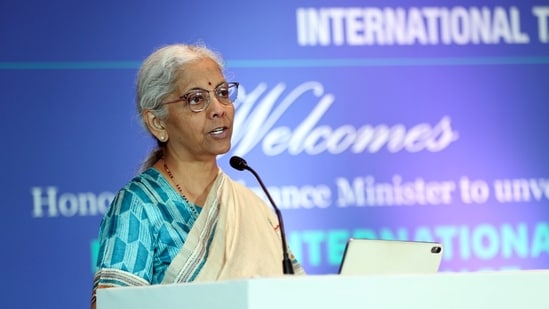
Responding to a question on whether India’s strategic autonomy could be affected by discussions around Russian oil during bilateral trade talks, Sitharaman said the global trading environment had changed significantly, with countries increasingly tailoring agreements around national interests and supply-chain concerns.
“In Europe, as much as I understand till today, there is no Lindsey Graham Bill,” Sitharaman said.
The remark came amid questions over India's continued purchases of Russian crude and whether the issue could feature in negotiations with European countries. India has maintained that its energy purchases are guided by national interests and energy security.
India’s trade strategy amid changing global order
Sitharaman said trade negotiations had become considerably more complicated as countries seek to protect supply chains and reduce their vulnerability to disruptions.
{{/usCountry}}Sitharaman said trade negotiations had become considerably more complicated as countries seek to protect supply chains and reduce their vulnerability to disruptions.
{{/usCountry}}“10 years ago, you wouldn't have had to do this pairing out of details. You would broadly agree on terms and get going with it,” she said.
“Today, you want to be conscious that the supply chains are not going to be disrupted. But where the supply chains have already got disrupted, you're finding a newer partner to ensure that supply chain continues,” she added.
Sitharaman said that in the current global environment, even agreements involving a larger grouping such as the European Union have to account for individual national interests.
“So, in the current reality, bilateral—or I would still call this bilateral, even within a larger body, the EU comes with a cluster of countries. I think, ultimately, you are tailoring the agreement to keep national interest alive, but to survive in a very challenging global environment where no WTO-related laws have been left to be respected,” she said.
“Everybody's broken the law here and there. And so, you're making it up now,” the finance minister added.
What is the Lindsey Graham law?
The Lindsey O Graham Sanctioning Russia and Iran Act of 2026 was signed into law by US President Donald Trump last month after being passed by both chambers of Congress.
The legislation gives the US president the authority to impose tariffs of up to 100% on goods from countries identified as major purchasers of Russian oil and gas.
India and China, two of the biggest buyers of Russian crude, could potentially face such measures. However, the law does not automatically impose a tariff on either country and gives the US president discretion over whether and how to use the provisions.
The legislation also provides for sanctions targeting Russia’s energy and defence sectors and its so-called shadow fleet of tankers.
The law has become an important factor in India-US relations as New Delhi and Washington continue negotiations for a bilateral trade agreement.
US-India trade talks ‘reached a plateau’
Sitharaman also spoke about the ongoing India-US trade negotiations, describing them as “hard and very rigorously negotiated”.
She said the talks were still underway but indicated that both sides may have reached a point where further concessions could be difficult.
“The agreement's negotiations are still ongoing, although we'd like to believe that both sides have reached a plateau, beyond which giving or taking might be very, very difficult,” she said.
Sitharaman, however, said there could still be room for movement if both sides found areas where they could compromise.
“But maybe if there are room—if there are rooms to operate from, both sides would do it,” she said.
The finance minister also pointed to the trade imbalance between India and the US as a major feature of the negotiations.
“But what is the predominant feature of the trade relations between India and US? The trade balance is very much in our favor. Naturally, the deficit is there in their side, or the balance is going unfavorably for the US,” she said.
She said the US would therefore want to reduce the imbalance and seek greater access to the Indian market.
“So they would want to reduce that imbalance, and their desire would be to see, as much as possible, get some kind of, from their point of view, making up for all that they've lost over these years...” Sitharaman said.
Why Russian oil remains a key issue
India sharply increased its purchases of Russian crude after Moscow’s invasion of Ukraine in 2022, when Western sanctions disrupted established global energy flows and Russian oil became available to major buyers at discounted prices.
The purchases have since become a major point of friction between India and the US, with Washington seeking to restrict Russia’s energy revenues that help fund its war in Ukraine.
New Delhi, however, has consistently maintained that it makes energy procurement decisions based on national interest, affordability and energy security.
The Lindsey Graham law has added another layer to that pressure because of its potential to target countries that continue to purchase Russian energy.
For India, the issue has become intertwined with its broader trade negotiations with Washington. At the same time, New Delhi is pursuing trade agreements with the European Union and other partners while attempting to preserve its strategic autonomy.