
 E-Paper



Triple talaq bill tabled in House amid division
The second NDA government started its legislative innings on Friday by introducing in the Lok Sabha a controversial bill that makes the Muslim practice of instant triple talaq a criminal offence.

 Prefer HTon Google


The second National Democratic Alliance (NDA) government started its legislative innings on Friday by introducing in the Lok Sabha a controversial bill that makes the Muslim practice of instant triple talaq a criminal offence, triggering protests by the Opposition that called for more consultations and termed the legislation a violation of constitutional rights.
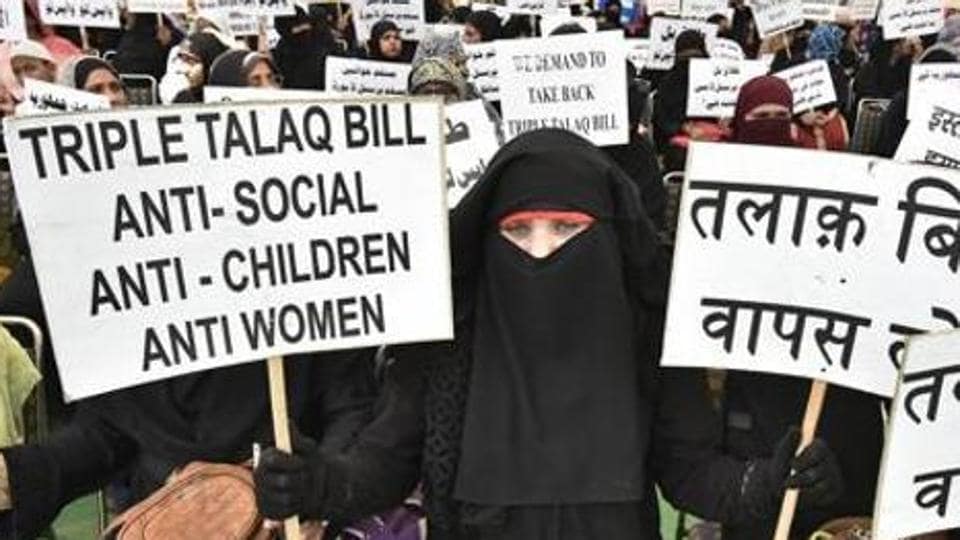
The protests forced an unusual division (voting) in the Lok Sabha through paper ballots. The government won the division by a vote of 186-74, and Union law minister Ravi Shankar Prasad then introduced The Muslim Women (Protection of Rights on Marriage) Bill 2019.
“This is not a question of religion but about justice to women. This is a question of dignity of women and we are committed to protect it,” Prasad said, while introducing the bill.
A previous version of the same bill was blocked by the Opposition in the Rajya Sabha during the NDA’s last term, but the government’s position in the Upper House has improved since then, although it is still short of a majority. With the dissolution of the 16th Lok Sabha last month, the previous bill had lapsed.
The Bill proposes to make the practice of instant triple talaq (talaq-e-biddat) – under which a Muslim man can divorce his wife by uttering the word ‘talaq’ thrice in succession -- a cognisable offence, attracting up to three years’ imprisonment with a fine. It, however, allows only the wife or her relatives to file a complaint against the husband. Cognisable offences are those for which the police may arrest someone without a warrant; the term is generally used for serious crimes such as theft, rape and murder.
The 2019 version of the bill has added certain safeguards as amendments, such as the provision to allow a magistrate to grant bail to an accused. It also leaves scope for reconciliation between a couple.
In 2017, acting on petitions filed by some Muslim women, the Supreme Court had banned instant triple talaq. The next year, the government brought the triple talaq bill that caused an uproar among sections of the Muslim community and opposition parties that claimed the piece of legislation was aimed at criminalising Muslim men.
The NDA government promulgated two ordinances – in September 2018 and February 2019 -- after the original bill could not be cleared in the Rajya Sabha.
Seeking to justify the need to bring in the legislation, Prasad after the 2017 Supreme Court judgment, more than 200 cases were reported. “In the Shayara Bano case, the Supreme Court had said triple talaq is unconstitutional and a bench said it is full of sin,” Prasad added.
Bano was the original petitioner in the triple talaq case; she approached the Supreme Court in 2016, demanding that the talaq-e-biddat pronounced by her husband be declared void.
But the Opposition, especially the Congress and the Majlis-e-Ittehad-ul-Muslimeen (AIMIM), was not impressed. Congress leader Shashi Tharoor maintained that the bill conflates civil and criminal laws.
“The bill is a textbook example, as the law minister well knows, of what is called a class legislation, which is pointed at one community or class and that violates Articles 14 and 15 of the Constitution,” Tharoor said. NK Premachandran, a Revolutionary Socialist Party MP, said criminalising a civil wrong done by a particular community, that is, the Muslim community, alone was discriminatory.
Article 14 provides for equality among citizens. Article 15 prohibits discrimination on the grounds of religion, race, caste and so on.
AIMIM chief Asaduddin Owaisi took a swipe at the ruling Bharatiya Janata Party (BJP), saying that while the saffron party had a lot of concern for Muslim women, it was opposed to the entry of Hindu women of child-bearing age into the Sabarimala temple in Kerala. Owaisi pressed for a division before the introduction of the Bill, which was accepted by speaker Om Birla.
As the House is yet to allot seat numbers to the MPs, ballot papers were used for the vote. BJP floor managers like Nishikant Dubey, SS Ahluwalia and parliamentary affairs minister Prahlad Joshi were seen running around and telling lawmakers how to vote.
Similarly, Congress floor leader Adhir Chowdhury, chief whip K Suresh and others were busy ensuring that their MPs opposed the introduction of the bill. Significantly, the Trinamool Congress, the second largest opposition party with 22 members, was not present during the voting. The entire voting process took almost 20 minutes.
The triple talaq issue has been a significant part of the BJP’s agenda of women’s rights. The issue found a mention in President Ram Nath Kovind’s speech to the joint session of Parliament on Thursday. In the Lok Sabha election campaign, several BJP leaders claimed they wanted to end the oppression of Muslim women by enacting the bill, and appealed for support to the saffron party.
After the vote, Prasad said it was a matter of distress that the Congress had chosen to oppose the bill and had not learnt a lesson even after its defeat in the elections. “A woman leader like Sonia Gandhi ji is the leader of the Congress party. Yet the Congress party takes an anti-woman position in the Lok Sabha by opposing even the introduction of the Bill. I must say it is not only painful but deeply regrettable,” he said.
Usually, the President’s speech to the joint session of Parliament is followed by a debate on the address.When speaker Birla was asked why he let the bill be introduced, he said the agenda had been decided in advance in the business advisory committee, which has members of both the government and opposition.
The bill is expected to sail through the Lok Sabha, where the NDA holds a majority of 353 in a House of 543 elected members. But it may face a rougher ride in the Rajya Sabha, where the government still doesn’t have a majority although its position has been bolstered by the addition of four Telugu Desam Party (TDP) members, whose shift to the saffron party was acknowledged by the Rajya Sabha secretariat on Friday. The BJP now has 75 members in the 250-member House, which has an effective strength of 236.


