An unannounced student protest on Gurugram’s Sohna Road triggered a traffic jam along a nearly three-kilometre stretch on Monday afternoon, with an ambulance remaining stuck for over 40 minutes. Paramedics and motorists watched helplessly as tightly packed cars, trucks, and motorcycles filled every inch, making it impossible for the ambulance to move.
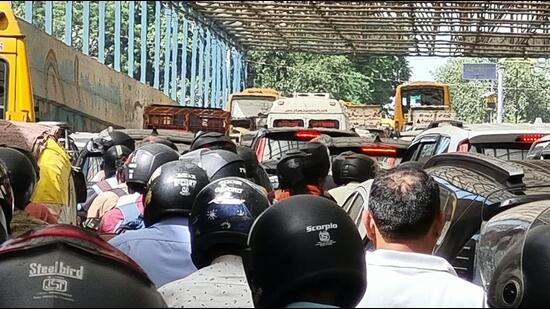
Desperate two-wheeler riders tried squeezing through narrow footpath edges, only to block lanes. The jam choked key arterial roads, from the busy Rajiv Chowk underpass and junction past Tau Devi Lal Sports Complex up to Civil Lines and the District and Sessions Court.
Also Read | No update on Google maps, multi-lane mergers: Traffic chaos continues on Delhi's Barapullah Phase 3
An HT spot check found bumper-to-bumper traffic for over two to three hours. “We had not moved an inch in nearly 40 minutes,” said a commuter in his car en route to Old Gurugram. “Inside the underpass, the trapped exhaust fumes and blaring horns were suffocating. The worst part was seeing an ambulance siren wailing right behind us with nowhere to go.”
Gurugram traffic police officers said some students staged the unannounced sit-in outside the State Council of Educational Research and Training office over some admission issues. “The traffic police were prompt in diverting traffic to ease the congestion. Our teams were deployed on the ground continuously to monitor the situation,” said Gurugram traffic police spokesperson Vikas Verma.
{{/usCountry}}Gurugram traffic police officers said some students staged the unannounced sit-in outside the State Council of Educational Research and Training office over some admission issues. “The traffic police were prompt in diverting traffic to ease the congestion. Our teams were deployed on the ground continuously to monitor the situation,” said Gurugram traffic police spokesperson Vikas Verma.
{{/usCountry}}Also Read | ‘Delhiites can learn’: Indian man in Dubai shows how ‘simple common sense’ keeps traffic moving
Traffic police personnel took nearly three hours to regulate and implement diversions to gradually ease the bottleneck and restore normal vehicular flow.