
Sign in

Uttarakhand disaster: Reni gets 1st warning system in case of sudden water surge

State Disaster Response Force commandant Navneet Bhullar said they have set up the water-level sensor nearly one kilometre upstream of the village.

Updated on: Feb 18, 2021, 01:32:04 IST
By , Dehradun
Share
Share via
  • facebook
  • twitter
  • linkedin
  • whatsapp
Copy link
  • copy link

Reni, the most-affected village in Chamoli, has got its first siren-based early warning water-level sensor system in case of a sudden surge in Rishiganga waters.
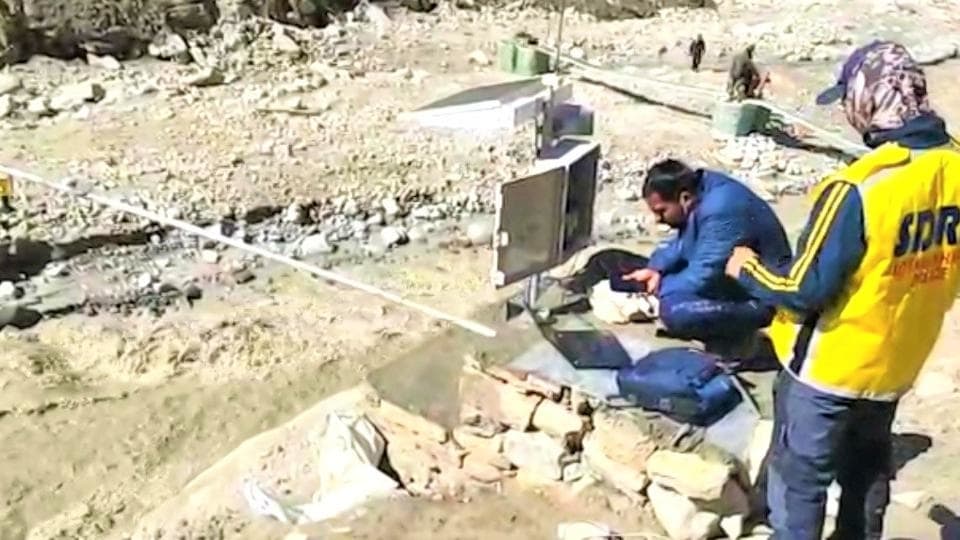
SDRF personnel setting up a siren-based early-warning water level sensor system for a sudden surge in Rishiganga waters in Chamoli district. (HT Photo)

Reni was severely affected by the February 7 flash floods and authorities said that muck is still being removed from the village to recover bodies.

State Disaster Response Force (SDRF) commandant Navneet Bhullar said they have set up the water-level sensor nearly one kilometre upstream of the village.

“If the water level rises by few feet, the siren will be sounded and villagers will be alerted downstream to move away from the river,” he said.

Also Read | Uttarakhand glacier burst: 31 of 58 recovered bodies identified

Bhullar said three SDRF teams have also been deployed to monitor the Rishiganga river upstream and downstream at Peng village, Rishiganga Dam site and Tapovan dam site to keep tabs on the water level.

Ravi Chauhan, Everest summiteer and part of SDRF’s high altitude rescue team (HART), said they have conducted the final trial of the early warning water-level sensor system on Tuesday, and it is operational now.

“If water rises by a few feet in the Rishiganga, the system will sound a siren to alert villagers downstream so that they can vacate the area well in time”, he said.

Watch: After Chamoli flood, why Char Dham road project is in spotlight: Ground Report


A lake has formed in upstream Rishiganga, which has worried officials about the water level in Rishiganga. Even as it is slowly draining, various experts and SDRF is keeping track of the lake and taking various precautionary measures.

The water level of Rishiganga had briefly risen, likely due to water draining from the lake, due to which the rescue and search operations had to be halted for over half an hour last week.

The rescuers have so far recovered 58 bodies with 146 still missing. Of the 58, so far 11 bodies have been recovered from Tapovan dam tunnel. Out of the total bodies recovered, 29 have been identified. The search and rescue operation is still on inside the tunnel where rescuers have succeeded in clearing muck up to about 146 metres
  • Neeraj Santoshi
    ABOUT THE AUTHOR
    Neeraj Santoshi

    Neeraj Santoshi is the Chief of Bureau for Hindustan Times in Uttarakhand, where he leads the state reporting team while covering government, politics, environment, wildlife, Uttarakhand High Court, and issues shaping the Himalayan region. With more than two decades in journalism across conflict zones, he has covered politically sensitive regions and environmentally fragile landscapes, and focused on stories that combine public interest with in-depth storytelling. An alumnus of Pune University with a Master’s in Communication Studies, he has reported extensively from Jammu & Kashmir (2003-2010), Madhya Pradesh (2010 to 2018 ) and Uttarakhand (Since 2018), covering subjects ranging from insurgency, elections and governance to wildlife conservation, mining, climate change, agriculture, human rights and social justice. He has covered politics and legislative assemblies of both Jammu & Kashmir and Madhya Pradesh over more than a decade. Before taking over as Chief of Bureau in Uttarakhand, he served as Special Correspondent with Hindustan Times in Madhya Pradesh and earlier reported for both Hindustan Times and The Indian Express in Jammu & Kashmir, where he covered state politics, environment and insurgency-related developments. Over the years, his stories have focused on environmental degradation, wildlife, illegal mining, governance and the changing social fabric of Himalayan states and Central India. He is particularly interested in long-form explanatory journalism, and stories that explore the intersection of ecology, conservation, governance and society. Outside the newsroom, Neeraj enjoys reading widely on neuroscience, consciousness studies, Artificial Intelligence and quantum physics, with a special interest in Kashmiri Tantric Shaivist traditions. He is also passionate about wildlife, mountaineering and the Himalayas, interests that continue to inform his reporting and deepen his understanding of the region he covers.Read More

Follow India news real-time updates and the latest news covered on Hindustan Times, featuring today's critical updates on Sonam Wangchuk LIVE and more across India.