Number theory: What does the $400bn export number mean?
India’s goods exports have breached the $400 billion level for the first time in 2021-22, the commerce ministry said in a statement issued on March 23.
India’s goods exports have breached the $400 billion level for the first time in 2021-22, the commerce ministry said in a statement issued on March 23. The previous high for this category was $330 billion in 2018-19. What exactly does this mean for the Indian economy? Here are four charts which explain this in detail.
PREMIUM
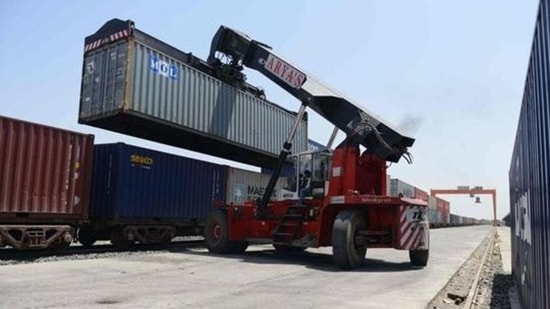
Global commodity prices have been increasing over the fiscal year and this is bound to have pushed the value of India’s exports, especially for goods categories such as petroleum products and metals.(Representational image) (AFP)
{{^htLoading}} {{/htLoading}}
What commodities have driven the rise in exports?
While the commerce ministry’s press release (https://bit.ly/3ixYYtKbit.ly) gives tidbits of information about the factors which have led
Break-up of increase in exports between 2021-22 and 2020-21 (quick estimates)
A comparison of provisional estimates gives a better idea of what kind of goods have led to a jump in exports compared to the pre-pandemic period (April 2019 to January 2020). It shows that the largest contributor to increase in exports were base metals and petroleum products. These two categories account for almost 45% of increase in exports between 2019-20 and 2021-22.
{{^htLoading}} {{/htLoading}}
Will this export growth sustain?
Unlike GDP numbers, export numbers need to be read with two important caveats. One, they are expressed in nominal terms, and therefore, can go up or down depending on global commodity prices. Two, an individual country’s exports are also contingent on what is happening to global trade growth at large. India’s export earnings have enjoyed tailwinds on both these counts.
Global commodity prices have been increasing over the fiscal year and this is bound to have pushed the value of India’s exports, especially for goods categories such as petroleum products and metals.
The exact impact of global inflation in boosting India’s export numbers will only be known once disaggregated data on value and volumes of exports is available. However, a comparison of past trends in indices of export value, volume and unit values for India from the United Nation Council on Trade and Development (UNCTAD) database is useful to understand what might have happened this year. India’s exports enjoyed a rising unit value for up to a decade beginning early 2000s. This led to a faster growth in export values (which is what this year’s $400 billion number captures) than export volumes. With global inflation coming down in the latter half of the last decade, value growth in exports also underwent a deceleration.
{{^htLoading}} {{/htLoading}}
If global inflation continues to surge, India’s exports are likely to maintain their rising trajectory just because of the price effect. To be sure, whether or not a country gains from rising global prices also depends on what is happening to its external terms of trade i.e. relative prices of export and import baskets (more on this later).
Value, volume and unit value index of India's exports
While prices may continue to boost India’s export numbers, global trade growth could lose momentum going forward.
{{^htLoading}} {{/htLoading}}
“Overall, the value of global trade reached a record level of about US$ 28.5 trillion in 2021, an increase of about 25 per cent relative to 2020 and an increase of about 13 per cent relative to the pre-pandemic level of 2019”, the UNCTAD Global Trade Update released in February said. Some of the export growth in 2021-22 is also likely to be pent-up demand.
UNCTAD does not expect this kind of growth to continue going forward though. “The positive trend for international trade in 2021 was largely the result of increases in commodity prices, subsiding pandemic restrictions and a strong recovery in demand due to economic stimulus packages. As these trends are likely to abate, international trade trends are expected to normalize during 2022”, the UNCTAD report says. This is bound to have an impact on India’s export performance as well.
{{^htLoading}} {{/htLoading}}
What about the larger macroeconomic impact of exports reaching an all-time high?
From a GDP perspective, the net impact of foreign trade is determined by the difference between exports and imports rather than just exports. According to the second advance estimates for GDP in 2021-22, exports of goods and services is expected to have a share of 20.9% in overall GDP at constant prices in 2021-22. This number was 18.8% in 2020-21. The rebound in import content of the economy has been even greater. Imports were 21.1% of GDP in 2020-21 and are expected to increase to 25.2% in 2021-22. Rise in petroleum prices has played a big role in this. This has actually taken down the net export content (in terms of share in GDP) down from -2.3% in 2020-21 to -4.2% in 2021-22. To be sure, both export and import share in GDP has been higher in the past.
{{^htLoading}} {{/htLoading}}
Export and import share in GDP
All Access. One Subscription.
Get 360° coverage—from daily headlines to 100 year archives.
Roshan Kishore is the Data and Political Economy Editor at Hindustan Times. He heads the newsroom's data journalism team, which produces Number Theory, a daily data-driven feature for the print edition and the HT app. Number Theory uses data analysis and story-telling based on it to add value to the newsroom’s daily coverage by putting stories in a larger context on a range of issues, including politics, macroeconomy, markets, global affairs and climate. Under his leadership HT’s data journalism work has established itself as a niche product in Indian journalism and pushed the boundaries of marrying academic rigour with news sense and speed. Along with writing and editing data stories, he has also been writing a weekly political economy column called Terms of Trade for HT Premium. A trained economist with an MPhil degree from Jawaharlal Nehru University, Kishore has also been a visiting fellow at the Centre for Advanced Studies of India (CASI) at the University of Pennsylvania. Along with his journalistic work, his writings have also appeared in journals such as the Economic and Political Weekly and working papers for CASI and UNESCAP.
Get real-time updates on CJP Delhi Protest LIVE , breaking headlines, and top India News, breaking headlines, and real-time updates from across the nation. Stay informed on politics, government policies, crime, Today Weather, and major developments on Hindustan Times
Get real-time updates on CJP Delhi Protest LIVE , breaking headlines, and top India News, breaking headlines, and real-time updates from across the nation. Stay informed on politics, government policies, crime, Today Weather, and major developments on Hindustan Times
Home/India News/What does the $400 billion export number mean?
{{^htLoading}}
Advertisement
{{/htLoading}}
SHARE THIS ARTICLE ON
{{#usCountry}}{{/usCountry}}
Notifications
Get breaking alerts directly from the newsroom
Notifications are on!You'll be notified when news breaks