The Delhi Police has defended its personnel in plain clothes during the July 20 “Sansad Chalo” protest march by the Cockroach Janta Party (CJP), telling the Supreme Court that they were strategically merged with the crowd due to the urgency of the situation.
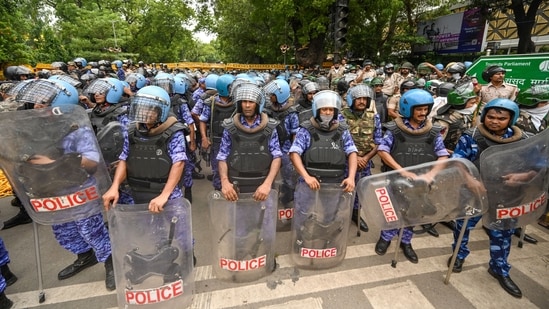
In a counter-affidavit filed before the Supreme Court, deputy commissioner of Police Sachin Sharma said that police personnel in plain clothes carrying lathis were “spotters” drawn from the Special Branch, Special Cell, Crime Branch and local police.
'Such deployment not illegal or unusual'
The affidavit has been filed in response to petitions seeking a court-monitored investigation into alleged police excesses and is intended to serve as a common response in four connected petitions.
The police said that deployment of such personnel is neither illegal nor unusual and claims similar arrangements are used during large public gatherings, including Independence Day and Republic Day events.
According to the affidavit, the plainclothes personnel were deployed as part of crowd-control operations and not as an independent force against protesters.
Cops deny ‘excessive force’ charge
{{/usCountry}}According to the affidavit, the plainclothes personnel were deployed as part of crowd-control operations and not as an independent force against protesters.
Cops deny ‘excessive force’ charge
{{/usCountry}}Police defended its use of force against student protesters during the protest march, saying that it resorted to a “graded” response only after the gathering ceased to remain peaceful, with sections of the crowd breaching multiple layers of barricades and attempting to move towards Parliament.
The police said in the affidavit that the allegation of excessive force was unsustainable given the scale of the gathering, claiming that about 5,000 police personnel were deployed to manage more than 30,000 protesters spread across nearly three kilometres. The police said that the ensuing confrontation left more than 240 police and uniformed personnel and around 200 protesters/public persons injured.
The police said its personnel initially attempted to regulate and contain the gathering, but the situation deteriorated after protesters allegedly breached successive barricades and moved towards Parliament despite there being no permission for a march to Parliament.
The affidavit contends that the gathering consequently assumed the character of an unlawful assembly and that the attempt to proceed towards Parliament was itself unlawful.
The police have also sought to counter the petitioners’ reliance on photographs, video clips, and media and social media reports, saying these materials were selective, incomplete, and not independently verified, and therefore presented only one side of the events without capturing the police’s efforts to control the situation.
On ‘lathis with nails’ charge
On the allegation that police personnel used lathis fitted with nails, the affidavit says that examination of the available videos showed one solitary instance of such an object, but claims it was in the hands of a protester and not a police officer.
The police further disputes the description of the object as a nail-studded police lathi, saying it was a stick carrying the National Flag. It maintains that lathis form part of permissible crowd-control equipment and were used only to contain groups of protesters who, according to the police, had begun attacking personnel.
The police have alleged that videos also show groups of protesters targeting individual police officers, pulling off their protective gear, dragging them and pushing them onto stone pavements.
Delhi Police have claimed that 2,873 persons at the protest site had criminal cases registered against them, including allegations relating to murder, attempt to murder, dacoity, rape and offences under the POCSO Act. The police say their antecedents will be examined by the Special Investigation Team constituted by the Delhi Police Commissioner.
At the same time, the police have told the Supreme Court that the question whether the force used was excessive can appropriately be examined by the committee proposed to be constituted by the Court, and that it would cooperate with such an exercise.