More than eight years after successfully launching the Aadhaar project, India’s unique identity authority (UIDAI) is looking at effecting a major “operational shift” from enrolment to large-scale data updates in order to ensure the long-term success of the scheme, according to an official note by the authority.
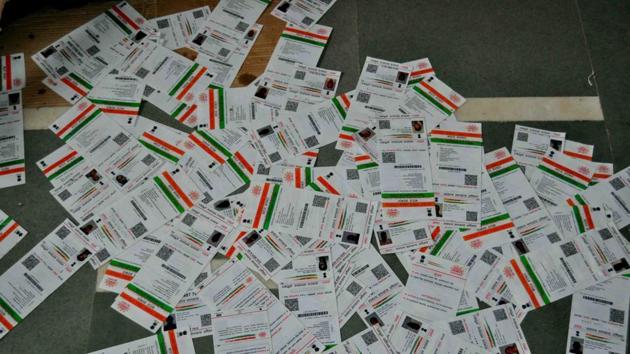
Set up in 2009 through a government notification, UIDAI has been generating the 12-digit unique identity number, called Aadhaar, since 2010.
As on September 30, more than 1.12 billion Aadhaar numbers have been generated.
As per UIDAI data, Delhi, Haryana, Himachal Pradesh, Goa, Kerala, Punjab, Chandigarh and Telangana have more than 100% saturation till October 31, while Sikkim has the lowest saturation at 87%. Hundred per cent saturation means the entire population of a city has been covered in terms of Aadhaar enrolment. It exceeds 100% when there is a migrant population availing of the service. “In these states, UIDAI needs to undertake an operational shift from enrolments to updates plus other Aadhaar services. The need for update is likely to increase as more states have become saturated and more and more government and non-government services are rolled out using Aadhaar,” said the internal note by UIDAI, which was accessed by HT.
“The success of Aadhaar, in the long run, will be a function of up-to-date status of the database making Aadhaar information update a critical activity of UIDAI,” the note added. In a landmark judgment on September 26, the Supreme Court said Aadhaar is constitutionally valid and gives “dignity to the marginalised”, allowing the Centre to use the unique identity number to access subsidies and welfare schemes. But the court, which was hearing a clutch of petitions challenging Aadhaar on its validity and on the right to privacy, said there was no need to use Aadhaar for operating bank accounts, mobile phones and admissions to school and colleges. The UIDAI note talks about enhanced efforts to enrol the remaining population into the Aadhaar platform, and about the plan to upgrade existing biometric devices to registered devices. The introduction of these registered devices “would rule out any possibility of use of stored biometric and replay of biometrics”, the note said. Registered devices refer to devices registered with Aadhaar system for encryption key management. Aadhaar authentication server can individually identify and validate these devices and manage encryption keys on each registered device. Ashwini Chhattre, executive director of Indian School of Business’s Digital Identity Research Initiative, said this was an important shift.
“It’s a great idea. Getting an Aadhaar card is actually easy. Trying to get it updated is more difficult for people who are not tech-savvy. UIDAI has been forward looking and has focused on technological solutions like virtual ID and online services, things tech-savvy people can use. But if you’re a 70-year-old pensioner without a smartphone, you’re out of luck. So the expansion of services is a great idea, but it should also focus on different ways. The expansion has to be lateral – core UIDAI services available in different ways, to differently abled people as well. That is the challenge,” he said.
{{/usCountry}}“It’s a great idea. Getting an Aadhaar card is actually easy. Trying to get it updated is more difficult for people who are not tech-savvy. UIDAI has been forward looking and has focused on technological solutions like virtual ID and online services, things tech-savvy people can use. But if you’re a 70-year-old pensioner without a smartphone, you’re out of luck. So the expansion of services is a great idea, but it should also focus on different ways. The expansion has to be lateral – core UIDAI services available in different ways, to differently abled people as well. That is the challenge,” he said.
{{/usCountry}}Chhattre also pointed out that enrolment is a non-linear process and people who are most difficult to reach are going to be the last to be added to the database. “The 1% left are the most vulnerable – the old, disabled, stigmatised and illiterate. More of the same enrolment procedures are not going to work. We need to do something different to reach those people if we want Aadhaar to be ethically justified.”