E-Paper



Yamuna crosses danger level in Delhi as high discharge continues at Hathnikund
The peak hourly discharge, which crossed 3 lakh cusecs for the first time this season, has been above 1 lakh cusecs every hour since 4am on Monday

 Prefer HTon Google


The Yamuna crossed the “danger level” of 205.33 metres for the fourth time this season as high discharge of water continued through Haryana’s Hathnikund barrage. The river’s level, recorded at Old Railway Bridge (ORB), was 205.81 metres at 9am on Tuesday.
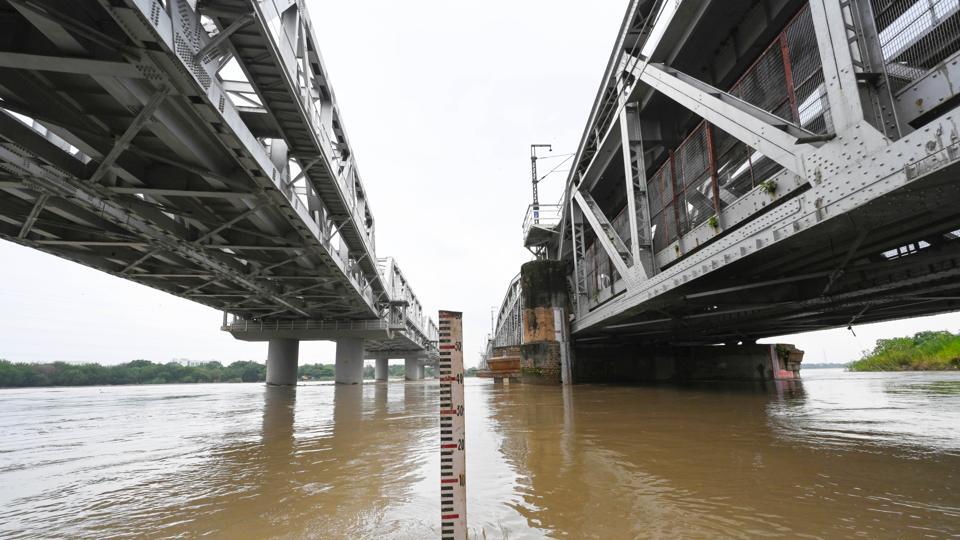
The Central Water Commission (CWC) forecast the level will rise and touch 206.41 metres by 9pm. The ORB is shut for operations once the river crosses 206 metres. Evacuations have commenced in low-lying areas.
The highest water level recorded this season (205.95 metres) was on August 19. “Unlike then, it is not expected to drop, but rise further. The district administration is prepared for evacuation,” said an official from the flood control room of the irrigation and flood control (I&FC) department.
The peak hourly discharge, which crossed 3 lakh cusecs for the first time this season, has been above 1 lakh cusecs every hour since 4am on Monday. In Delhi’s worst-ever flood in 2023, it remained over 1 lakh cusecs for five days, with a peak discharge of 359,760 cusecs from Hathnikund.
On Monday, the discharge touched 1,65,512 cusecs at 4am, 2,10,359 cusecs at 5am, and 3,11,029 cusecs at 8 am. It touched a season-high of 3,29,313 cusecs at 9am. At 9am on Tuesday, the peak discharge was 1,63,386 cusecs, the Central Water Commission said.
“Peak discharge remains over 1 lakh cusecs every hour, and that has already pushed the water level beyond the danger level in Delhi. Until discharge remains this high, water level will only rise further,” said Bhim Singh Rawat, associate coordinator at the South Asia Network on Dams, Rivers and People.
Rawat said biodiversity parks on the floodplain, including Amrut Biodiversity Park and Asita East, and ghats like Vasudev were likely to get partially submerged. “The spread on the Chilla floodplains will depend on further release and operations at Okhla,” he said.
A flood warning was issued on Monday, which estimated water level is expected to cross 206.50 metres. In 2023, the Yamuna swelled to its highest-ever water level of 208.66m on July 13. Last year’s peak was only 204.38m on September 26.
In the past 63 years, the I&FC department data shows the warning level has been breached 53 times, making it a common annual occurrence. The river has crossed the 205-metre mark in 43 years and the 206-metre mark in only 14 years. Historically, the 207-metre mark has been breached in only four years, including 2023.