When the RSS-affiliated Akhil Bharatiya Vidyarthi Parishad (ABVP) claimed last week that it was not allowed to hold functions at Jammu University (JU), it triggered a storm of protests and several BJP leaders threatened action against the vice-chancellor.
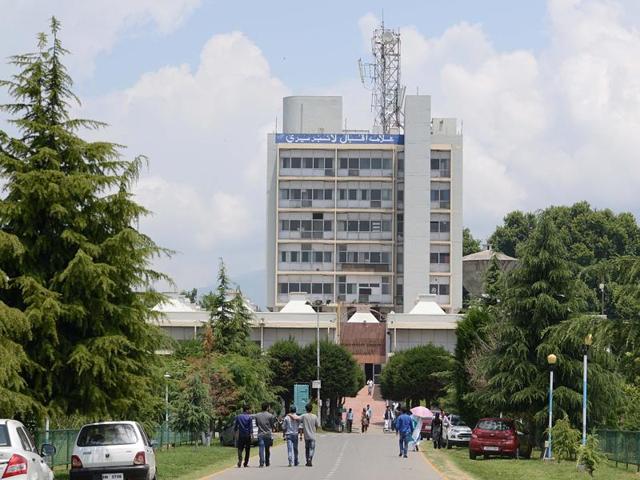
A week later, vice-chancellor RD Sharma continues to hold office and the ABVP is still barred from the campus. But the controversy did serve a purpose: it brought to focus the state of student politics, or absence thereof, in Jammu and Kashmir.
ABVP isn’t the only organisation barred from the JU campus. The university restricts all student bodies that have political links.
“Anybody who has any political linkage will not be allowed to function in the campus. Nothing new about it, it’s a rule,” says the Jammu University vice-chancellor. “And it’s not for any specific group, but all such political student groups.”
Read: Banning ABVP in Jammu is varsity V-C’s misuse of autonomy, says BJP
A similar situation exists in Kashmir University (KU), where a blanket ban has existed since 2009. “No political activity is allowed in KU, no students’ union. You can say it is because of the larger issue of the Kashmir conflict,” says prominent political scientist Prof Noor Ahmad Baba.
{{/usCountry}}A similar situation exists in Kashmir University (KU), where a blanket ban has existed since 2009. “No political activity is allowed in KU, no students’ union. You can say it is because of the larger issue of the Kashmir conflict,” says prominent political scientist Prof Noor Ahmad Baba.
{{/usCountry}}In 2007, KU authorities recognized a students’ union called the KUSU, but banned it two years later. In May 2010, the KUSU office was bulldozed.
Today, the union exists only informally. Students get together to hold public meetings or protests, but the body enjoys no official sanction. New recruits join only through word of mouth. Students involved with the informal union say they pursue an ideology of “resistance politics” while the administration is “pro-India.”
Politics in Jammu is markedly different from that in the Valley, explains Aala Fazili, a PhD student in the pharmaceutical sciences department at KU — student activism in Kashmir has always “challenged the narrative of the state”, which has not happened in Jammu in recent times.
Yet, all that JU has is a Jammu University Research Scholars Executive Association (JURSEA), membership of which is limited only to research scholars.
Read: Campus politics ban not meant to target ABVP, clarifies Jammu univ V-C
“Instead of open elections, as practiced in most universities, JU follows a closed election pattern in selecting the members of the JURSEA. Research scholars in all 33 departments vote for a department representative and from that the president is chosen,” says Lokinder Singh, a JU student leader.
Singh belongs to the ABVP, but the university does not allow his political ideology to bear upon his activity on the campus, unlike in Jawaharlal Nehru University or Delhi University in the national capital.
“The basic aim is to give students a good education. Student activism should be a part of it but in order to achieve that aim, we should not lose the basic purpose of education,” says state education minister Naeem Akhtar. “Moreover, that decision [to allow student politics] is subject to the university’s autonomy, which demarcates our area of influence in their operation.”